
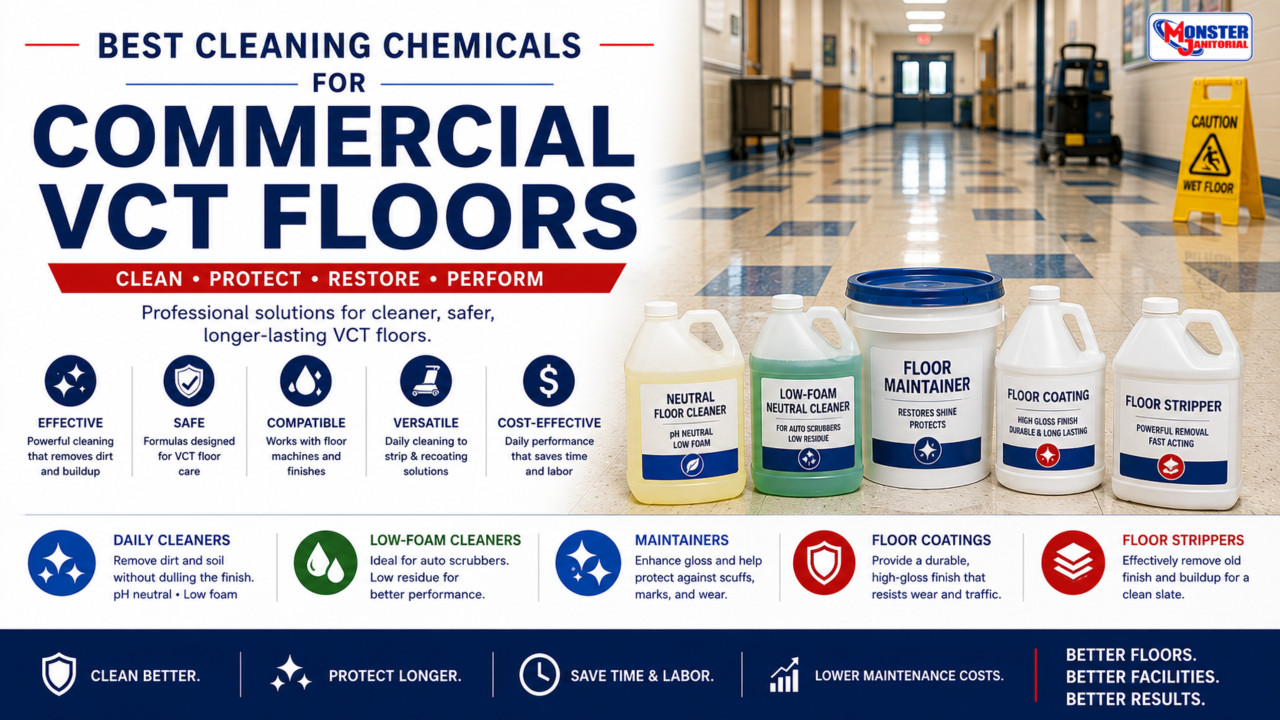
Best Cleaning Chemicals for Commercial VCT Floors
Commercial VCT maintenance may involve several different chemical categories because routine cleaning, deep scrubbing, finish maintenance, stripping, neutralizing, sealing, and refinishing are separate floor-care processes.
The goal is to match the chemical to the condition of the floor and the maintenance task instead of using stronger chemistry than necessary.
For routine VCT maintenance, start with a compatible neutral or low-residue cleaner and move into maintainer, deep-scrub, stripping, neutralizing, sealing, or finishing chemistry only when the floor condition requires it.
The Commercial VCT Chemical Maintenance Path
Not every floor needs every step. Use the least aggressive process that meets the maintenance objective.

VCT chemical selection depends on the maintenance objective. Neutral cleaners support routine cleaning, cleaner-maintainers support ongoing finish care, and deep-scrub cleaners are used when heavier corrective cleaning is needed.
Neutral & Routine Cleaners for VCT
These products belong at the routine-cleaning end of the VCT maintenance program rather than the stripping or refinishing end.
Pioneer Eclipse Eclipse Neutral Cleaner 301
A practical option for routine cleaning within a compatible finished-floor maintenance program.
View Eclipse 301 →Karcher Neutral Floor Cleaner 8.698-103.0
Another neutral-cleaning option for commercial floor-care programs where the product is compatible with the existing finish system.
View Karcher Neutral Floor Cleaner →Pioneer Eclipse Ultra MSC 3038
A non-detergent multi-surface cleaner that can be considered where its label and the floor-maintenance system support the application.
View Ultra MSC 3038 →Choose Low-Residue, Machine-Compatible Chemistry
For automatic scrubbing, verify dilution, foam characteristics, floor-finish compatibility, and machine-use directions on the chemical label.
Cleaner / Maintainer & Enhancer Options
Cleaner-maintainers and enhancers serve a different purpose than plain neutral cleaners. Use them as part of a compatible finish-maintenance program rather than automatically substituting them for every daily-cleaning process.
Pioneer Eclipse ReBound 211 Floor Cleaner & Enhancer
Use when a cleaner/enhancer is appropriate for the existing commercial floor-finish maintenance program.
View ReBound 211 →Pioneer Eclipse Lumen L217 Floor Cleaner & Maintainer
A cleaner-maintainer option for facilities using a compatible VCT finish-maintenance system.
View Lumen L217 →Pioneer Eclipse ReBoot 342 Deep Scrub Cleaner
Deep scrubbing sits between routine cleaning and complete stripping. It can be useful when the objective is to remove heavier contamination or prepare a compatible coated floor for the next maintenance step without automatically removing the entire finish system.
View ReBoot 342 →
A proper VCT restoration process removes the old finish, completely recovers the stripping solution and residue, and prepares the floor for the next neutralizing, sealing, or finishing step.
Floor Strippers for Commercial VCT
Floor stripper is not a stronger version of daily cleaner. It is restorative chemistry intended for removal of compatible floor-finish systems when full stripping is necessary.
Pioneer Eclipse Lumen L556
Heavy-duty floor stripper option for restorative floor-finish removal.
View Lumen L556 →Pioneer Eclipse Final Strip HD 502
Another option for removal of compatible commercial floor-finish systems.
View Final Strip HD 502 →Pioneer Eclipse Flash 55 516
Low-foaming floor-stripper option for compatible restorative floor-care applications.
View Flash 55 516 →Pioneer Eclipse EnviroStar 338 All Purpose Neutralizer
A floor neutralizer belongs in the restorative side of the maintenance program. Follow the stripper, neutralizer, sealer, and finish manufacturer instructions so the prepared floor is suitable for the next coating step.
View EnviroStar 338 →Commercial Floor Sealer Options
A sealer is not automatically required for every VCT maintenance job. Use it when the selected floor system and application call for one.
Pioneer Eclipse Eclipse Hard Floor Sealer 403
Sealer option for compatible commercial hard-floor coating systems.
View Eclipse 403 →Pioneer Eclipse EnviroStar Floor Sealer 413
Another sealer option for compatible floor-preparation and finish systems.
View EnviroStar 413 →Commercial VCT Floor-Coating Options
After proper preparation, a compatible coating creates the maintainable protective surface used for ongoing VCT floor care. Select the coating based on the facility, desired appearance, maintenance program, and manufacturer directions.
Lumen L122 Floor Coating
Commercial floor-coating option for compatible maintenance systems.
View Lumen L122 →Lumen L142 Floor Coating
Commercial coating option for compatible VCT finish programs.
View Lumen L142 →Lumen L143 Floor Coating
Another coating option for compatible commercial floor-care programs.
View Lumen L143 →Lumen L144 Floor Coating
Commercial floor-coating option for an appropriate VCT finish system.
View Lumen L144 →Which Finish Should You Choose?
Compare desired appearance, traffic, maintenance frequency, burnishing program, application requirements, and compatibility rather than selecting by gloss alone.
Do Not Treat Every VCT Chemical as Interchangeable
Routine Cleaning vs. Restorative VCT Chemistry
Routine / Maintenance Chemistry
- Eclipse Neutral Cleaner 301
- Karcher Neutral Floor Cleaner
- Ultra MSC 3038 where appropriate
- ReBound 211
- Lumen L217
Restorative Chemistry
- ReBoot 342 Deep Scrub Cleaner
- Lumen L556 Floor Stripper
- Final Strip HD 502
- Flash 55 516
- EnviroStar 338 Neutralizer
- Sealers and floor coatings
Before Choosing a Chemical for Commercial VCT
Common VCT Chemical Mistakes
VCT Floor Care Learning Library
Explore commercial VCT guides covering floor identification, cleaning chemicals, machines and pads, deep cleaning, troubleshooting, stripping and refinishing, repair, and complete maintenance.
How to Identify VCT Floors Before Cleaning
Tile construction, finish layers, wear patterns, damage, and overall floor condition.
Read Identification Guide →Best Cleaning Chemicals for Commercial VCT Floors
Neutral cleaners, maintainers, deep-scrub chemistry, strippers, neutralizers, sealers, and coatings.
Current GuideAuto Scrubbers, Floor Machines & Pads for Commercial VCT Floors
Select equipment, pads, brushes, burnishers, and recovery systems for the maintenance objective.
Read Equipment & Pad Guide →How to Deep Clean Commercial VCT Floors
Heavier soil removal, dwell time, agitation, recovery, and deciding when restoration is needed.
Read Deep-Cleaning Guide →Commercial VCT Floor Problems
Diagnose dullness, haze, streaks, scratches, scuffs, yellowing, finish wear, and buildup.
Read Troubleshooting Guide →Commercial VCT Stripping & Refinishing Guide
Learn when to top scrub and recoat and when full finish removal and refinishing are necessary.
Read Stripping & Refinishing Guide →Commercial VCT Floor Repair & Replacement Guide
Learn when cracked, loose, stained, worn, or damaged VCT needs repair, restoration, or replacement.
Read Repair & Replacement Guide →Complete Commercial VCT Floor Cleaning & Maintenance Guide
Central reference for cleaning, burnishing, recoating, stripping, refinishing, troubleshooting, and repair.
Read Complete Guide →VCT Cleaning Chemical FAQs
What type of cleaner should be used for routine VCT maintenance?
Start with a compatible neutral or low-residue cleaner that removes normal soil without unnecessarily attacking the existing floor finish.
Can VCT cleaner be used in an auto scrubber?
Use chemistry whose label supports the intended machine application. Pay particular attention to dilution, foam control, finish compatibility, and complete dirty-water recovery.
When should a deep-scrub cleaner be used?
Deep-scrub chemistry can be appropriate when routine cleaning is no longer enough and the goal is deeper soil or upper-layer finish maintenance without automatically performing a full strip.
When should VCT floor stripper be used?
Stripper belongs in restorative maintenance when the existing floor-finish system needs to be removed. It should not be used as a routine cleaning chemical.
Why is a floor neutralizer used?
A neutralizer may be part of the post-stripping preparation process when required by the products and floor-finish system being used. Follow the specific product directions before recoating.
Does every VCT floor need a sealer?
No. Whether a separate sealer is appropriate depends on the substrate, coating system, existing floor condition, and manufacturer recommendations.
Can different brands of stripper, sealer, and floor finish be mixed into one system?
Do not assume products are interchangeable. Confirm chemical and coating compatibility and follow the manufacturers' application instructions before combining products from different systems.
Need Help Choosing VCT Floor Chemicals?
Monster Janitorial can help you compare neutral cleaners, cleaner-maintainers, deep-scrub products, floor strippers, neutralizers, sealers, coatings, pads, machines, and complete commercial VCT maintenance systems.
Tax-exempt purchasing and purchase-order support are available for qualifying schools, universities, government agencies, healthcare facilities, municipalities, and other institutional customers.