
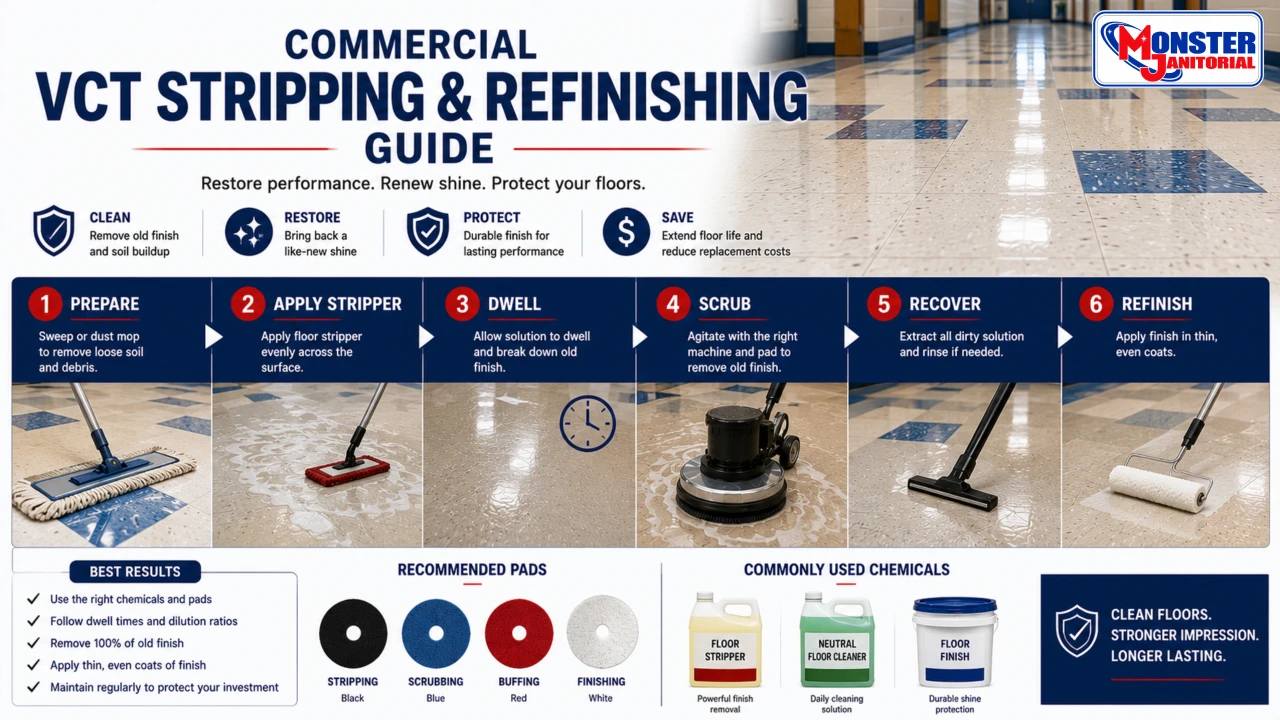
Commercial VCT Stripping & Refinishing Guide
Stripping and refinishing commercial VCT removes failed, contaminated, excessively built-up, or badly worn floor finish so the floor can be properly prepared and protected with a new finish system.
Full stripping is one of the most aggressive VCT maintenance procedures, so first determine whether deep cleaning, burnishing, or a top scrub and recoat can restore the floor without removing the entire finish system.
Strip VCT only when the existing finish can no longer be restored. Apply compatible stripper, allow proper dwell time, agitate, recover the slurry completely, rinse or neutralize as required, allow the floor to dry, then apply the appropriate sealer and/or floor finish.
When Does Commercial VCT Need Full Stripping?
Full stripping is appropriate when the existing finish system is too worn, contaminated, uneven, yellowed, damaged, or built up to be restored through less aggressive maintenance.
- Upper finish layers show wear
- Lower finish remains sound
- Floor is not heavily contaminated
- No excessive buildup or major yellowing
- Surface can be cleaned and prepared properly
- Finish is severely worn or failed
- Heavy buildup is present
- Finish is yellowed or contaminated
- Multiple uneven coating layers exist
- Floor cannot be restored through burnishing or recoating
Inspect the VCT Tile, Edges & Installation
Stripping removes floor finish; it does not repair cracked, chipped, loose, curled, deeply gouged, or moisture-damaged tile. Identify physical tile or substrate problems before starting the refinishing process.
How to Strip Commercial VCT Floors
Follow the stripper manufacturer's dilution, dwell time, safety, recovery, and rinse instructions.
Remove Dry Soil
Sweep, dust mop, or vacuum loose grit and debris before introducing stripping solution.
Mix the Floor Stripper
Dilute according to the product label. Over-concentration can create unnecessary chemical load and does not replace proper dwell time or agitation.
Apply Stripping Solution
Apply enough solution to thoroughly wet the working area while avoiding uncontrolled flooding at walls, doors, transitions, and damaged seams.
Allow Proper Dwell Time
Allow the stripper time to soften and release the finish according to its instructions. Keep the floor wet during the dwell period.
Agitate the Floor
Use a low-speed floor machine with an appropriate stripping pad. Work edges and corners separately where the machine cannot reach.
Recover the Slurry
Use a wet vacuum or appropriate recovery system to remove the dissolved finish and stripping solution completely before it dries.
Rinse / Neutralize as Required
Follow the stripper, neutralizer, sealer, and finish-system instructions. Neutralization is not automatically required for every product system.
Allow the Floor to Dry
The VCT must be clean, free of residue, and properly dry before sealer or finish is applied.
EDIC Saturn HD 17" Low-Speed Floor Machine
A traditional 17-inch, 172 RPM low-speed machine is well suited to controlled VCT stripping when paired with the correct stripping pad, floor stripper, and slurry-recovery process.
View EDIC Saturn HD 17" →Commercial VCT Floor Stripper Options
Select stripping chemistry based on the existing finish system, facility conditions, required dwell time, dilution, and manufacturer directions.
Pioneer Eclipse Lumen L556
Heavy-duty floor-stripper option for restorative commercial floor-finish removal.
View Lumen L556 →Pioneer Eclipse Final Strip HD 502
Floor-stripper option for compatible commercial floor-finish removal.
View Final Strip HD 502 →Pioneer Eclipse Flash 55 516
Low-foaming floor-stripper option for compatible restorative maintenance processes.
View Flash 55 516 →Pioneer Eclipse EnviroStar 338 All Purpose Neutralizer
A neutralizer can be part of the post-stripping floor-preparation process when required by the stripper and finish system. Follow the product directions before applying new sealer or floor finish.
View EnviroStar 338 →Does Commercial VCT Need a Separate Floor Sealer?
Not every VCT finish system requires a separate sealer. Use one when the selected coating system, existing floor condition, and manufacturer instructions call for it.
Pioneer Eclipse Eclipse Hard Floor Sealer 403
A hard-floor sealer option for compatible commercial floor-coating systems.
View Eclipse 403 →Pioneer Eclipse EnviroStar Floor Sealer 413
Another sealer option for compatible commercial floor-preparation and coating systems.
View EnviroStar 413 →Applying New Floor Finish to VCT
Only apply floor finish after the VCT is properly stripped, prepared, residue-free, and dry. Follow the coating manufacturer's application rate, drying time, cure time, and maintenance instructions.
Floor is clean, dry, and residue-free.
Follow the selected coating instructions.
Do not rush coats or trap moisture.
Keep traffic off until the system allows reopening.
Commercial Floor Finish Options
Helios H106
View Helios H106 →Lumen L122
View Lumen L122 →Lumen L142
View Lumen L142 →Lumen L143
View Lumen L143 →Lumen L144
View Lumen L144 →Choose by Maintenance Program
Compare traffic, appearance goals, burnishing program, application requirements, and manufacturer instructions.
Common VCT Stripping & Refinishing Mistakes
VCT Floor Care Learning Library
Explore commercial VCT guides covering floor identification, cleaning chemicals, machines and pads, deep cleaning, troubleshooting, stripping and refinishing, repair, and complete maintenance.
How to Identify VCT Floors Before Cleaning
Understand VCT construction, finish layers, wear patterns, physical damage, and overall floor condition.
Read Identification Guide →Best Cleaning Chemicals for Commercial VCT Floors
Compare neutral cleaners, maintainers, deep-scrub cleaners, strippers, neutralizers, sealers, and floor finishes.
Read Chemical Guide →Auto Scrubbers, Floor Machines & Pads for Commercial VCT Floors
Choose the right auto scrubbers, floor machines, pads, brushes, and burnishing equipment for commercial VCT maintenance.
Read Equipment Guide →How to Deep Clean Commercial VCT Floors
Learn the apply, dwell, scrub, recover, and inspection process for heavily soiled commercial VCT.
Read Deep-Cleaning Guide →Commercial VCT Floor Problems
Diagnose dullness, haze, streaks, scratches, scuffs, finish wear, buildup, and other appearance problems.
Read Troubleshooting Guide →Commercial VCT Stripping & Refinishing Guide
Learn when to strip VCT, remove failed finish, prepare the floor, and rebuild the protective finish system.
Current GuideCommercial VCT Floor Repair & Replacement Guide
Learn when VCT can be restored, when individual tiles should be replaced, and when larger flooring failure requires replacement.
Read Repair & Replacement Guide →Complete Commercial VCT Floor Cleaning & Maintenance Guide
The complete reference for cleaning, burnishing, recoating, stripping, refinishing, troubleshooting, repair, and ongoing VCT maintenance.
Read Complete Guide →VCT Stripping & Refinishing FAQs
Does dull VCT always need to be stripped?
No. Clean first and evaluate whether deep cleaning, burnishing, or a top scrub and recoat can restore the floor before choosing full stripping.
What machine is commonly used to strip VCT?
A low-speed commercial floor machine with an appropriate stripping pad is commonly used for controlled finish removal.
Should floor stripper be allowed to dwell?
Follow the product label. Proper dwell time helps soften the finish, but stripping solution should not be allowed to dry on the floor.
Does VCT always need to be neutralized after stripping?
Not necessarily. Follow the specific stripper, neutralizer, sealer, and finish-system instructions for the products being used.
Does every VCT floor need sealer before finish?
No. Whether a separate sealer is needed depends on the floor condition and the selected coating system.
Can finish be applied immediately after stripping?
Only after the floor has been properly prepared, all stripper and residue have been removed, and the surface is dry enough for the selected coating system.
Need Help With a Commercial VCT Strip & Refinish Project?
Monster Janitorial can help you compare floor strippers, neutralizers, sealers, floor finishes, stripping pads, low-speed machines, wet recovery equipment, and complete VCT restoration systems.
Tax-exempt purchasing and purchase-order support are available for qualifying schools, universities, government agencies, healthcare facilities, municipalities, and other institutional customers.