
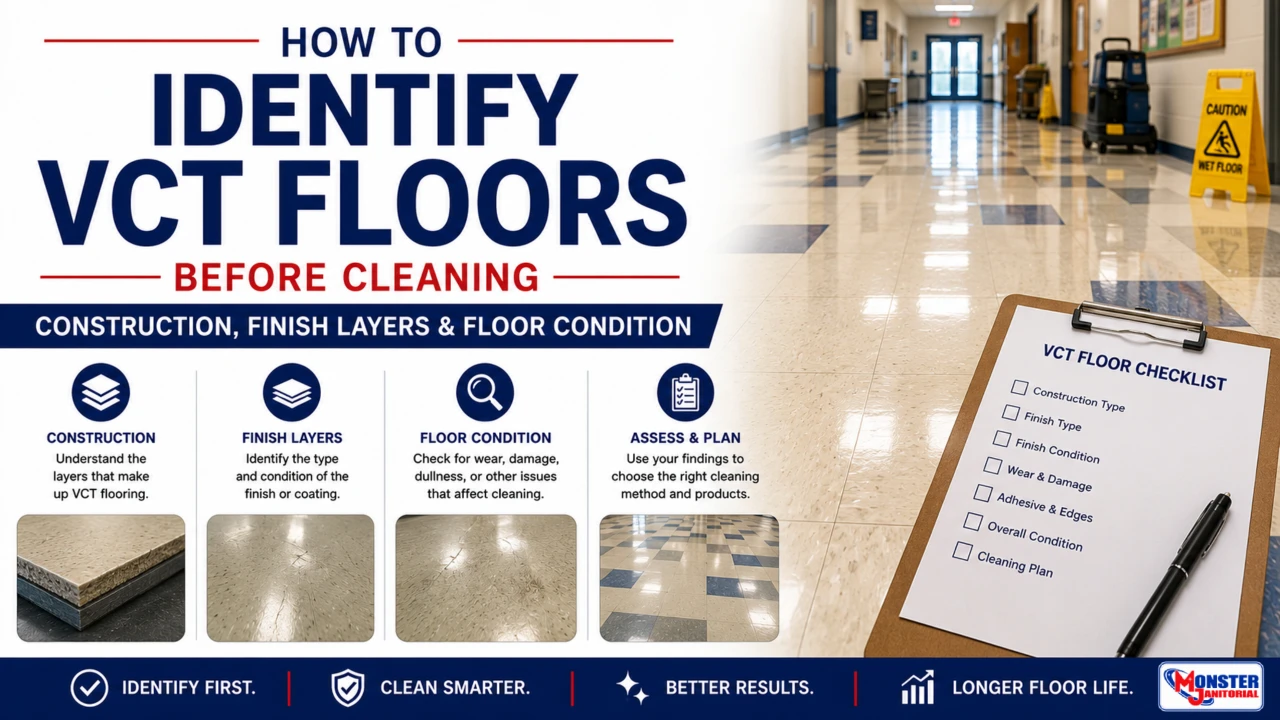
How to Identify VCT Floors Before Cleaning
Construction, Finish Layers & Floor Condition
Commercial Vinyl Composition Tile (VCT) can look similar to other resilient flooring, but its cleaning and restoration process depends heavily on the condition of the tile and the floor-finish system above it.
Before selecting cleaners, auto scrubbers, floor machines, pads, burnishers, strippers, or floor finish, identify the flooring, determine whether finish is present, and inspect the tile and installation for wear or damage.
Identify VCT by checking the tile format, construction, seams, finish layers, wear patterns, maintenance history, and overall floor condition.
The most important question is not simply whether the tile is VCT. You also need to know whether the floor is bare, finished, heavily built up with finish, worn through in traffic lanes, contaminated, or physically damaged.
What Is VCT Flooring?
VCT is a resilient commercial tile flooring commonly found in schools, healthcare facilities, retail spaces, offices, government buildings, and institutional environments.
Individual Resilient Tiles
VCT is installed as individual tiles, creating visible seams between pieces. Commercial installations often use repeated square tile patterns.
Usually Protected With Floor Finish
Commercial VCT is commonly maintained with an applied floor-finish system that becomes the renewable wear surface above the tile.
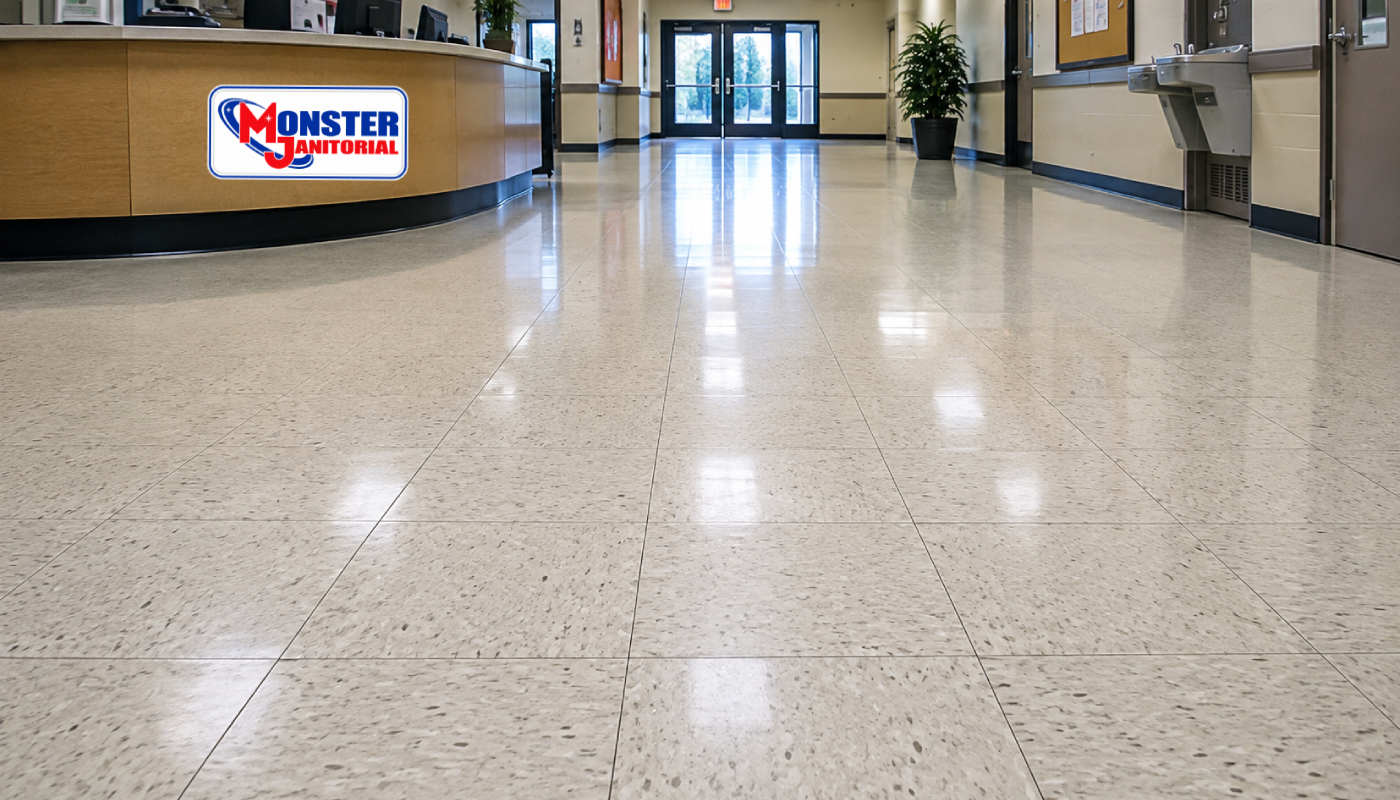
Commercial VCT is commonly installed in individual square tiles with visible seams and is often protected by an applied floor-finish system.
Do Not Confuse VCT With Other Resilient Floors
Using a VCT strip-and-finish process on the wrong floor can create unnecessary damage or maintenance problems.
Understanding the VCT Tile & Finish System
When evaluating a commercial VCT floor, think of the tile itself and the applied maintenance layers as two separate parts of the floor-care system.

Bare or poorly protected VCT has a flatter, more worn appearance, while properly finished VCT has a more uniform protective surface with visible sheen.
Bare VCT vs. Finished VCT
Knowing whether finish is present changes the entire cleaning and restoration decision.
Bare or Poorly Protected VCT
The tile surface may look flat, porous, worn, or difficult to maintain because there is little or no protective finish above it.
- Low or uneven appearance
- Traffic soil may become difficult to remove
- Tile itself may show wear
- May require preparation before finishing
Finished VCT
An applied floor finish provides a maintainable protective layer above the tile.
- More uniform appearance
- Gloss level depends on finish and maintenance
- Scuffs and scratches may be limited to finish
- Can often be cleaned, burnished, top scrubbed, or recoated
Why Existing Floor Finish Matters Before Cleaning
Most day-to-day appearance problems on a finished VCT floor occur in the maintenance layer above the tile rather than in the tile itself.
Look for Excessive or Uneven Floor-Finish Buildup
Repeated recoating without enough preparation can leave a floor with thick or uneven finish layers.
Inspect High-Traffic Areas Before Choosing a Maintenance Process
Traffic lanes often reveal the real condition of the VCT maintenance system more clearly than low-traffic edges.

Light scuffs and worn traffic lanes may involve the protective floor-finish system, while cracked, chipped, loose, or damaged VCT tiles require repair rather than additional cleaning or floor finish.
Is the Damage in the Finish or the VCT Tile?
Often Restorable
Light scratches, dullness, scuffs, worn gloss, and upper-layer finish damage may respond to cleaning, burnishing, top scrubbing, or recoating.
May Require Repair or Replacement
Cracked tiles, chips, deep gouges, missing sections, severe staining, loose tiles, or substrate-related failure cannot be corrected simply by applying more finish.
Inspect Loose, Cracked or Damaged VCT Before Machine Cleaning
Look for Signs of Problems Beneath the Tile
Repeated surface problems may originate beneath the VCT rather than from the cleaning process.
How Floor Condition Changes the VCT Maintenance Plan
Healthy Finished Floor
Routine cleaning may be all that is needed when finish remains intact and soil is removable.
Clean Finish With Reduced Gloss
Burnishing may restore gloss when the finish is compatible, clean, and still sufficiently intact.
Upper Finish Layers Are Worn
Restore the maintenance layer before finish wear progresses to the tile.
Finish Is Failed or Severely Contaminated
Full restoration may be needed when existing finish can no longer be maintained or recoated effectively.
What If You Do Not Know What Finish Is on the Floor?
Use a conservative inspection and testing process before committing to full-floor restoration.
Commercial VCT Floor Identification Checklist
Common VCT Identification Mistakes
VCT Floor Care Learning Library
Explore focused commercial VCT guides covering identification, chemicals, equipment, deep cleaning, troubleshooting, stripping, refinishing, repair, and complete maintenance.
How to Identify VCT Floors Before Cleaning
Learn how tile construction, floor finish, finish buildup, wear patterns, damage, and installation condition affect VCT maintenance.
Current GuideBest Cleaning Chemicals for Commercial VCT Floors
Compare neutral cleaners, maintainers, floor strippers, neutralizers, restorers, and floor finishes.
Read Chemical Guide →Auto Scrubbers, Floor Machines, Burnishers & Pads for Commercial VCT
Learn how to select auto scrubbers, rotary machines, burnishers, pads, brushes, and wet recovery equipment.
Read Equipment & Pad Guide →How to Deep Clean Commercial VCT Floors
Learn how to remove heavier soil while preserving the finish and deciding when deeper restoration is actually necessary.
Read Deep-Cleaning Guide →Commercial VCT Floor Problems
Diagnose dullness, haze, streaks, scuffs, scratches, yellowing, finish wear, buildup, and other common problems.
Read Troubleshooting Guide →Commercial VCT Stripping & Refinishing Guide
Learn when to top scrub and recoat, when full stripping is required, and how to rebuild a floor-finish system.
Read Stripping & Refinishing Guide →Commercial VCT Floor Repair & Replacement Guide
Learn when cracked, loose, damaged, stained, or severely worn VCT should be repaired, restored, or replaced.
Read Repair & Replacement Guide →Complete Commercial VCT Floor Cleaning & Maintenance Guide
Use the complete guide as the central reference for cleaning, burnishing, recoating, stripping, refinishing, troubleshooting, and repair.
Read Complete Guide →Helpful Equipment & Chemical Guides
VCT Floor Identification FAQs
How can I tell if a floor is VCT?
Look at the tile format, visible seams, installation pattern, maintenance history, and presence of an applied floor-finish system. When uncertain, confirm the flooring specification before using restorative chemicals or aggressive pads.
How is VCT different from LVT?
Traditional commercial VCT commonly uses an applied floor-finish maintenance system, while many LVT products rely more heavily on factory-applied wear layers and manufacturer-specific maintenance procedures.
How can I tell if VCT has floor finish on it?
Inspect gloss, edge buildup, traffic-lane wear, scuffing, scratch patterns, and maintenance records. Existing finish may be easier to see in low-traffic areas where previous coats remain thicker.
Does dull VCT always need to be stripped?
No. Dullness may result from soil, residue, scuffs, worn gloss, or upper-layer finish wear. Clean and evaluate the finish before deciding whether burnishing, recoating, or full stripping is necessary.
Can damaged VCT be fixed with floor finish?
Floor finish can renew the protective maintenance layer, but it cannot repair cracked, broken, loose, missing, or deeply damaged tile.
Why should VCT be inspected before machine cleaning?
The condition of the finish, tile, seams, adhesive, traffic lanes, and existing damage determines which cleaner, pad, machine pressure, burnishing process, or restoration method is appropriate.
Need Help Identifying or Maintaining Commercial VCT?
Monster Janitorial can help you compare cleaners, floor finish, strippers, auto scrubbers, floor machines, burnishers, pads, brushes, and restoration equipment for commercial VCT floors.
Tax-exempt purchasing and purchase-order support are available for qualifying schools, universities, government agencies, healthcare facilities, municipalities, and other institutional customers.