
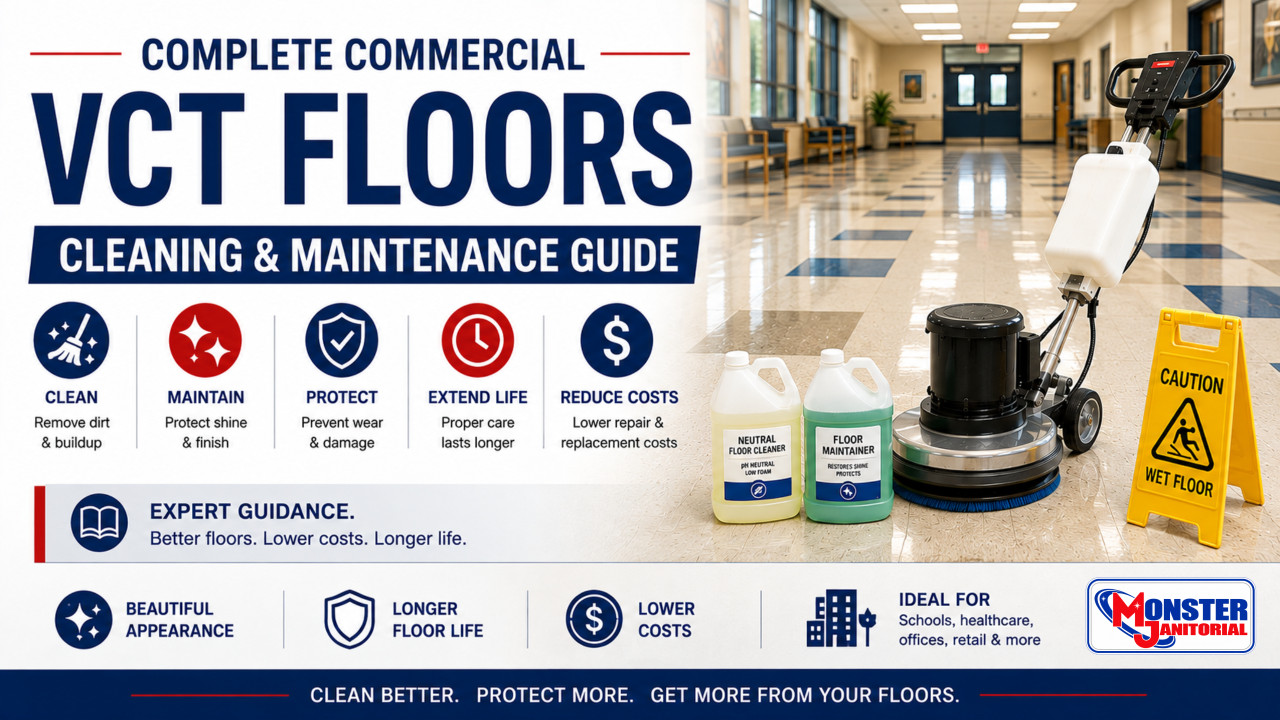
Complete Commercial VCT Floor Cleaning & Maintenance Guide
Vinyl Composition Tile (VCT) is a durable commercial flooring material, but long-term appearance depends heavily on maintaining the protective floor-finish system above the tile.
This guide covers routine cleaning, auto scrubbing, floor pads, burnishing, spray buffing, top scrubbing, recoating, stripping, refinishing, troubleshooting, repair, and replacement.
A successful VCT maintenance program protects the floor finish instead of repeatedly wearing it away.
Remove abrasive soil, clean with compatible chemistry, use the correct pads and machines, burnish when appropriate, top scrub and recoat before finish becomes severely worn, and reserve full stripping for floors that can no longer be restored through normal maintenance.
Make Sure the Floor Is Actually VCT
Do not choose a stripping, finishing, burnishing, or pad system until the flooring and existing maintenance layers have been identified.
VCT and LVT Should Not Automatically Use the Same Maintenance Program
Traditional commercial VCT commonly relies on an applied floor-finish system that becomes the maintainable wear surface. Modern LVT and LVP frequently rely more heavily on factory wear layers and may not require the same strip-and-finish process.
Clean, Burnish, Recoat or Strip?
Use the least aggressive maintenance process that restores the floor to the required condition.
Clean
Use dry-soil removal and compatible neutral cleaning to remove routine traffic soil while preserving the finish.
Burnish
Restore gloss and improve the appearance of a clean, compatible floor finish before deeper restoration is necessary.
Top Scrub & Recoat
Remove worn or contaminated upper finish layers while preserving sound finish below, then apply fresh compatible finish.
Strip & Refinish
Remove the existing finish system when it is badly worn, contaminated, yellowed, damaged, or no longer responding to maintenance.
Daily & Regular VCT Floor Cleaning
Routine cleaning should remove abrasive grit, spills, traffic soil, and residues before they damage or dull the finish.
Cleaning Chemicals for Commercial VCT
Match the chemistry to the maintenance goal instead of using one chemical for every floor-care task.
Pioneer Eclipse 301 Eclipse Neutral Cleaner
Commercial neutral cleaner for routine maintenance and periodic scrubbing of compatible finished floors.
View Eclipse 301 →Pioneer Eclipse Floor Strippers
Designed to break down and remove existing commercial floor-finish systems before refinishing.
Browse Floor Strippers →Commercial Floor Finish
Applied after proper floor preparation to create a maintainable protective layer over VCT.
Browse Floor Finish →Maintainers & Restorers
Used within compatible finished-floor programs to support gloss restoration and ongoing floor appearance between recoats.
Browse Maintainers →Do Not Use Restorative Chemistry for Routine Cleaning
Machines Used to Maintain Commercial VCT
Different stages of VCT maintenance require different equipment.
Match the Floor Pad to the Maintenance Task
Pad color is not completely universal between manufacturers, so confirm the pad's intended application rather than relying only on color.
More Help Choosing Floor Pads
Use these MJ University guides to compare floor-pad aggressiveness, brushes versus pads, diamond-pad systems, and burnishing before choosing a pad for commercial VCT.
How to Choose the Right Floor Pads
Compare cleaning, scrubbing, stripping, polishing, and burnishing pads for commercial floor machines.
Read Floor Pad Guide →Brushes vs. Floor Pads
Learn when smooth VCT favors a floor pad and when a brush may provide better contact.
Read Brushes vs. Pads Guide →How Diamond Floor Pads Work
Learn where diamond-pad cleaning and polishing systems may fit into commercial hard-floor maintenance.
Read Diamond Pad Guide →TASKI Twister Diamond Floor Pad System
Compare Twister pad programs, pad colors, floor types, and commercial maintenance applications.
Read TASKI Twister Guide →Floor Buffing vs. Burnishing
See how machine speed, floor finish, and pad selection affect gloss maintenance.
Read Buffing vs. Burnishing →Shop Commercial Floor Pads
Browse floor pads, brushes, and pad drivers for auto scrubbers, floor machines, and burnishers.
Shop Floor Pads →When Should VCT Be Burnished?
Burnishing can restore gloss and improve the appearance of a compatible floor finish that remains in serviceable condition.
Top Scrub & Recoat VCT Before Full Stripping
A top scrub and recoat can be appropriate when the lower finish layers remain sound but the upper surface has become worn, scratched, or difficult to restore through burnishing alone.
When Should Commercial VCT Be Stripped & Refinished?
Full stripping is appropriate when the existing finish system can no longer be restored efficiently through normal cleaning, burnishing, or top scrubbing and recoating.
Basic Commercial VCT Refinishing Workflow
Why Floor Finish Is Important on VCT
Floor finish creates a renewable maintenance layer above the tile. Instead of allowing traffic and cleaning procedures to wear directly against the flooring, the facility maintains and periodically renews the finish system.
Common Commercial VCT Floor Problems
Floor Finish Cannot Repair Damaged VCT
Stripping and refinishing can restore the maintenance layer, but it cannot rebuild broken, cracked, loose, missing, or severely damaged tile.
Common Commercial VCT Maintenance Mistakes
Commercial VCT Floor-Care Checklist
VCT Floor Care Learning Library
Explore focused commercial VCT guides covering identification, chemicals, equipment, deep cleaning, floor problems, stripping and refinishing, repair, and complete maintenance.
How to Identify VCT Floors Before Cleaning
Learn how VCT construction, finish layers, tile condition, installation, and previous maintenance affect floor care.
Read Identification Guide →Best Cleaning Chemicals for Commercial VCT Floors
Compare neutral cleaners, maintainers, restorers, floor strippers, neutralizers, and commercial floor finishes.
Read Chemical Guide →Auto Scrubbers, Floor Machines & Pads for Commercial VCT Floors
Learn how to match auto scrubbers, rotary machines, burnishers, pads, brushes, and wet recovery equipment to VCT maintenance.
Read Equipment & Pad Guide →How to Deep Clean Commercial VCT Floors
Learn when routine cleaning is not enough and how to improve chemistry, dwell time, agitation, pads, and recovery.
Read Deep-Cleaning Guide →Commercial VCT Floor Problems
Diagnose dullness, haze, streaks, scuffs, scratches, yellowing, finish wear, and other common VCT problems.
Read Troubleshooting Guide →Commercial VCT Stripping & Refinishing Guide
Learn when to top scrub and recoat, when full stripping is necessary, and how to rebuild a commercial VCT finish system.
Read Stripping & Refinishing Guide →Commercial VCT Floor Repair & Replacement Guide
Learn when damaged, cracked, loose, stained, or severely worn VCT should be repaired, restored, or replaced.
Read Repair & Replacement Guide →Complete Commercial VCT Floor Cleaning & Maintenance Guide
Use this guide as the central reference for cleaning, burnishing, recoating, stripping, refinishing, troubleshooting, and VCT maintenance.
Current GuideHelpful Equipment & Chemical Guides
Commercial VCT Floor Cleaning & Maintenance FAQs
What is the best cleaner for commercial VCT?
For routine maintenance of finished VCT, start with a compatible neutral or low-residue cleaner that will clean without unnecessarily attacking the floor finish.
Can an auto scrubber be used on VCT?
Yes. Auto scrubbers are commonly used for commercial VCT maintenance. Match the cleaner, pad or brush, pressure, solution flow, and recovery system to the floor finish and cleaning objective.
How often should VCT be burnished?
Burnishing frequency depends on traffic, appearance requirements, floor finish, routine cleaning quality, and facility conditions. Burnish when the clean finish needs gloss restoration and the finish system is compatible with burnishing.
When should VCT be top scrubbed and recoated?
Consider top scrubbing and recoating when upper finish layers are worn or scratched but the lower finish remains sound enough to preserve.
When should VCT be stripped?
Full stripping is generally reserved for finish that is badly worn, contaminated, yellowed, uneven, failing, or no longer responding effectively to normal maintenance and recoating.
Does VCT need floor finish?
Commercial VCT is commonly protected with an applied floor-finish system that becomes the maintainable wear surface over the tile.
Can damaged VCT tiles be replaced individually?
Often yes. Localized cracked, broken, loose, or badly damaged tiles may be candidates for individual replacement when compatible replacement material and proper installation conditions are available.
Need Help With Commercial VCT Floor Care?
Monster Janitorial can help you compare neutral cleaners, floor finish, strippers, maintainers, auto scrubbers, floor machines, burnishers, pads, brushes, and wet recovery equipment for commercial VCT maintenance.
Tax-exempt purchasing and purchase-order support are available for qualifying schools, universities, government agencies, healthcare facilities, municipalities, and other institutional customers.