
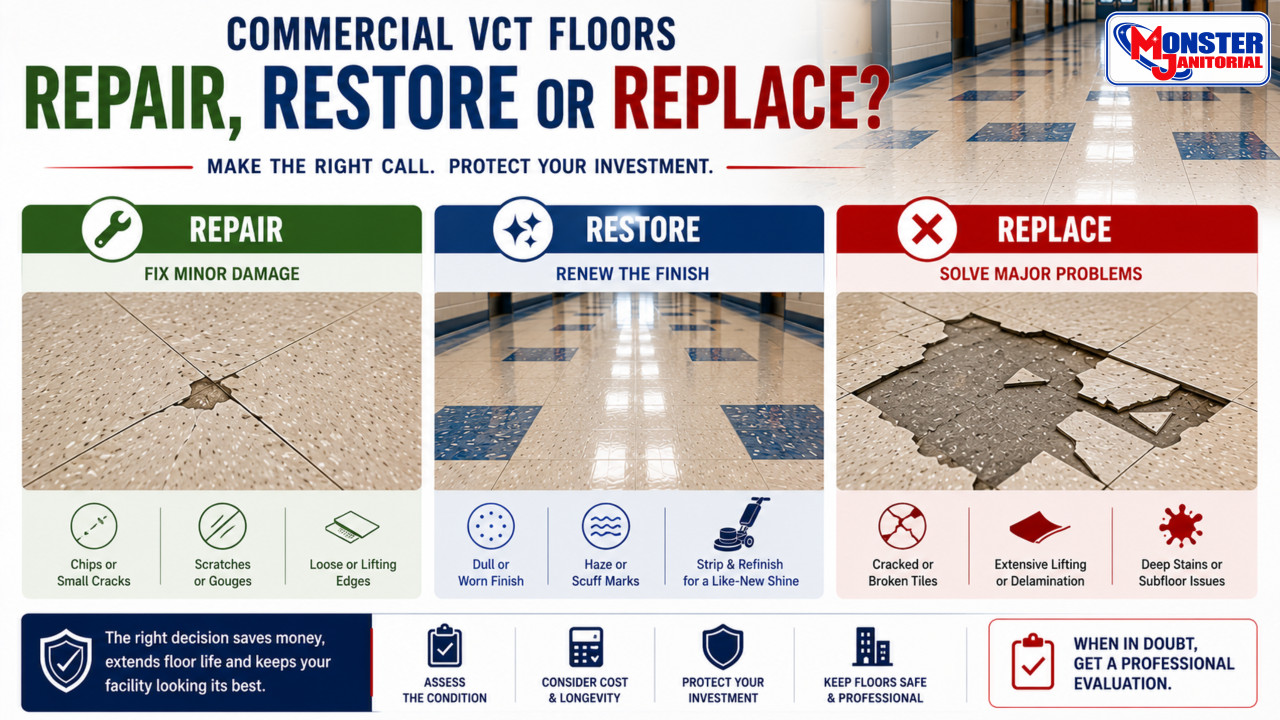
Commercial VCT Floor Repair & Replacement Guide: When to Repair, Restore or Replace
Commercial VCT problems do not all require the same solution. Some appearance issues can be corrected through cleaning, burnishing, recoating, or refinishing, while cracked, loose, deeply damaged, or failing tiles may require physical repair or replacement.
The first step is deciding whether the problem is in the renewable floor finish, the VCT tile itself, or the installation and substrate below it.
Restore the floor when the problem is mainly in the finish, replace individual tiles when physical damage is isolated, and consider larger-area replacement when damage, moisture, adhesive, or substrate problems are widespread.
Restore, Repair or Replace?
The correct solution depends on whether the floor finish, individual tile, or larger flooring system has failed.
Finish Is the Main Problem
- Dull appearance
- Light scuffs
- Light finish scratches
- Worn traffic lanes
- Haze or residue
- Uneven or worn floor finish
Physical Damage Is Isolated
- Cracked tile
- Chipped tile
- Deep gouges
- Permanent tile staining
- Loose or damaged edge
- Localized adhesive failure
Failure Extends Beyond a Few Tiles
- Widespread loose tile
- Extensive cracking
- Recurring moisture problems
- Substrate failure
- Large areas of missing VCT
- Repeated repairs keep failing
Finish Damage vs. Actual VCT Tile Damage
The applied floor finish acts as a renewable wear layer. Light scuffs, minor scratches, dullness, and traffic wear may affect the finish without permanently damaging the tile below.
Cracks, chips, deep gouges, broken corners, loose tile, and significant edge damage are physical flooring problems that cannot be corrected simply by burnishing or applying additional finish.
When Can Commercial VCT Be Restored?
If the tiles remain securely bonded and physically sound, many appearance problems can be corrected through the existing VCT maintenance system.
Clean / Deep Clean
Use when soil, residue, haze, or contamination is the primary issue and the underlying finish remains serviceable.
Burnish
Use when the floor is clean and the compatible finish is still intact but has lost gloss.
Top Scrub & Recoat
Use when upper finish layers are worn but the remaining finish system is still sound and can be properly prepared for recoating.
Strip & Refinish
Use when the existing finish is badly worn, contaminated, yellowed, uneven, excessively built up, or cannot be restored through less aggressive maintenance.
Can a Deep Scratch in VCT Be Polished Away?
It depends on the depth. A light scratch contained within the finish may improve through compatible maintenance, but a deep scratch that reaches the actual VCT tile is physical damage.
Clean first
May respond to restoration
Repair or replace tile
New Floor Finish Does Not Repair Cracked VCT
Floor finish creates a protective maintenance layer. It does not structurally bond a cracked tile, restore missing material, correct loose adhesive, flatten curled edges, or repair substrate movement underneath the flooring.
When Should an Individual VCT Tile Be Replaced?
Individual tile replacement makes sense when physical damage is limited to a small area and the surrounding installation remains secure and serviceable.
Replacing an Individual VCT Tile
Matching Replacement VCT Color & Pattern
Even when the same product is available, a new replacement tile may look different from older surrounding VCT because of age, wear, finish buildup, cleaning history, and manufacturing variation.
Whenever possible, confirm the original manufacturer, color, pattern, size, and product information before ordering replacement material.
Adhesive & Substrate Problems
A loose or repeatedly failing VCT tile may be a symptom rather than the root problem. Check the condition below the tile before repeatedly replacing surface material.
Possible Adhesive Issues
- Loss of bond
- Incorrect adhesive application
- Contaminated substrate
- Installation before adhesive was ready
- Adhesive incompatibility
Possible Substrate Issues
- Cracks or movement
- Uneven substrate
- Moisture-related conditions
- Damaged patching or underlayment
- Recurring structural movement
When Should Moisture or Flooring Specialists Be Involved?
Widespread lifting, repeated adhesive failure, unexplained discoloration, multiple loose tiles, or recurring replacement failures can indicate conditions below the finished floor.
When the cause is unclear or appears widespread, professional flooring evaluation and appropriate moisture or substrate assessment may be necessary before additional VCT is installed.
When Should a Larger VCT Area Be Replaced?
Repeatedly replacing individual tiles may stop making sense when the underlying failure affects a large section of flooring.
Before Repairing or Replacing Commercial VCT
Common VCT Repair & Replacement Mistakes
VCT Floor Care Learning Library
Explore focused commercial VCT guides covering identification, chemicals, equipment, deep cleaning, troubleshooting, stripping, refinishing, repair, and complete maintenance.
How to Identify VCT Floors Before Cleaning
Tile construction, finish layers, wear patterns, damage, and overall floor condition.
Read Identification Guide →Best Cleaning Chemicals for Commercial VCT Floors
Neutral cleaners, maintainers, deep-scrub chemistry, strippers, neutralizers, sealers, and coatings.
Read Chemical Guide →Auto Scrubbers, Floor Machines, Burnishers & Pads for Commercial VCT
Choose equipment and pads for cleaning, deep scrubbing, stripping, and burnishing.
Read Equipment Guide →How to Deep Clean Commercial VCT Floors
Apply, dwell, scrub, recover, and evaluate the remaining finish.
Read Deep-Cleaning Guide →Commercial VCT Floor Problems
Diagnose dullness, haze, streaks, scratches, scuffs, finish wear, and buildup.
Read Troubleshooting Guide →Commercial VCT Stripping & Refinishing Guide
Remove failed finish, prepare the floor, and rebuild the protective coating system.
Read Stripping & Refinishing Guide →Commercial VCT Floor Repair & Replacement Guide
Learn when VCT should be restored, when individual tile should be replaced, and when a larger flooring area may require replacement.
Current GuideComplete Commercial VCT Floor Cleaning & Maintenance Guide
Central reference for cleaning, burnishing, recoating, stripping, refinishing, troubleshooting, and repair.
Read Complete Guide →VCT Repair & Replacement FAQs
Can worn VCT be restored instead of replaced?
Yes, when the tiles remain physically sound and securely bonded. Many appearance problems are caused by the floor finish rather than failure of the tile itself.
Can a cracked VCT tile be repaired with floor finish?
No. Floor finish protects the surface but does not structurally repair a cracked or broken tile.
When should one VCT tile be replaced?
Individual replacement is appropriate when damage is localized and the surrounding flooring, adhesive, and substrate remain serviceable.
Why does a replacement VCT tile sometimes look different?
Age, wear, finish buildup, maintenance history, and manufacturing variation can make new tile appear different from surrounding older flooring.
What if replacement tiles keep coming loose?
Repeated failure may indicate an adhesive, substrate, moisture, or installation problem that should be corrected before continuing to replace tiles.
When is it better to replace a larger VCT area?
Larger replacement may make more sense when loose tile, cracking, adhesive failure, substrate problems, or recurring repairs affect a significant portion of the installation.
Not Sure Whether Your VCT Needs Restoration or Replacement?
Monster Janitorial can help you determine whether the issue is routine finish wear, a restoration problem, isolated tile damage, or a larger flooring failure.
Tax-exempt purchasing and purchase-order support are available for qualifying schools, universities, government agencies, healthcare facilities, municipalities, and other institutional customers.