
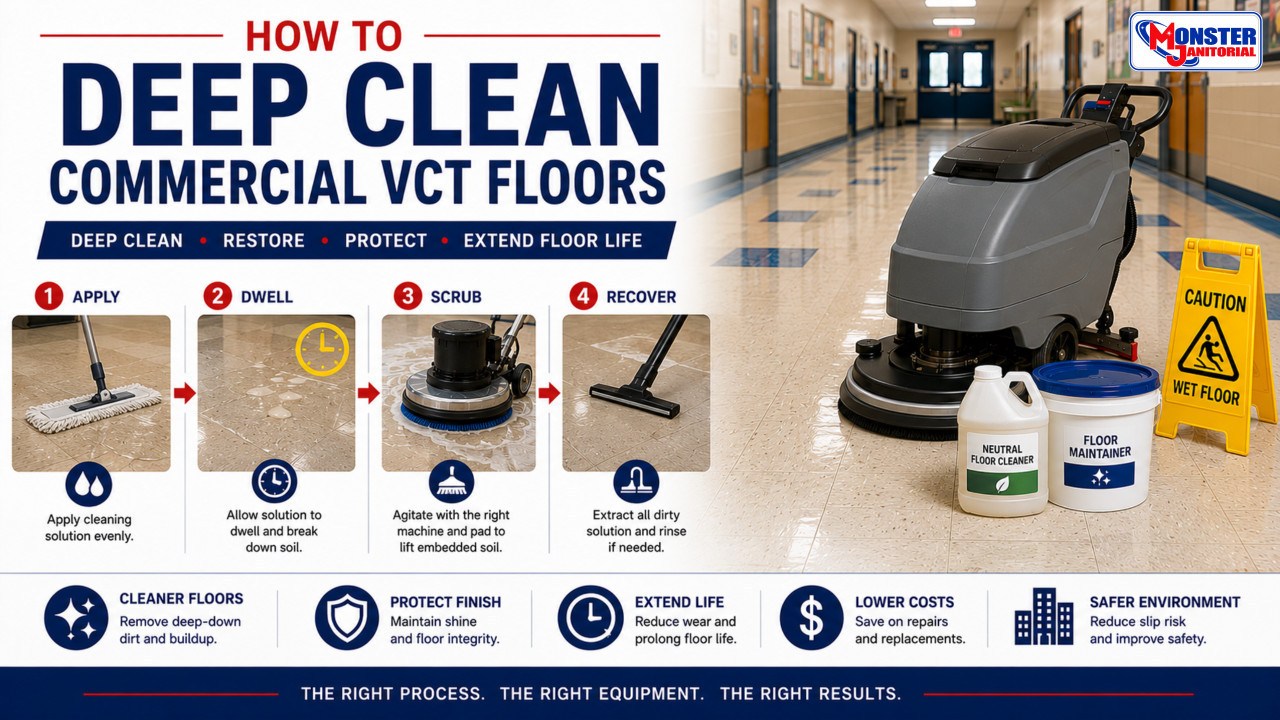
How to Deep Clean Commercial VCT Floors
Deep cleaning commercial VCT removes heavier soil, residue, embedded contamination, and buildup that routine cleaning may leave behind.
The key is to clean aggressively enough to correct the problem without automatically removing more floor finish than necessary.
Deep clean VCT by removing loose soil, applying the correct cleaner, allowing proper dwell time, agitating with the appropriate machine and pad, recovering the dirty solution completely, and then inspecting the remaining floor finish.
When Does Commercial VCT Need Deep Cleaning?
Routine cleaning should handle normal dust and everyday soil. Deep cleaning becomes useful when soil or residue remains after normal cleaning but the floor finish may still be serviceable.
- Light dust and tracked-in soil
- Minor surface marks
- Floor still responds to normal cleaning
- Finish remains even and serviceable
- Embedded traffic-lane soil
- Cleaner or detergent residue
- Heavy scuffing and surface contamination
- Soil remaining after routine auto scrubbing
- Preparation for possible recoating
Inspect the Existing VCT Floor Finish
Deep cleaning can improve a dirty but serviceable finish. It cannot rebuild finish that has worn through, repair cracked tile, correct loose tile, or fix substrate and moisture problems.

A controlled VCT deep-cleaning process follows four basic stages: apply the cleaning solution, allow proper dwell time, scrub the floor, and recover the dirty solution completely.
How to Deep Clean Commercial VCT Step by Step
Remove Dry Soil
Sweep, dust mop, or vacuum loose grit and debris before applying liquid cleaner. Dry soil can interfere with scrubbing and increase scratching.
Choose the Correct Chemical
Use chemistry designed for the required cleaning level and compatible with the existing VCT finish. Do not automatically reach for floor stripper.
Apply Solution Evenly
Apply enough solution to wet the work area according to product directions without flooding seams, edges, walls, or adjacent surfaces.
Allow Proper Dwell Time
Give the chemical time to loosen soil according to its label. Do not let the cleaning solution dry on the floor.
Agitate the Floor
Use an auto scrubber, orbital machine, or low-speed floor machine with a pad appropriate for the finish condition and cleaning objective.
Recover Dirty Solution
Recover the contaminated solution with the scrubber recovery system or a wet vacuum instead of allowing loosened soil to dry back onto the floor.
Rinse if Required
Some cleaning systems may require additional rinsing or preparation. Follow the chemical and finish-system directions instead of automatically adding unnecessary steps.
Dry & Inspect
Allow the floor to dry and inspect it under good lighting before deciding whether routine maintenance, burnishing, recoating, or stripping should follow.
Pioneer Eclipse ReBoot 342 Deep Scrub Cleaner
ReBoot 342 is an example of chemistry intended for deeper scrubbing of compatible finished hard floors when routine neutral cleaning is no longer enough but complete stripping is not yet the objective.
View Pioneer Eclipse ReBoot 342 →Machines for Deep Cleaning Commercial VCT
The right machine depends on floor size, required agitation, recovery needs, and whether the process is routine deep cleaning or preparation for recoating.
TASKI ULTIMAXX 2900 OB50
The orbital deck provides controlled agitation while the scrubber applies solution and recovers dirty water in the cleaning process.
View TASKI ULTIMAXX 2900 OB50 →EDIC Saturn HD 17" – 172 RPM
A traditional low-speed rotary machine provides controlled agitation for deep scrubbing and restorative floor preparation when paired with an appropriate pad.
View EDIC Saturn HD →Use a Deep-Scrub Pad — Not Automatically a Stripping Pad
The goal of deep cleaning is usually to remove heavier contamination while preserving serviceable finish. A stripping pad may remove much more finish than intended.
For normal soil and regular maintenance.
For heavier soil and controlled corrective cleaning.
For finish removal when full stripping is actually required.
Pad colors and aggressiveness vary by manufacturer. Verify the specific pad's intended use instead of choosing by color alone.
Need Help Choosing the Right Pad?
Use these MJ University guides to compare pad aggressiveness, brushes versus pads, diamond-pad systems, and burnishing before selecting a pad for deep cleaning VCT.
How to Choose the Right Floor Pads
Compare cleaning, scrubbing, stripping, polishing, and burnishing pads for commercial floor machines.
Read Floor Pad Guide →Brushes vs. Floor Pads
Learn when smooth VCT favors a floor pad and when a brush may provide better contact.
Read Brushes vs. Pads Guide →How Diamond Floor Pads Work
Understand diamond-pad cleaning and polishing systems and where they may fit into hard-floor maintenance.
Read Diamond Pad Guide →TASKI Twister Diamond Pad System
Compare Twister pad programs, pad colors, compatible floor types, and maintenance applications.
Read TASKI Twister Guide →Floor Buffing vs. Burnishing
See how machine speed, pad selection, and floor-finish condition change appearance-maintenance results.
Read Buffing vs. Burnishing →Shop Commercial Floor Pads
Browse floor pads for auto scrubbers, floor machines, burnishers, and commercial floor-care applications.
Shop Floor Pads →Recover the Dirty Solution Completely
Scrubbing loosens contamination but does not remove it from the facility. The dirty solution must be recovered with an auto scrubber, wet vacuum, or other suitable recovery system. Leaving slurry behind can create haze, residue, streaks, and redeposited soil.
What Should You Do After Deep Cleaning?
Do not assume every deep-cleaned VCT floor needs the same next step.
Return to Routine Maintenance
If soil is removed and the finish remains even and serviceable, resume the normal maintenance program.
Consider Burnishing
Burnishing may restore gloss if the existing finish is compatible, clean, cured, and still in good condition.
Top Scrub & Recoat
When lower finish remains sound, a controlled top scrub and compatible recoat may restore the protective wear surface without a complete strip.
Strip & Refinish
Full stripping may be appropriate when the finish is severely worn, contaminated, yellowed, uneven, failed, or cannot be restored through less aggressive maintenance.
Deep Cleaning Is Not the Same as Stripping VCT
Deep cleaning removes heavier soil and contamination. Stripping intentionally removes the existing floor-finish system. Do not use stripping chemistry or stripping pads simply because routine cleaning did not produce enough improvement.
Common VCT Deep-Cleaning Mistakes
VCT Floor Care Learning Library
Explore commercial VCT guides covering floor identification, cleaning chemicals, machines and pads, deep cleaning, troubleshooting, stripping and refinishing, repair, and complete maintenance.
How to Identify VCT Floors Before Cleaning
Understand VCT construction, finish layers, wear patterns, physical damage, and overall floor condition.
Read Identification Guide →Best Cleaning Chemicals for Commercial VCT Floors
Compare neutral cleaners, maintainers, deep-scrub cleaners, strippers, neutralizers, sealers, and floor finishes.
Read Chemical Guide →Auto Scrubbers, Floor Machines & Pads for Commercial VCT Floors
Choose auto scrubbers, floor machines, pads, brushes, and burnishing equipment for commercial VCT maintenance.
Read Equipment Guide →How to Deep Clean Commercial VCT Floors
Learn the apply, dwell, scrub, recover, and inspection process for heavily soiled commercial VCT.
Current GuideCommercial VCT Floor Problems
Diagnose dullness, haze, streaks, scratches, scuffs, finish wear, buildup, and other appearance problems.
Read Troubleshooting Guide →Commercial VCT Stripping & Refinishing Guide
Learn when to strip VCT, remove failed finish, prepare the floor, and rebuild the protective finish system.
Read Stripping & Refinishing Guide →Commercial VCT Floor Repair & Replacement Guide
Learn when VCT can be restored, when individual tiles should be replaced, and when larger flooring failure requires replacement.
Read Repair & Replacement Guide →Complete Commercial VCT Floor Cleaning & Maintenance Guide
The complete reference for cleaning, burnishing, recoating, stripping, refinishing, troubleshooting, repair, and ongoing VCT maintenance.
Read Complete Guide →Commercial VCT Deep-Cleaning FAQs
How is deep cleaning different from routine VCT cleaning?
Routine cleaning removes everyday soil. Deep cleaning uses stronger agitation or specialized chemistry to remove heavier contamination while attempting to preserve serviceable finish.
Do you need to strip VCT every time it is deep cleaned?
No. Deep cleaning and stripping are different maintenance processes. Full stripping should be reserved for finish that truly needs removal.
Can an auto scrubber deep clean VCT?
Yes. An auto scrubber can provide controlled agitation and immediate solution recovery when equipped with the appropriate pad, chemical, and operating settings.
Should deep-cleaning solution be allowed to dwell?
Follow the chemical label. Proper dwell time can help loosen soil, but the solution should not be allowed to dry on the floor.
Should VCT be burnished immediately after deep cleaning?
Only after the floor is clean, dry, and the remaining finish is inspected. Burnishing is appropriate only when the finish is compatible and still serviceable.
What if deep cleaning does not restore the floor?
The floor may need burnishing, top scrubbing and recoating, or full stripping and refinishing depending on the condition of the existing finish.
Need Help Deep Cleaning Commercial VCT?
Monster Janitorial can help you compare deep-scrub chemicals, auto scrubbers, low-speed floor machines, pads, wet recovery equipment, and complete VCT maintenance systems.
Tax-exempt purchasing and purchase-order support are available for qualifying schools, universities, government agencies, healthcare facilities, municipalities, and other institutional customers.