
Robotic Cleaning Learning
Robotic Cleaning Learning Center
Learn how commercial robotic cleaning equipment works, which facilities are good candidates for automation, how robots navigate, what robotic cleaning costs, and how to prepare, operate, maintain, and troubleshoot autonomous equipment.
Explore guides for schools, healthcare facilities, airports, warehouses, retail stores, government buildings, universities, transportation facilities, and other commercial environments.

Is Robotic Cleaning Right for Your Facility?
Start by looking at your actual cleaning routes, floor layout, traffic, obstacles, staffing, floor type, cleaning schedule, charging location, and how repeatable the work is. Building size alone does not determine whether robotics will be a good fit.
Learn About Commercial Cleaning Robotics
Move from the basics into facility selection, navigation, deployment, cost and ROI, fleet management, maintenance, troubleshooting, platforms, and future technology.
Robotics Basics
Understand what robotic floor cleaning machines do and where autonomous cleaning fits into a commercial cleaning program.
Facility Fit
Compare robotics for schools, healthcare, airports, warehouses, retail stores, and public facilities.
Navigation
Learn about AI, LiDAR, cameras, sensors, mapping, teach-and-repeat, and adaptive navigation.
Cost & ROI
Understand equipment costs, labor utilization, maintenance, software, ownership costs, and potential payback.
Docking & Fleet Management
Learn about machine status, charging, docking, route reporting, alerts, and multi-machine operations.
Machine Care
Maintain robotic equipment and diagnose common navigation, docking, charging, sensor, and cleaning problems.
Start With These Robotic Cleaning Guides
Guide to Robotic Floor Cleaning Machines
Learn the basics of autonomous cleaning, robotic machine types, facility applications, and equipment selection.
Read Robotics Guide →Best Robotic Floor Scrubbers by Facility Type
Compare robotic cleaning needs for schools, healthcare, airports, warehouses, retail stores, and public buildings.
Compare by Facility →Robotic Floor Scrubber vs Traditional Auto Scrubber
Compare flexibility, supervision, productivity, cleaning consistency, cost, and facility fit.
Read Comparison →Understand How Robotic Cleaning Works
Learn how robotic navigation works, compare structured and adaptive approaches, and prepare a building before deployment.
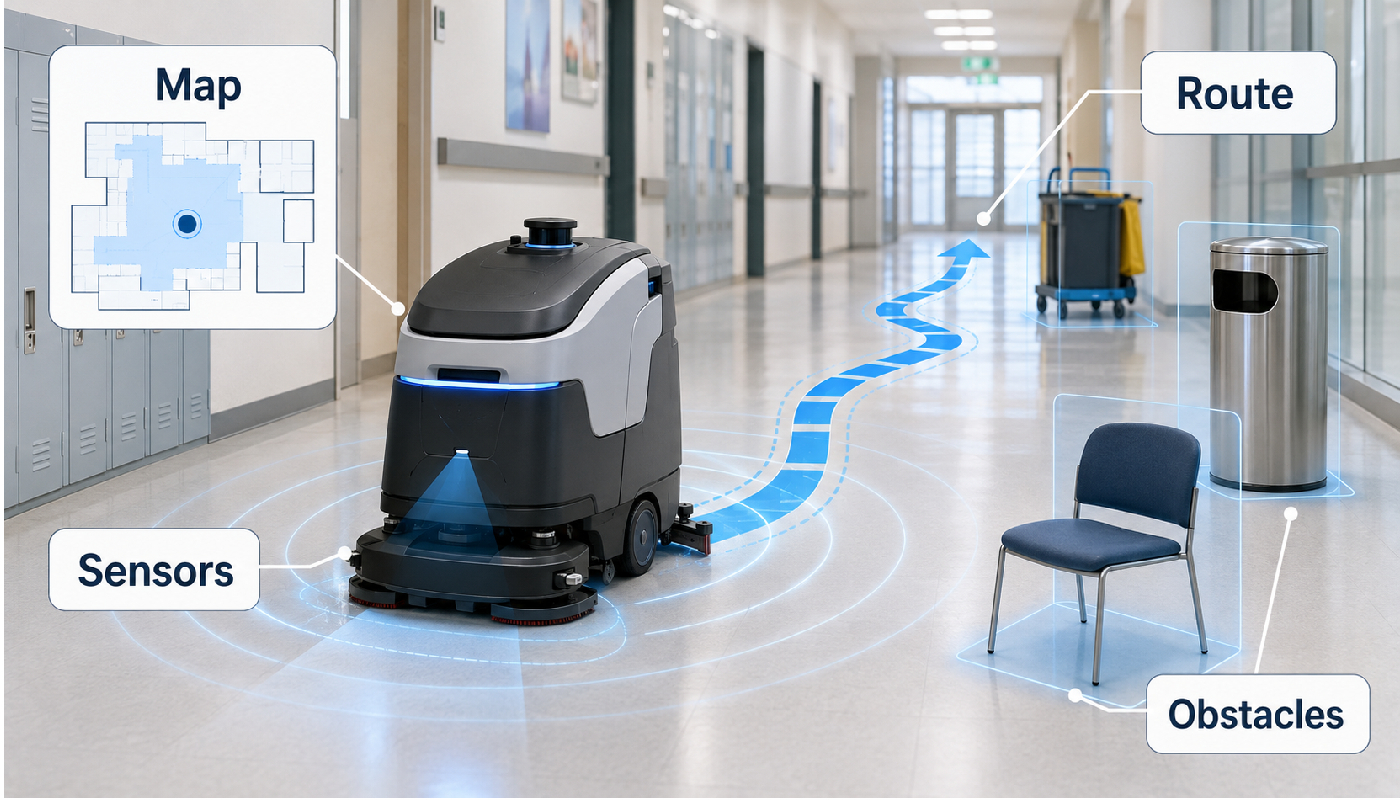
Commercial Cleaning Robot Navigation Explained
Learn how AI, LiDAR, cameras, sensors, mapping, obstacle detection, and autonomous navigation technologies work.
Read Navigation Guide →Teach-and-Repeat Robotics vs AI-Adaptive Robotics
Compare predictable taught routes with more adaptive robotic navigation for changing environments.
Read Robotics Comparison →How to Prepare a Facility for a Robotic Floor Scrubber
Prepare routes, doorways, floors, docks, obstacles, connectivity, staff procedures, mapping, and testing.
Read Preparation Guide →
Cost, ROI & Fleet Operations
Robotic Floor Scrubber Cost & ROI
Understand equipment cost, labor utilization, maintenance, software expenses, ownership costs, machine utilization, and potential payback.
Read Cost & ROI Guide →Robotic Cleaning Fleet Management, Docking & Charging Explained
Learn about machine status, route reporting, charging, autonomous docking, alerts, connected operations, and fleet management.
Read Fleet & Docking Guide →Maintenance & Troubleshooting
Autonomous machines still require routine inspection, wear-part replacement, battery care, sensor cleaning, and troubleshooting.

Robotic Floor Scrubber Maintenance Checklist
Inspect tanks, brushes, pads, squeegees, hoses, sensors, batteries, wheels, and charging equipment.
Read Maintenance Guide →Robotic Floor Scrubber Troubleshooting Guide
Diagnose navigation errors, route stops, dirty sensors, docking problems, charging issues, poor pickup, streaking, and system alerts.
Read Troubleshooting Guide →Robotics Platforms & Future Technology
Understanding Commercial Cleaning Robotics Platforms
Compare Karcher, TASKI, Tennant, Nilfisk, and Gausium robotics approaches, deployment styles, and platform priorities.
Read Platforms Guide →The Future of Autonomous Commercial Cleaning
Explore evolving AI, navigation, connected fleets, analytics, docking, predictive maintenance, and facility automation.
Explore Future Technology →TASKI Connected & Smart Cleaning Resources
These resources are useful for understanding connected equipment and TASKI technology, but they apply more broadly than robotic cleaning alone.
IntelliTrail Benefits
Learn about connected fleet visibility, machine usage, location, battery status, service information, and equipment monitoring.
Read IntelliTrail Benefits →TASKI Smart Cleaning Technology Explained
Explore IntelliFlow, IntelliDose, IntelliTrail, battery technology, cleaning controls, and other TASKI equipment features.
Read TASKI Technology Guide →All Robotic Cleaning Articles
Browse all 12 current MJ University robotics guides.
Shop Commercial Robotic Cleaning Equipment
Robotic Cleaning Equipment
Explore autonomous scrubbers, robotic vacuums, sweepers, and commercial cleaning platforms.
Shop Robotic Equipment →Commercial Auto Scrubbers
Compare traditional walk-behind, ride-on, compact, disc, and cylindrical scrubbers.
Shop Auto Scrubbers →Brushes & Floor Pads
Find floor pads, brushes, pad drivers, and related commercial floor-care accessories.
Shop Brushes & Floor Pads →Explore Related Cleaning Equipment

Auto Scrubbers Learning Center
Learn how to choose, operate, maintain, and troubleshoot commercial auto scrubbers.
Visit Auto Scrubber Learning Center →
Floor Sweepers Learning Center
Compare manual, battery walk-behind, and ride-on commercial floor sweepers.
Visit Sweeper Learning Center →
Commercial Vacuums Learning Center
Compare commercial vacuum types, filtration, carpet cleaning, detail cleaning, and facility applications.
Visit Vacuum Learning Center →Commercial Robotic Cleaning FAQs
What facilities are best for robotic floor scrubbers?
Facilities with suitable repeatable routes can be strong candidates, but layout, traffic, obstacles, route width, charging, and cleaning schedule should all be evaluated.
Do robotic floor scrubbers replace cleaning staff?
No. They can reduce continuous machine-driving time, but staff are still needed for preparation, maintenance, consumables, route management, detail cleaning, and responding to alerts.
Do all commercial cleaning robots use LiDAR?
No. Navigation varies by platform and may use LiDAR, cameras, other sensors, maps, taught routes, or combinations of multiple technologies.
Do robotic scrubbers need Wi-Fi?
Requirements vary. Some platforms use Wi-Fi, cellular connectivity, or cloud services for reporting, updates, remote monitoring, and fleet tools.
Should a robotic scrubber be tested before purchase?
Yes. A facility demonstration can help confirm route access, obstacles, floor transitions, cleaning performance, docking, and overall fit before deployment.
Is one robotic scrubber best for every facility?
No. Machine size, navigation style, cleaning width, runtime, floor type, traffic, route complexity, and docking requirements should be matched to the actual facility.
Need Help Choosing a Robotic Cleaning Solution?
Monster Janitorial can help evaluate your facility, compare robotic cleaning machines, plan equipment demonstrations, and determine whether autonomous cleaning is a good fit for your operation.
Free equipment demonstrations are available for qualifying facilities in South Texas and the Rio Grande Valley. Tax-exempt purchasing and purchase-order support are available for qualifying schools, universities, government agencies, municipalities, healthcare facilities, and other institutional customers.