
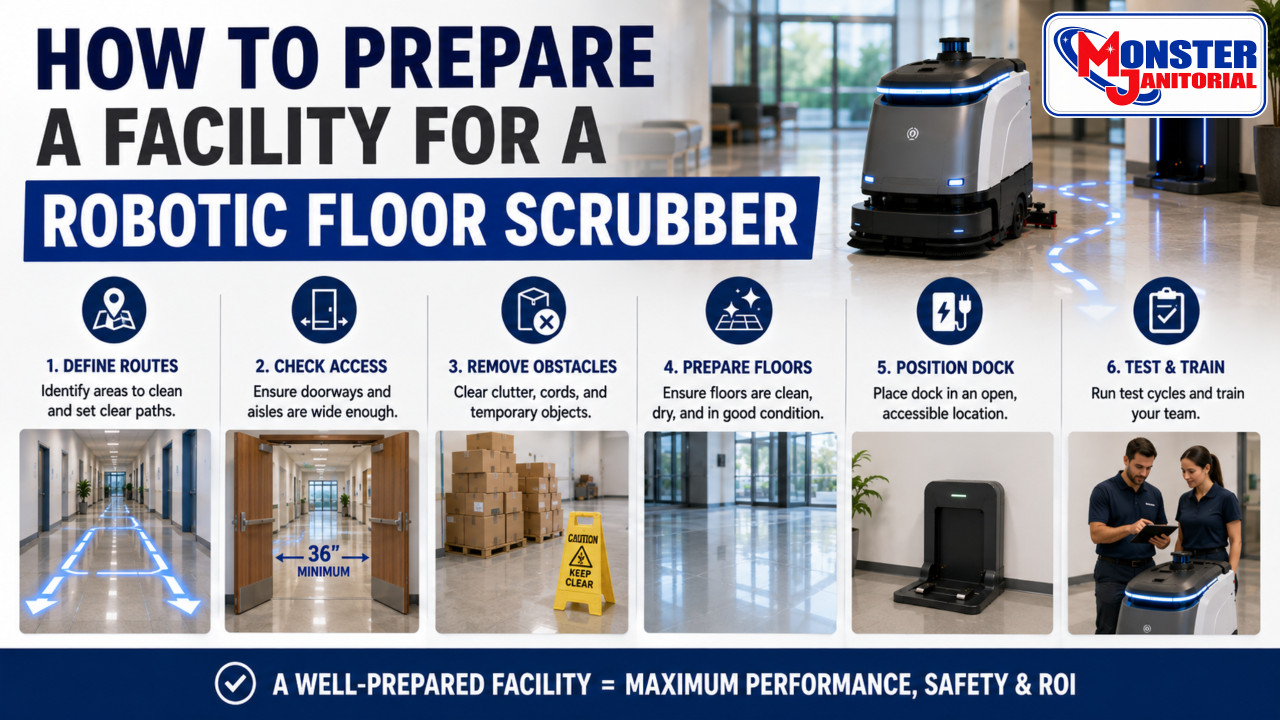
How to Prepare a Facility for a Robotic Floor Scrubber
Successful robotic floor scrubber deployment starts before the robot begins cleaning. Routes, doorways, floor conditions, temporary obstacles, traffic patterns, charging access, and dock placement can all affect how reliably an autonomous scrubber operates.
Facility requirements vary by robotic platform and manufacturer. Always review the machine specifications, site requirements, operator documentation, and recommended deployment process for the specific system.
What Should Be Ready Before a Robotic Scrubber Arrives?
Start with clear, repeatable cleaning routes. Check doorway widths, floor transitions, ramps, thresholds, high-traffic areas, temporary obstacles, and potential docking locations. Confirm power and connectivity requirements, prepare the floor for mapping, train staff, and test the robot in the actual facility before full deployment.
Why Facility Preparation Matters
Robotic scrubbers perform best when the facility provides predictable travel paths, suitable floor conditions, adequate clearance, and a practical charging location.
Preparing the site before mapping can reduce unnecessary route interruptions, repeated obstacle avoidance, docking problems, missed areas, and operator intervention after deployment.

Routes, doorways, floor conditions, and dock placement are four of the most important areas to evaluate before deployment.
Evaluate the Facility Floor Plan
Walk the facility before creating robotic routes. Look at how people, equipment, carts, pallets, furniture, and other objects normally move throughout the building.
- Identify large open areas that are cleaned repeatedly.
- Identify narrow corridors or congested areas.
- Locate doorways, thresholds, ramps, and floor transitions.
- Note permanent equipment and fixed obstacles.
- Identify areas where the layout changes frequently.
Identify Good Robotic Cleaning Zones
Robotic scrubbers are generally strongest in areas where cleaning paths are large, repeatable, and reasonably predictable.
Large hallways, open retail floors, warehouse aisles, airport corridors, school hallways, healthcare corridors, and other repeatable floor areas.
Constantly changing storage zones, very tight rooms, heavily cluttered spaces, or areas where temporary obstacles repeatedly block travel paths.
Check Doorways, Aisles & Travel Clearance
A robot needs enough room to travel through doorways, aisles, turns, and other restricted areas while maintaining the safety clearances required by its navigation system.
- Measure narrow doorways and passageways.
- Check whether doors normally remain open or closed.
- Look for tight turns immediately before or after doorways.
- Consider carts, bins, pallets, or furniture that may reduce usable width.
- Compare actual facility clearances with the requirements of the specific robotic platform.
Review Floor Transitions, Thresholds & Ramps
A route may cross multiple flooring materials or elevation changes. Inspect transitions before mapping so they can be tested under actual operating conditions.
- Raised doorway thresholds
- Expansion joints
- Ramps and sloped areas
- Changes between hard-floor materials
- Damaged or uneven flooring
- Drain areas or other unusual floor features
Plan for Elevators Separately
Do not assume every robotic scrubber can independently use elevators. Elevator integration and multi-floor operation vary significantly by platform and building.
If elevator use is required, verify compatibility, building-system requirements, safety procedures, and manufacturer support before including elevators in the deployment plan.
Reduce Temporary Obstacles
Robotic navigation systems are designed to detect and respond to obstacles, but constantly changing clutter can make otherwise simple routes less efficient.
Before scheduled robotic cleaning, keep primary routes reasonably clear of carts, boxes, pallets, trash containers, temporary displays, cleaning supplies, and other movable objects when practical.

A clear, repeatable route is easier for a robotic scrubber to clean consistently than a narrow path filled with changing obstacles.
Review Traffic Patterns
Observe how the facility changes throughout the day. A route that is open early in the morning may be crowded with people, carts, deliveries, or equipment later.
- Shift changes
- Student passing periods
- Patient or visitor traffic
- Warehouse receiving and shipping periods
- Retail opening and closing times
- Scheduled deliveries or facility events
Choose the Right Docking & Charging Location
The dock should be placed where the robot can approach and align reliably without competing with normal facility traffic or storage.
- Provide adequate open space around the dock.
- Keep the approach path clear.
- Avoid placing the dock where carts or supplies are regularly stored.
- Protect the dock from accidental impact where practical.
- Follow manufacturer clearance and installation requirements.

An open, unobstructed docking area gives the robot room to approach and align with the charging station.
Confirm Power & Charging Requirements
Before choosing a permanent dock location, verify the electrical requirements of the charger or docking system.
Use the manufacturer’s installation requirements and qualified electrical personnel when electrical work is needed. Do not assume all robotic scrubber docks use the same power requirements.
Check Wi-Fi or Connectivity Requirements
Connectivity requirements vary. Some robotic platforms use Wi-Fi, cellular connections, cloud-based fleet management, or other network services, while others may be able to perform core cleaning functions differently.
Confirm the requirements of the specific platform before deployment, especially if remote monitoring, reporting, software updates, or fleet-management features are expected.
Plan Storage, Parking & Service Access
Leave enough space for operators or service personnel to access tanks, brushes, pads, squeegees, filters, charging components, and other normal maintenance areas. Avoid locating the robot where other equipment routinely blocks access.
Prepare the Floor Before Mapping
The facility should resemble normal operating conditions when routes are mapped and tested.
- Remove unusual temporary clutter.
- Place normal furniture and equipment where it will typically remain.
- Correct major floor hazards or damaged areas.
- Confirm doors needed for the route are accessible.
- Make sure the planned dock location is ready.
Train the Cleaning Staff
Robotic cleaning changes the operator’s role, but it does not eliminate the need for trained staff.
Operators should understand normal start-up, route selection, tank filling and emptying, pads or brushes, squeegee care, sensor cleaning, charging, alerts, obstacle handling, and when to call for service.
Decide Who Manages the Robot
Assign responsibility for routine operation instead of treating the robot as equipment that runs without oversight.
- Who starts or schedules routes?
- Who responds to alerts?
- Who performs daily maintenance?
- Who reviews route performance?
- Who contacts service when a technical problem occurs?
Test the Robot in the Real Facility
A specification sheet cannot show exactly how a robot will behave in every building. Test routes under realistic conditions before relying on them for routine cleaning.
- Check route completion.
- Watch doorway and aisle navigation.
- Test expected floor transitions.
- Observe obstacle behavior.
- Check cleaning coverage.
- Verify water pickup and cleaning results.
- Test docking and charging where supported.
Prepare, Map, Test, Adjust & Deploy
Deployment should be treated as a process rather than a single setup event. After the first routes are created, test them, identify problem areas, refine boundaries or operating conditions where supported, and confirm the machine performs reliably before expanding use.

A staged deployment gives facility managers time to test routes, adjust the setup, and verify performance before expanding robotic cleaning.
Review Performance After the First Week
Early operation can reveal conditions that were not obvious during the initial site walk.
- Where does the robot stop most often?
- Which areas are frequently blocked?
- Are routes completing consistently?
- Is the machine docking reliably?
- Are operators responding to alerts correctly?
- Are cleaning results meeting facility expectations?
Robotic Floor Scrubber Facility Readiness Checklist
- Identify repeatable cleaning zones.
- Measure doorways and narrow aisles.
- Inspect thresholds, ramps, and floor transitions.
- Review normal facility traffic patterns.
- Reduce unnecessary temporary obstacles.
- Choose an open docking location.
- Confirm electrical requirements.
- Confirm connectivity requirements if applicable.
- Prepare the floor for mapping.
- Train operators and assign responsibility.
- Run realistic test routes.
- Adjust the deployment based on actual performance.
Related Robotic Cleaning Guides
Continue learning about robotic scrubber facility fit, troubleshooting, cost, and equipment selection.
How to Prepare a Facility for a Robotic Floor Scrubber
Prepare routes, doorways, floors, traffic patterns, docking areas, connectivity, staff, and test procedures before robotic deployment.
Robotic Floor Scrubber Troubleshooting Guide
Troubleshoot route stops, navigation errors, docking, charging, sensors, poor pickup, streaks, and other common problems.
Read Troubleshooting Guide →Best Robotic Floor Scrubbers by Facility Type
Compare robotic cleaning applications for schools, healthcare, airports, warehouses, retail, and other facilities.
Read Facility Guide →Robotic Floor Scrubber vs Traditional Auto Scrubber
Compare labor, productivity, flexibility, cleaning consistency, supervision, and facility fit.
Read Comparison Guide →Robotic Floor Scrubber Cost & ROI
Learn how labor, utilization, software, maintenance, and ownership costs affect robotic scrubber payback.
Read Cost & ROI Guide →Commercial Robotic Cleaning Equipment
Explore autonomous floor scrubbers and robotic cleaning equipment for commercial facilities.
Shop Robotic Cleaning Equipment →Robotic Floor Scrubber Facility Preparation FAQ
Does a facility need to be completely obstacle-free for a robotic scrubber?
No. Robotic scrubbers are designed to detect and respond to obstacles, but consistently cluttered or blocked routes can reduce cleaning efficiency and increase interruptions.
How much space does a robotic scrubber need to travel through a doorway?
Required clearance depends on the machine dimensions, turning requirements, and navigation system. Compare actual doorway and aisle measurements with the specifications for the specific robotic platform.
Where should a robotic scrubber charging dock be installed?
Choose an accessible location with the required electrical service and enough open space for the robot to approach and align. Keep the dock away from areas where carts, boxes, or supplies commonly block access.
Do robotic floor scrubbers require Wi-Fi?
Requirements vary by platform. Some systems use Wi-Fi, cellular connectivity, or cloud services for features such as reporting, fleet management, remote monitoring, or updates. Verify the requirements of the specific machine.
Can a robotic scrubber use elevators?
Some robotic systems may support elevator integration, but this is not universal. Compatibility can depend on the robot, elevator system, building infrastructure, and available integration options.
Should a robotic floor scrubber be tested before full deployment?
Yes. Testing in the actual facility helps confirm route access, cleaning coverage, obstacle behavior, floor transitions, docking performance, and operator procedures before the robot becomes part of the regular cleaning schedule.
Need Help Preparing Your Facility for Robotic Cleaning?
Monster Janitorial can help evaluate facility applications, compare robotic floor scrubbers, plan demonstrations, and determine whether autonomous cleaning is a good fit for your operation.
Tax-exempt purchasing and purchase-order support are available for qualifying schools, universities, government agencies, municipalities, healthcare facilities, and other institutional customers.
- #autonomous cleaning equipment
- #autonomous floor scrubber setup
- #commercial robotic cleaning equipment
- #facility cleaning automation
- #robotic cleaning deployment
- #robotic cleaning facility planning
- #robotic floor cleaning
- #robotic floor scrubber deployment
- #robotic floor scrubber facility preparation
- #robotic scrubber charging station
- #robotic scrubber connectivity
- #robotic scrubber dock placement
- #robotic scrubber doorway clearance
- #robotic scrubber facility readiness
- #robotic scrubber facility requirements
- #robotic scrubber floor transitions
- #robotic scrubber mapping
- #robotic scrubber routes
- #robotic scrubber staff training
- #robotic scrubber test routes
- #robotic scrubber traffic patterns