
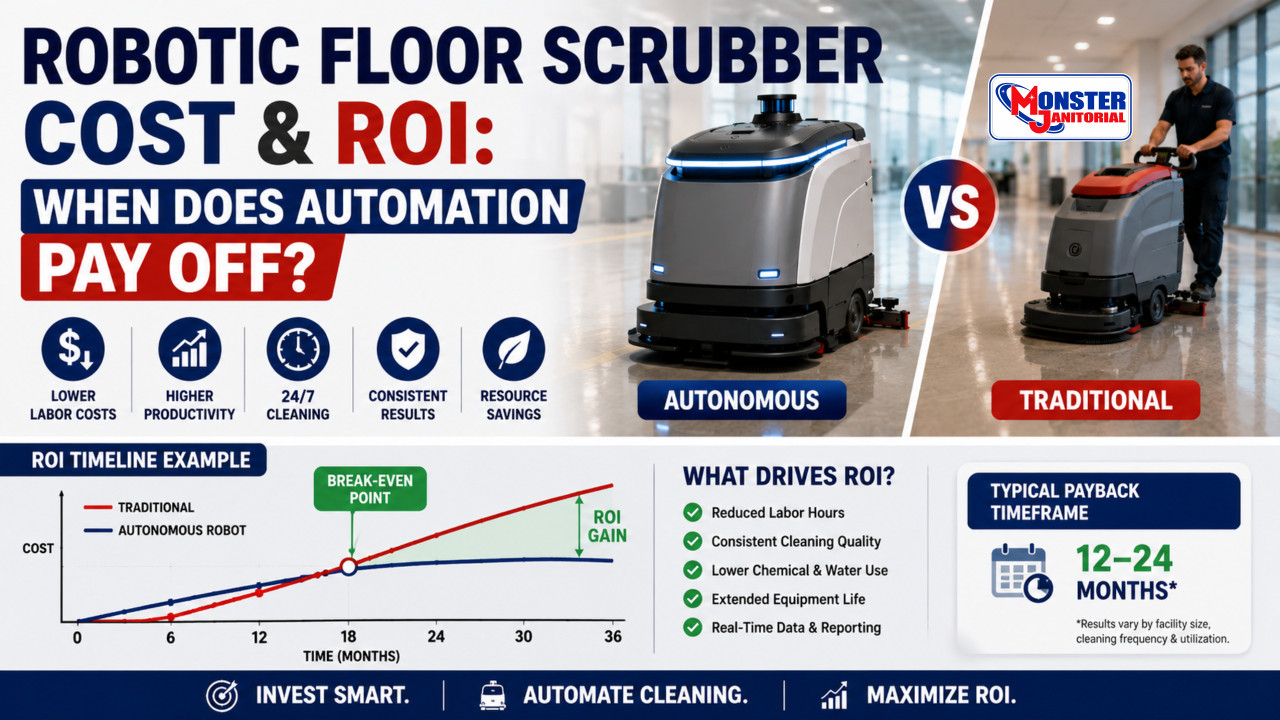
Robotic Floor Scrubber Cost & ROI: When Does Automation Pay Off?
Robotic floor scrubbers usually cost more upfront than traditional auto scrubbers, but the real question is whether the machine can save enough labor, increase productive cleaning hours, and improve utilization to justify that added investment.
ROI varies widely by facility. Labor rates, square footage, route consistency, operating hours, staffing challenges, software costs, maintenance, and how often the robot actually runs all affect the payback period.
When Can a Robotic Floor Scrubber Pay Off?
A robotic floor scrubber is more likely to produce a favorable return when it has enough suitable floor area and enough operating hours to reduce significant hands-on machine-driving time. The strongest opportunities are usually facilities with large, repeatable cleaning routes, high labor costs, staffing shortages, multiple shifts, or employees who can perform other valuable cleaning tasks while the robot operates.
Why Do Robotic Floor Scrubbers Cost More?
A robotic scrubber includes many of the same cleaning components found on a traditional auto scrubber, but it also adds autonomous navigation hardware and software.
LiDAR, cameras, proximity sensors, and other systems may be used to help the machine map and navigate the facility.
Robotic systems may include onboard computing, route-management software, cloud connectivity, and fleet-management tools.
Some systems use autonomous charging docks or more advanced service stations that increase the total system cost.
Upfront Cost vs Total Cost of Ownership
Purchase price alone does not tell you whether robotics is expensive or economical over time. A better comparison includes both the initial investment and the ongoing operating costs.
- Machine purchase price
- Battery and charger costs
- Docking equipment
- Software or connectivity fees
- Maintenance and repairs
- Brushes, pads, squeegees, and other wear parts
- Training and deployment
- Labor required to operate, service, and manage the machine

Total cost of ownership includes more than the machine price. Labor, software, maintenance, batteries, service, and deployment can all affect the final cost.
Labor Savings: Where the ROI Usually Comes From
The biggest financial opportunity with robotic cleaning is usually not lower chemical, water, or pad cost. It is the possibility of reducing the amount of employee time spent continuously driving an auto scrubber.
If an employee can start a robotic cleaning route and then perform restroom cleaning, detail work, trash removal, touch-point cleaning, dusting, or other tasks, the facility may get more productive work from the same labor hours.
The value depends on whether that employee time is actually redirected to useful work. A robot sitting idle does not create labor savings.
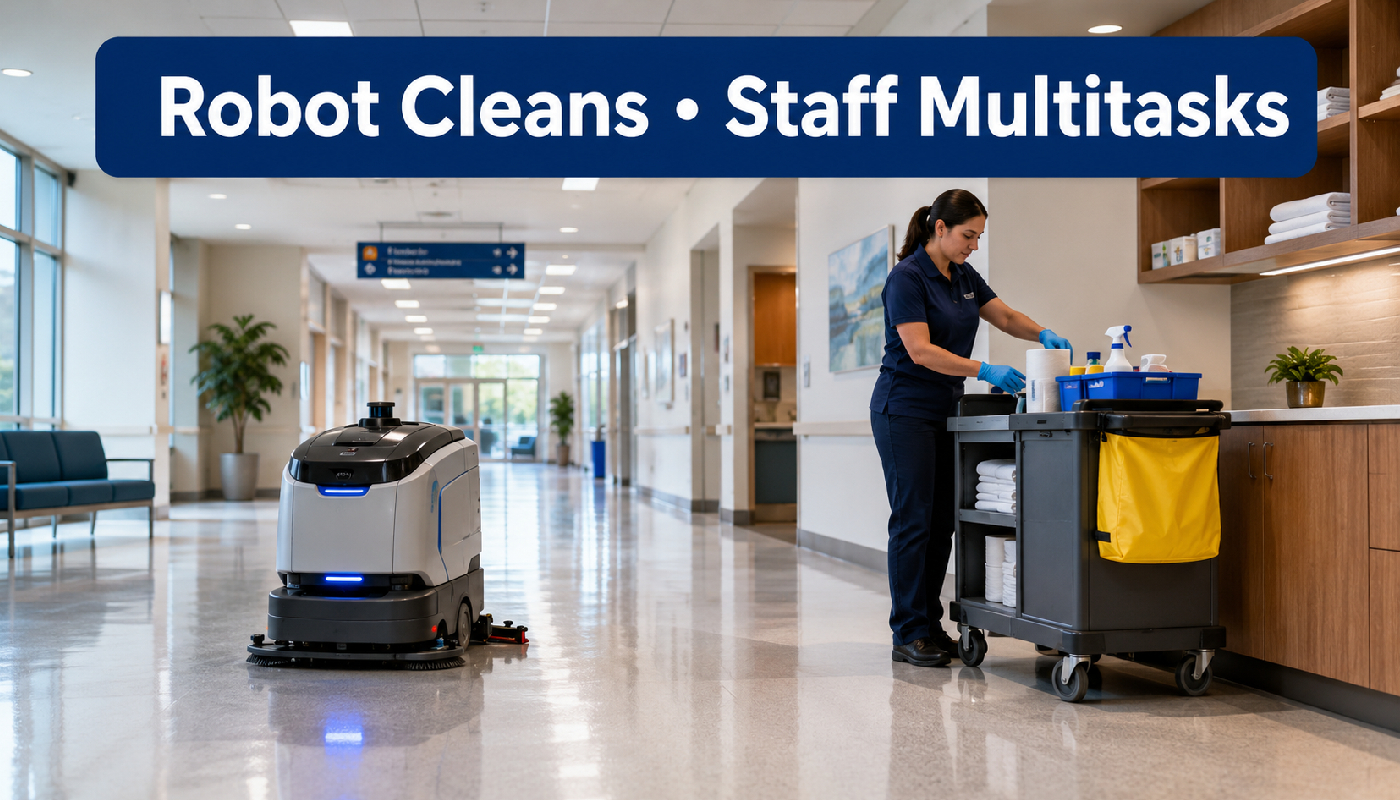
Robotics can create labor value when staff can perform other productive cleaning tasks while the machine completes a route.
How Many Cleaning Hours Matter?
A robotic scrubber generally becomes easier to justify when it can operate for more productive hours each week. A machine used for several large routes across multiple shifts may create far more value than a robot that cleans one small area occasionally.
When comparing systems, estimate how many hours per day the robot can realistically clean rather than relying only on theoretical runtime or maximum productivity ratings.
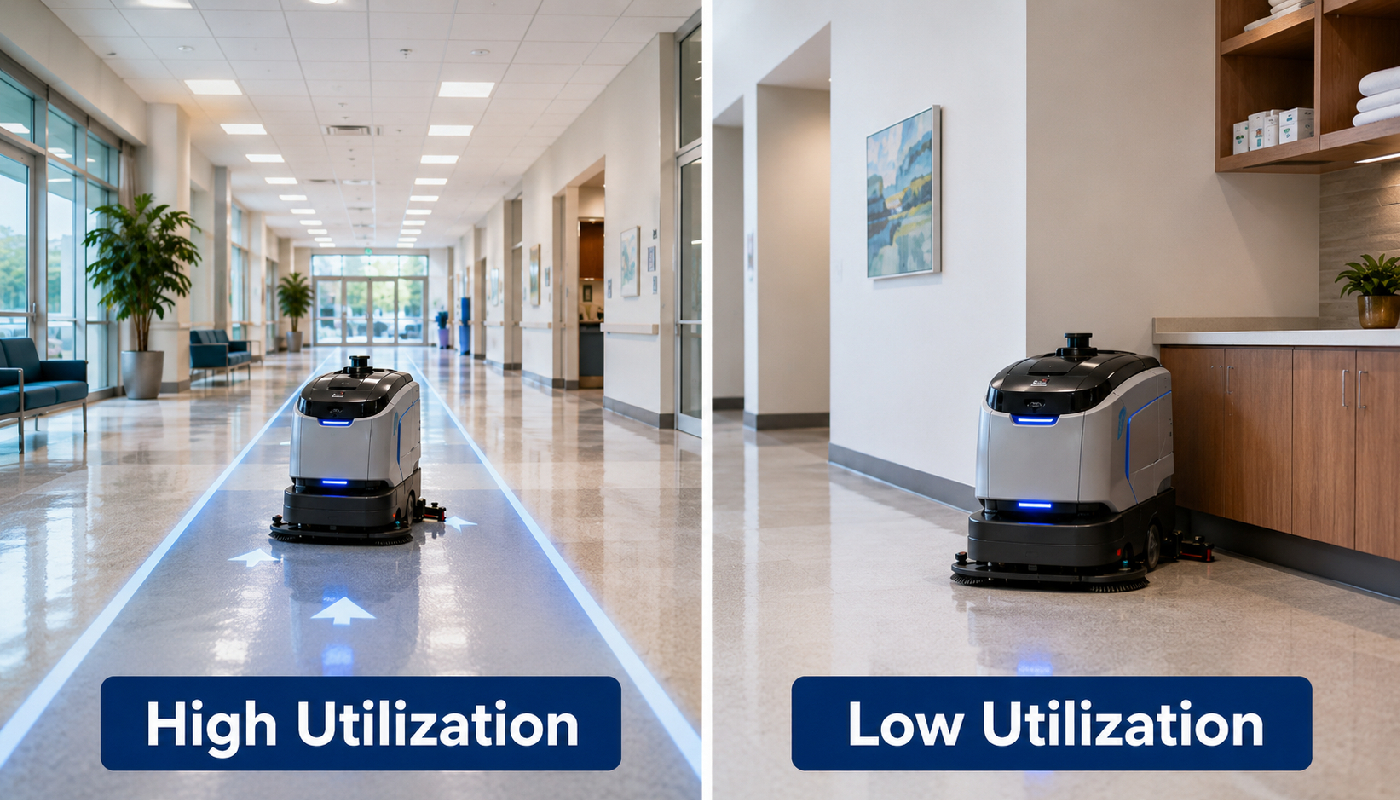
A robot that spends more time completing useful cleaning routes generally has a better opportunity to produce value than one that remains idle.
Square Footage and Route Utilization
Large square footage alone does not guarantee a good robotic application. The floor area also needs to be suitable for autonomous cleaning.
Wide corridors, open areas, predictable warehouse aisles, concourses, large common areas, and repeatable routes can support stronger utilization. Constantly changing, highly cluttered, or difficult-to-access spaces may reduce how much of the facility the robot can clean efficiently.
Software, Connectivity & Fleet Fees
Some robotic platforms may require ongoing software, cloud, connectivity, fleet-management, or service fees. Other systems may bundle some of these services into the equipment purchase or service agreement.
Before calculating ROI, ask exactly which recurring costs apply, what features they support, and whether those costs change based on the number of robots or facilities.
Maintenance, Sensors, Batteries & Docking Costs
Robotic scrubbers still require normal auto-scrubber maintenance, including brushes or pads, squeegees, tanks, vacuum systems, wheels, hoses, batteries, and cleaning components.
They may also require maintenance or support for navigation sensors, cameras, charging contacts, docking equipment, software, or connectivity. These costs should be included when comparing long-term ownership.
Training and Deployment Costs
A traditional auto scrubber can usually be put into service relatively quickly after operator training. Robotics may require additional preparation.
- Facility mapping
- Route setup and testing
- Dock placement
- Connectivity setup where required
- Operator and supervisor training
- Initial route adjustments after real-world use
Robotic vs Traditional Auto Scrubber Cost
The lower-cost machine is not always the lower-cost cleaning solution.
Robotic Floor Scrubber
- Higher upfront investment
- Potential software and connectivity costs
- More complex deployment
- Potential reduction in hands-on driving labor
- Can allow staff to multitask
- ROI depends heavily on utilization
Traditional Auto Scrubber
- Lower upfront purchase cost
- Usually simpler to deploy
- No autonomous navigation system required
- Requires a dedicated operator while cleaning
- Strong flexibility in changing environments
- Labor remains tied directly to machine operation
How to Estimate Robotic Floor Scrubber ROI
A simple estimate can help determine whether the added robotic investment may make financial sense.
This is only an estimate. Actual ROI depends on labor rates, machine pricing, route completion, utilization, maintenance, software fees, staffing, downtime, and other facility-specific costs.

Robotic cleaning usually starts with a higher equipment investment, with potential payback driven largely by labor savings and productive machine utilization over time.
Simple ROI Calculation Example
Imagine a facility estimates that robotics could redirect 20 hours of machine-driving time each week into other productive cleaning work.
If the facility assigns a fully burdened labor value to those hours, it can estimate the annual value of the time redirected. From that amount, subtract software fees, service costs, additional maintenance, and other robotic operating expenses.
The remaining annual benefit can then be compared with the additional investment required to purchase the robotic system instead of a traditional scrubber.
What Can Slow Down Robotic Scrubber ROI?
- Too little suitable floor area
- Robot sits idle for long periods
- Routes are frequently blocked
- Facility layout changes constantly
- Staff still follows the robot continuously
- Frequent route interruptions reduce completion
- Unexpected software or service costs
- The machine is oversized or poorly matched to the facility
What Can Improve ROI?
- Use the robot on multiple suitable routes
- Schedule cleaning during lower-traffic periods
- Redirect staff time to other productive tasks
- Keep routes clear and consistent
- Maintain brushes, pads, squeegees, sensors, and batteries
- Review cleaning reports and route interruptions
- Choose a machine sized correctly for the facility
Facilities That May See Faster Payback
Large Schools & Universities
Long hallways, common areas, gyms, and repeatable routes can support high robotic utilization.
Airports
Large concourses and extended operating schedules may create more available cleaning hours.
Warehouses
Large open floors and stable aisles may support long autonomous routes when traffic and staging are managed.
Healthcare Campuses
Repeatable corridor cleaning may provide an opportunity to redirect staff toward higher-detail cleaning tasks.
Large Retail Facilities
Open areas cleaned during low-traffic hours may provide repeatable robotic cleaning opportunities.
Multi-Building Operations
Organizations with enough suitable routes across multiple facilities may gain more value from connected robotic fleets.
When Robotics May Not Make Financial Sense
A robotic scrubber may be difficult to justify when the facility has only a small amount of scrub-able floor space, routes change constantly, the machine would be used only occasionally, or most cleaning areas require direct operator judgment.
In those situations, a traditional walk-behind or ride-on auto scrubber may provide better value and flexibility.
When a Hybrid Fleet Makes More Sense
Some facilities do not need to replace every traditional scrubber with robotics. A better strategy may be to automate the most repeatable and labor-intensive routes while keeping traditional equipment for flexible work.
Large repeatable routes, corridors, concourses, open floor areas, and predictable cleaning schedules.
Changing environments, spot cleaning, spills, detailed cleanup, heavily soiled areas, and routes that are difficult to automate.
Questions to Ask Before Investing in Robotics
- How many hours per week will the robot realistically clean?
- How much employee time is currently spent driving an auto scrubber?
- What work will staff perform while the robot cleans?
- How much suitable square footage can be automated?
- What are the software, connectivity, and service fees?
- What maintenance is included in the service plan?
- What battery and charging equipment is required?
- How often are routes likely to be interrupted?
- What training and deployment support is included?
- Would one robotic scrubber plus traditional equipment provide a better return than a fully robotic fleet?
Related Robotic Cleaning Guides
Learn more about robotic scrubber selection, facility fit, navigation, deployment, and fleet management.
Robotic Floor Scrubber Cost & ROI
Learn how labor, utilization, ownership cost, maintenance, software, and facility fit affect robotic scrubber payback.
Robotic Floor Scrubber vs Traditional Auto Scrubber
Compare labor, productivity, supervision, route flexibility, cleaning consistency, and ownership considerations.
Read Comparison Guide →Best Robotic Floor Scrubbers by Facility Type
Compare robotic scrubber applications for schools, healthcare, airports, warehouses, retail, and other facilities.
Read Facility Guide →Commercial Cleaning Robot Navigation Explained
Learn how AI, LiDAR, cameras, sensors, mapping, teach-and-repeat routes, and adaptive navigation work.
Robotic Cleaning Fleet Management, Docking & Charging Explained
Learn how fleet dashboards, connected robots, charging, docking, and route resumption can support robotic operations.
What Facility Managers Should Know Before Deploying Robotic Scrubbers
Review routes, obstacles, charging, connectivity, staff training, and facility readiness before deployment.
Read Deployment Guide →Commercial Robotic Cleaning Equipment
Explore autonomous floor scrubbers and other robotic cleaning equipment for commercial facilities.
Shop Robotic Cleaning Equipment →Robotic Floor Scrubber Cost & ROI FAQ
How long does it take for a robotic floor scrubber to pay for itself?
There is no universal payback period. ROI depends on purchase price, labor cost, utilization, suitable floor area, operating hours, software fees, maintenance, and how much employee time is redirected to other productive work.
Is labor savings the main reason to buy a robotic scrubber?
Labor productivity is often one of the biggest financial reasons to consider robotics because employees may be able to perform other cleaning tasks while the machine completes a route.
Do robotic scrubbers have monthly software fees?
Some platforms may have software, cloud, connectivity, fleet-management, or service fees, while others may bundle certain services differently. Confirm recurring costs before calculating ROI.
Does a large building automatically make robotics worthwhile?
No. The floor area must also be suitable for autonomous cleaning. Large but constantly changing or highly cluttered spaces may provide lower utilization than predictable open routes.
Can a facility improve ROI by using one robot with traditional scrubbers?
Yes. A hybrid fleet may provide a strong balance by automating high-volume repeatable routes while keeping traditional equipment for flexible, detailed, or unpredictable cleaning tasks.
Should I calculate ROI before scheduling a robotic scrubber demo?
A preliminary estimate can be useful, but an on-site or facility-specific evaluation can help determine how much of the actual floor plan is suitable for automation and how realistic the utilization assumptions are.
Want to Know Whether Robotics Makes Financial Sense for Your Facility?
Monster Janitorial can help compare robotic floor scrubbers, traditional auto scrubbers, cleaning routes, labor requirements, facility layouts, operating hours, batteries, docking systems, and deployment needs.
Tax-exempt purchasing and purchase-order support are available for qualifying schools, universities, government agencies, municipalities, healthcare facilities, and other institutional customers.
- #auto scrubber ROI
- #autonomous cleaning equipment
- #autonomous floor scrubber cost
- #cleaning automation ROI
- #cleaning productivity
- #commercial cleaning automation
- #commercial floor cleaning equipment
- #facility cleaning automation
- #hybrid cleaning fleet
- #labor savings
- #robotic cleaning equipment
- #robotic cleaning ROI
- #robotic floor cleaning
- #robotic floor scrubber cost
- #robotic floor scrubber ROI
- #robotic scrubber labor savings
- #robotic scrubber maintenance
- #robotic scrubber payback
- #robotic scrubber software costs
- #robotic scrubber total cost of ownership