
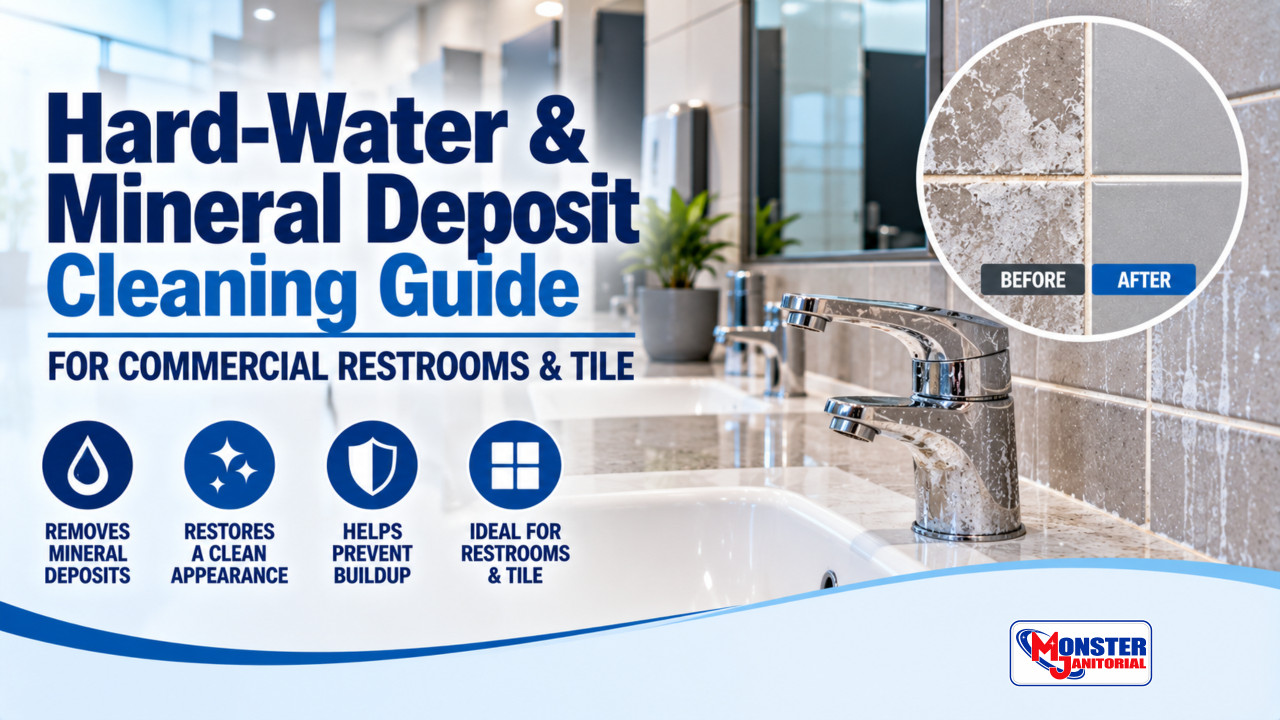
Hard-Water & Mineral Deposit Cleaning Guide for Commercial Restrooms & Tile
White crust, chalky residue, cloudy deposits, and stubborn buildup in commercial restrooms are not always ordinary dirt. Correctly identifying mineral scale, soap residue, routine soil, and grout damage helps you choose the right cleaning chemistry without using stronger products than necessary.
Identify the Buildup Before Choosing the Cleaner
Routine soil, grease, soap residue, and mineral scale can look similar from a distance, but they may require very different chemistry. Do not assume every white or cloudy deposit needs an acidic cleaner.

Routine Soil vs. Mineral Buildup
Routine restroom soil usually includes dust, tracked-in dirt, light spills, body oils, and general traffic contamination. Mineral buildup is different: it develops when water leaves dissolved minerals behind as it evaporates.
Usually responds to an appropriate routine cleaner, proper dilution, agitation, and recovery.
Often appears as white, chalky, crusty, or cloudy residue around wet areas, grout lines, fixtures, and floor edges.

Soap Residue vs. Hard-Water Scale
Soap film and mineral scale can both leave tile looking cloudy, but they are not the same problem.
Where Mineral Buildup Usually Appears
Hard-water deposits tend to develop where water repeatedly splashes, pools, leaks, or evaporates.

Match the Cleaner to the Problem
Cleaning strength should be based on the type of buildup, not simply how dirty the surface looks.
Use a compatible routine cleaner at the correct dilution.
Use chemistry appropriate for oily or soap-based residue and the surface being cleaned.
A compatible acidic or descaling product may be appropriate when the surface and manufacturer permit it.

When Might an Acidic Cleaner Be Needed?
Acidic and descaling cleaners are commonly used for compatible mineral deposits because they can help dissolve alkaline mineral scale. They should not automatically be used for every restroom-cleaning problem.
Acidic Cleaners Are Not Safe for Every Surface
Always verify surface compatibility before using acidic chemistry. Some stone, grout, metals, coatings, finishes, and surrounding materials may be damaged or discolored by an incompatible acid cleaner.
Neutral vs. Alkaline vs. Acidic Cleaner Guide →Mineral Buildup on Tile & Grout
Tile and grout can collect different types of restroom residue at the same time. A floor may have routine soil, soap film, mineral scale, and stained grout in the same area.
Confirm the tile material before choosing stronger chemistry.
Porous or damaged grout can hold soil and buildup differently than the tile.
These areas commonly show visible mineral deposits because water repeatedly dries there.
Clean vs. Stained vs. Damaged Grout
Not every dark or discolored grout line can be restored with stronger cleaner.

Basic Mineral Deposit Cleaning Workflow
Do Not Automatically Make the Cleaner Stronger
Using more concentrate than directed can increase residue, chemical exposure, surface risk, and cost. Follow the product label for dilution, dwell time, application method, and rinsing requirements.
Commercial Cleaner Dilution Guide →Hard-Water & Mineral Cleaning Mistakes to Avoid
- Assuming every white residue is mineral scale.
- Using acidic chemistry on a surface without checking compatibility.
- Using stronger concentrate than the label recommends.
- Expecting cleaning chemicals to repair cracked or deteriorated grout.
- Skipping dwell time when the product requires it.
- Allowing loosened mineral residue to dry back onto the surface.
- Failing to rinse or recover chemical residue when required.
- Mixing restroom cleaning chemicals together.
Hard-Water & Mineral Deposit FAQ
They form when water containing dissolved minerals evaporates and leaves mineral residue behind.
No. Soap residue, cleaning chemical residue, grout haze, and other deposits can also appear white or cloudy.
Not always. Acidic or descaling chemistry may be appropriate for compatible mineral scale, but surface compatibility and product instructions should determine the cleaning method.
Some tile, stone, grout, metals, coatings, and surrounding materials can be damaged by incompatible acidic chemistry.
If hard water continues to splash or dry on the surface, new mineral deposits can form after cleaning.
No. Some discoloration can remain after removable soil is gone, and damaged grout may require repair rather than additional cleaning.
Commercial Restroom, Tile & Floor Cleaning Chemicals
Browse commercial restroom cleaners, floor-care chemistry, and specialty cleaning products for professional facilities.
How to Choose a Commercial Floor Cleaner
Learn the difference between neutral, alkaline, and acidic cleaners and how to match chemistry to the soil and surface.
Neutral vs. Alkaline vs. Acidic Cleaners →Need Help Choosing a Restroom or Tile Cleaner?
Tell Monster Janitorial what surface you are cleaning and what the buildup looks like. We can help you compare commercial cleaners for routine soil, soap residue, mineral buildup, and other restroom cleaning problems.
Always follow the chemical manufacturer's label, dilution instructions, surface-compatibility guidance, and Safety Data Sheet. Never mix cleaning chemicals, and verify compatibility before using acidic or descaling products on tile, grout, stone, metals, coatings, or nearby surfaces.