
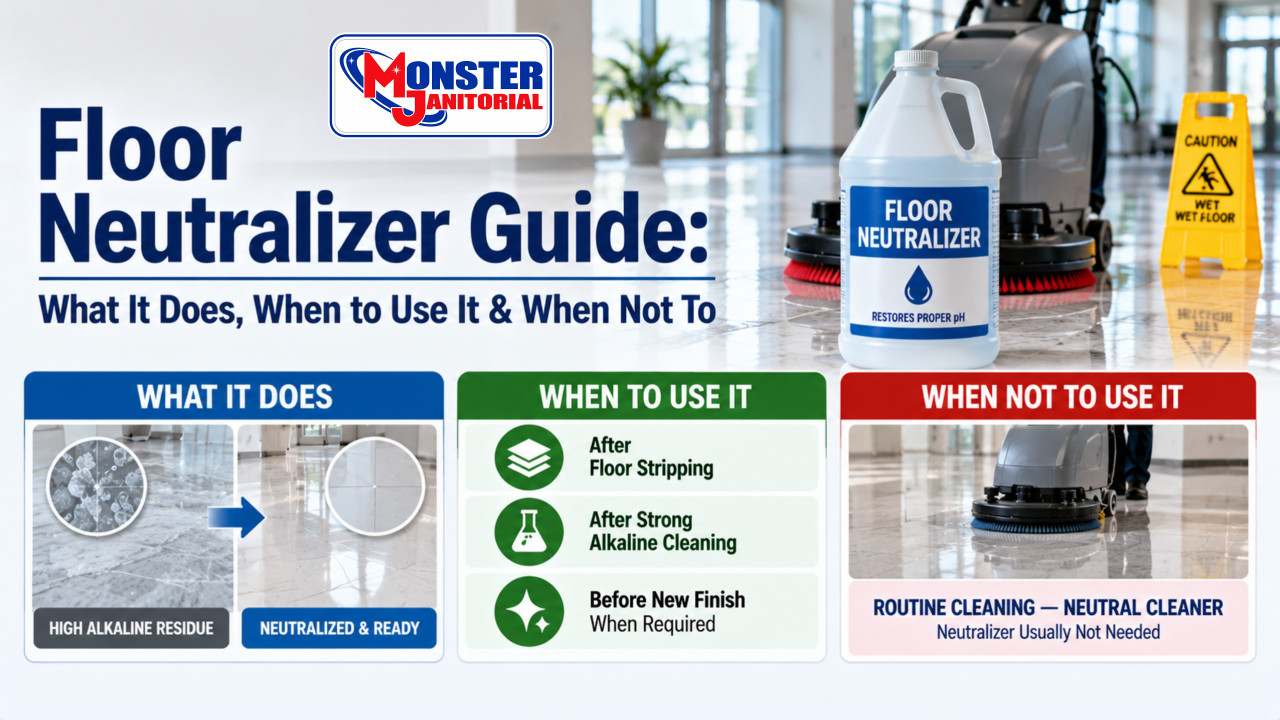
Floor Neutralizer Guide: What It Does, When to Use It & When Not To
Floor neutralizer is a specialty chemical used in certain floor-care processes to help address alkaline residue after stripping or strong alkaline cleaning. It is not the same as a neutral cleaner and is not normally required for everyday floor maintenance.
A Floor Neutralizer Is Not a Daily Cleaner
Use a neutralizer only when the cleaning process, floor-care system, or product instructions call for it. Routine soil is normally handled with an appropriate cleaner rather than a neutralizing product.
What Does a Floor Neutralizer Do?
After floor stripping or strong alkaline cleaning, residue can remain on the surface if the process is not completed correctly. A floor neutralizer is designed to help reduce or correct alkaline residue when required by the floor-care procedure.


When Should You Use a Floor Neutralizer?
Neutralizer is most commonly associated with heavy floor-care procedures where alkaline chemistry has been used and the surface must be properly prepared for the next step.
Why Neutralizer May Be Used After Floor Stripping
Floor strippers are designed to break down old finish and can use strong alkaline chemistry. After the finish and stripping slurry are removed, the floor must be prepared according to the stripper and new-finish instructions.
Remove spent stripper, dissolved finish, and dirty solution completely.
Use the rinsing and neutralizing procedure specified for the chemical system.
Allow the floor to dry and confirm it is properly prepared before applying new finish.
After Strong Alkaline Cleaning
Strong alkaline cleaners and degreasers can be useful for appropriate heavy-soil applications, but they are different from routine neutral cleaners. If the floor-care procedure requires neutralizing after heavy alkaline cleaning, complete that step before returning the floor to normal maintenance or applying finish.
Neutral Cleaner vs. Degreaser Guide →Floor Neutralizer vs. Neutral Cleaner
The similar names can cause confusion, but these products serve different purposes.


When Is a Floor Neutralizer Usually Not Needed?
Routine daily cleaning generally does not require a floor neutralizer. If the floor has normal traffic soil, use a compatible routine cleaner according to the floor and chemical manufacturer's instructions.
Floor Neutralizer vs. Rinse Water
Rinsing removes loosened soil and chemical residue from the floor. Neutralizer has a more specific role and should only be added when the floor-care procedure calls for it. Do not assume that adding neutralizer eliminates the need for proper recovery and rinsing.
Helps remove remaining cleaning solution, loosened soil, and residue from the floor.
Used when the procedure specifically requires correction of alkaline residue or floor preparation.
Why Correct Neutralizer Dilution Matters
Floor neutralizers are concentrates and should be mixed exactly according to the product label. Using more than recommended does not automatically improve the result and may leave unnecessary chemical residue on the floor.
Commercial Floor Cleaner Dilution Guide →Can Too Much Floor Neutralizer Cause Problems?
Yes. Overusing any floor-care chemical can leave residue or interfere with the intended cleaning and preparation process. Measure carefully, follow the label, recover the solution completely, and complete any required rinsing before the floor dries.
Does Every Floor Use Neutralizer the Same Way?
No. The correct floor-care process depends on the floor material, finish, coating, sealer, and chemical system being used. Always verify that neutralizing is appropriate before adding it to the process.
Neutralizer is most commonly associated with traditional stripping and refinishing procedures on finished resilient floors.
Follow the flooring manufacturer's maintenance instructions before using strong chemistry or neutralizing products.
Cleaning chemistry depends on whether the problem is routine soil, grease, soap residue, or mineral buildup.
Bare, polished, sealed, and coated concrete can require very different maintenance procedures.
Verify compatibility with the coating manufacturer before using strong alkaline chemistry or neutralizer.
Natural stone can be sensitive to certain chemistries and should be cleaned with products compatible with the stone type.
Typical Neutralizing Workflow
Floor Neutralizer Mistakes to Avoid
- Using neutralizer for routine daily cleaning.
- Assuming every floor-stripping product requires the same neutralizing process.
- Using more neutralizer than the label recommends.
- Failing to recover stripping slurry before the rinse or neutralizing step.
- Treating neutralizer as a replacement for proper rinsing.
- Applying new finish before the floor is fully prepared and dry.
- Using strong chemistry on an incompatible floor or coating.
- Ignoring the chemical and floor manufacturer's instructions.
Floor Neutralizer FAQ
It is used in certain floor-care procedures to help address alkaline residue after stripping or strong alkaline cleaning.
Not necessarily. Follow the specific floor stripper, finish, and flooring manufacturer's preparation instructions.
No. Neutral cleaner is intended for routine cleaning, while neutralizer is used for specific floor-preparation and residue-control procedures.
Only if the neutralizer and equipment manufacturers allow that application and the floor-care procedure calls for it.
No. Proper recovery and rinsing remain important parts of the floor-care process.
Usually no. Routine soil is generally cleaned with an appropriate daily or neutral floor cleaner.
Floor Neutralizers, Maintainers & Floor Care Chemicals
Browse commercial floor neutralizers, maintainers, cleaners, floor strippers, and floor finishes for professional floor-care programs.
Choosing the Right Floor Cleaner
Learn how neutral, alkaline, and acidic commercial floor cleaners differ and how soil type affects chemical selection.
Neutral vs. Alkaline vs. Acidic Cleaners →Need Help Choosing a Floor Neutralizer?
Tell Monster Janitorial what floor you are working on, what stripper or cleaning chemical you used, and whether you are preparing the floor for new finish. We can help you compare commercial floor-care chemistry.
Always follow the chemical manufacturer's label, dilution instructions, floor-compatibility guidance, and Safety Data Sheet. Follow the flooring, stripper, and floor-finish manufacturer's preparation instructions before applying new finish.
- #after floor stripping
- #alkaline residue
- #commercial cleaning chemicals
- #commercial floor care chemicals
- #commercial floor cleaning chemicals
- #commercial floor neutralizer
- #concrete floor care
- #epoxy floor care
- #floor care chemistry
- #floor finish compatibility
- #floor finish preparation
- #floor maintenance chemicals
- #floor neutralizer
- #floor neutralizer dilution
- #floor neutralizer guide
- #floor neutralizer vs neutral cleaner
- #floor neutralizing process
- #floor prep chemicals
- #floor stripper rinse
- #floor stripping chemicals
- #floor stripping neutralizer
- #floor stripping rinse process
- #high alkaline residue
- #LVT floor care
- #MJ University
- #natural stone floor care
- #neutralizer dilution
- #neutralizer vs neutral cleaner
- #tile and grout cleaning
- #VCT floor care