
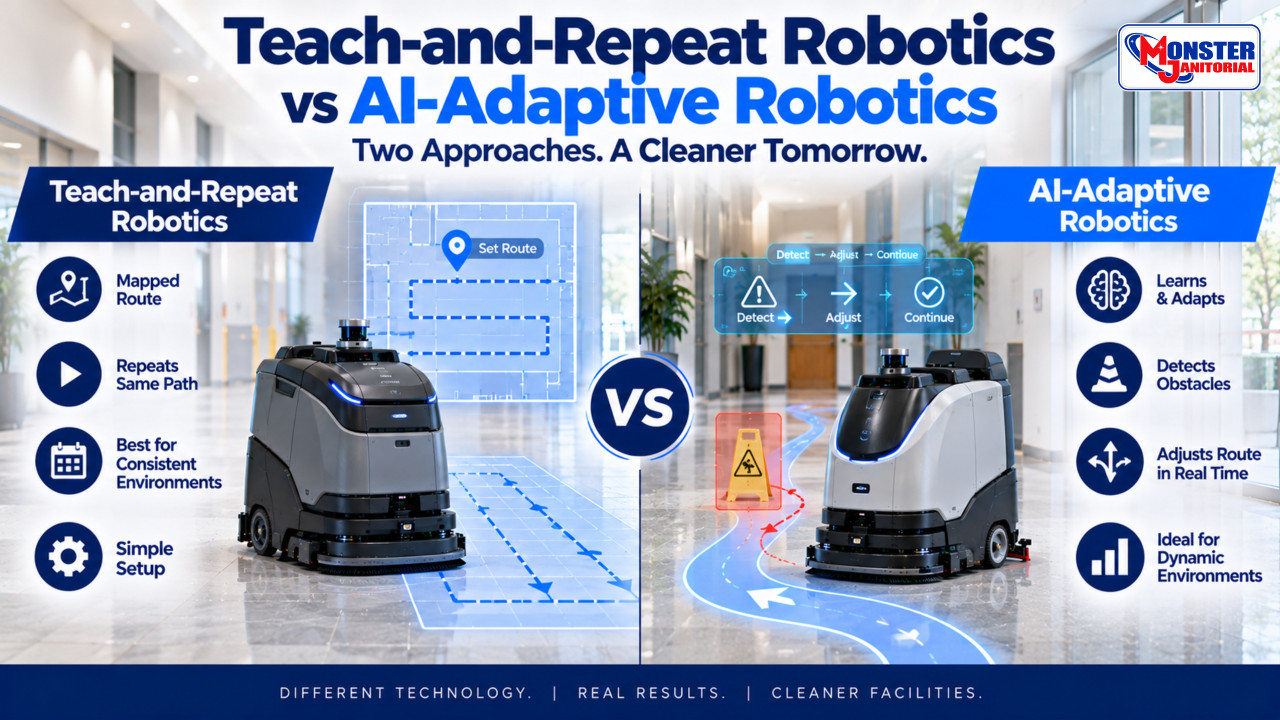
Teach-and-Repeat Robotics vs AI-Adaptive Robotics
Commercial cleaning robots can use very different approaches to autonomous navigation. Some rely primarily on a taught, repeatable cleaning route, while others use more adaptive sensing and software to respond to changing surroundings.
Neither approach is automatically better. The right fit depends on how predictable your facility is, how often obstacles change, when cleaning occurs, and how much flexibility the robot needs.
What Is the Main Difference?
Teach-and-repeat robotics follows a route that was previously taught or mapped and is strongest when the environment remains fairly predictable. AI-adaptive robotics uses more advanced sensing and software to make navigation decisions as conditions change. The better choice depends on the facility rather than the technology label alone.
Teach-and-Repeat vs AI-Adaptive
Teach-and-Repeat Robotics
Best suited to facilities where routes, layouts, and traffic patterns remain relatively consistent from one cleaning cycle to the next.
AI-Adaptive Robotics
Better suited to environments where people, carts, furniture, temporary obstacles, or traffic conditions can change throughout the cleaning period.
How Teach-and-Repeat Robotics Works
In a teach-and-repeat workflow, an operator establishes a cleaning route and the robotic system records the path or associated navigation information. The machine can then repeat that assigned route during future autonomous cleaning cycles.
Teach the Route
An operator establishes the intended cleaning path.
Store the Route
The system saves route and navigation information for autonomous use.
Repeat the Route
The machine follows the assigned cleaning route during later cycles.
Strengths of Teach-and-Repeat
- Predictable route behavior
- Strong fit for repetitive cleaning
- Well suited to structured facilities
- Useful for scheduled or lower-traffic cleaning
- Can be straightforward to deploy on stable routes
Where Teach-and-Repeat Can Struggle
- Frequent layout changes
- Temporary obstacles blocking the route
- Heavy or unpredictable pedestrian traffic
- Furniture, pallets, displays, or carts moving regularly
- Route changes that may require adjustment or retraining
Where Teach-and-Repeat Robotics Makes Sense
Examples of Structured Autonomous Cleaning Equipment
How AI-Adaptive Robotics Works
AI-adaptive systems use onboard sensors and navigation software to analyze surroundings while the machine operates. Depending on the platform, this can include LiDAR, cameras, additional proximity sensors, mapping systems, and software that helps the robot respond to temporary obstacles or changing conditions.
Sense
The robot monitors its surroundings.
Evaluate
Software analyzes obstacles and available space.
Respond
The machine stops, waits, or reroutes as appropriate.
Continue
Cleaning continues when a usable route remains available.
Strengths of AI-Adaptive Robotics
- More flexible around temporary obstacles
- Better suited to changing environments
- Can support busier public spaces
- More responsive to variable traffic conditions
- Can combine multiple sensing technologies
AI-Adaptive Systems May Also Require
- More advanced robotics hardware and software
- Additional deployment and staff training
- Connectivity depending on the platform
- Potential software or service costs
- Higher upfront equipment investment on some systems
Where AI-Adaptive Robotics Makes Sense
AI-Adaptive Robotic Cleaning Equipment
TASKI Ecobot 50 Pro
Autonomous floor scrubber using OMNIE AI and 3D LiDAR navigation.
View Ecobot 50 Pro →TASKI Ecobot 40
Autonomous vacuum sweeper designed for commercial debris pickup and robotic navigation.
View Ecobot 40 →TASKI Phantas 1.2
Compact robotic cleaning platform designed for smaller and more active commercial spaces.
View Phantas 1.2 →Teach-and-Repeat vs AI-Adaptive Robotics
Actual capabilities vary by manufacturer and model, but these differences can help frame the selection process.
| Comparison Area | Teach-and-Repeat | AI-Adaptive |
|---|---|---|
| Route Style | Primarily follows an established route | Can respond more dynamically during navigation |
| Best Layout | Stable and predictable | More variable or active |
| Temporary Obstacles | May stop, wait, or require route adjustment depending on system | Often designed for more advanced obstacle response and rerouting |
| Traffic Conditions | Best when traffic is predictable | Better suited to more variable traffic |
| Typical Use Case | Structured repeatable routes | Dynamic public environments |
| Deployment Complexity | Can be simpler on stable routes | May involve more advanced setup, software, or connectivity |
Which Robotics Approach Should You Choose?
Consider Teach-and-Repeat If:
- Your layout rarely changes
- Routes are highly repeatable
- Cleaning occurs during quieter periods
- Obstacles are relatively predictable
- You want structured autonomous route cleaning
Consider AI-Adaptive If:
- People and obstacles move frequently
- Your environment changes during the day
- Public traffic is significant
- More flexible obstacle response is important
- You need autonomous operation in more dynamic spaces
Robotics Technology Is Not Always Either/Or
Modern robotic cleaning systems can combine characteristics of multiple navigation approaches. A machine may use a taught or mapped route while also using advanced sensors, obstacle detection, localization, or rerouting capabilities. Compare the actual capabilities of the specific machine instead of relying only on a category label.
Learn More About Robotic Cleaning
Explore robotic cleaning guides covering navigation, deployment, fleet management, maintenance, troubleshooting, ROI, docking, and autonomous cleaning technology.
Explore MJ University →Not Sure Which Robotics Approach Fits Your Facility?
Monster Janitorial can help compare autonomous cleaning systems based on facility layout, traffic, cleaning routes, obstacles, operating schedule, docking requirements, and long-term automation goals.