
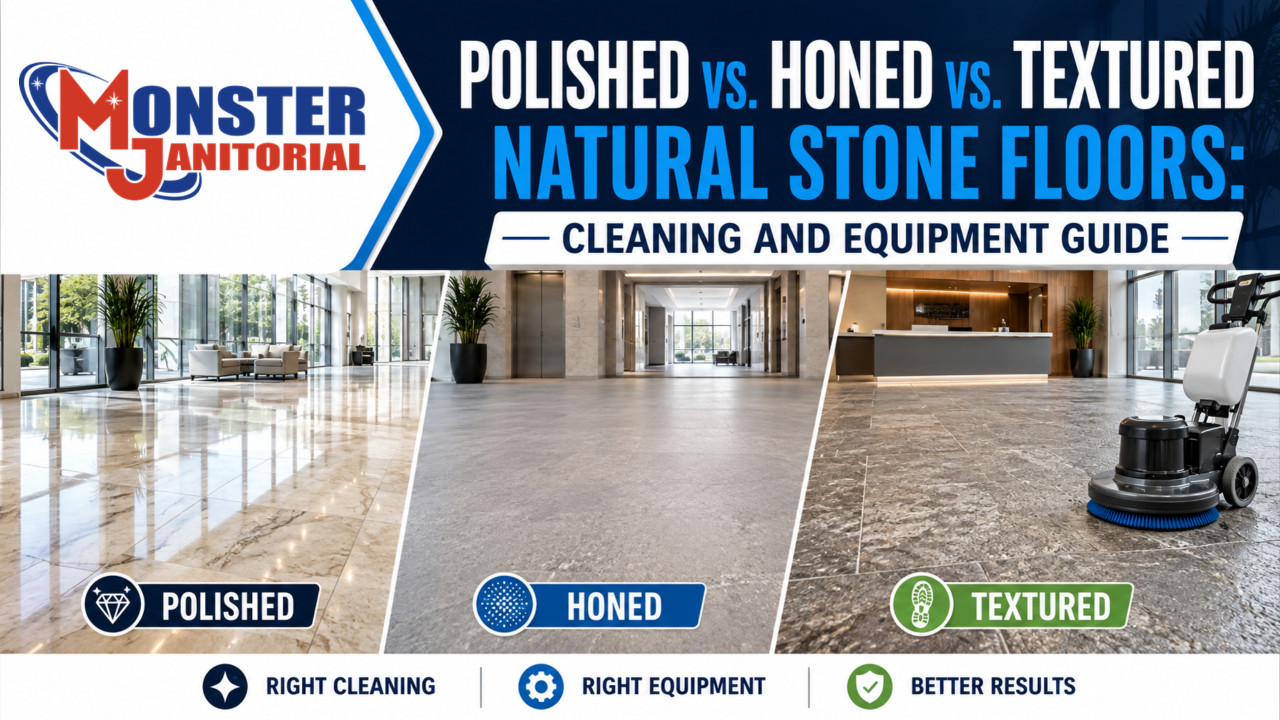
Polished vs. Honed vs. Textured Natural Stone Floors
Natural stone floors may be made from the same material but behave very differently depending on whether the surface is polished, honed, brushed, flamed, tumbled, sandblasted, or naturally cleft.
The surface finish affects appearance, traction, soil retention, chemical sensitivity, pad selection, brush selection, water recovery, equipment choice, and the maintenance process required to preserve the floor.
Polished stone needs the gentlest process, honed stone allows slightly more cleaning flexibility, and textured stone usually requires brushes instead of flat pads.
Use soft pads and strong dry-soil control on polished stone, controlled neutral cleaning on honed stone, and soft cylindrical or nylon brushes on textured surfaces. Always identify the stone, finish, sealer, and damage before selecting equipment.
How Polished, Honed, and Textured Stone Differ
Surface finish changes how the floor reflects light, holds soil, responds to cleaning, and wears under traffic.
Polished Stone
Polished stone has a smooth, reflective surface that emphasizes color, veining, and depth. It is common in commercial lobbies, hotels, offices, retail spaces, and high-end public areas.
- High light reflection
- Smooth surface texture
- Shows scratches and etching easily
- Requires excellent grit control
- Can become slippery when wet
Honed Stone
Honed stone has a smooth but low-gloss or matte appearance. It provides a softer visual finish and may hide minor scratching better than highly polished stone.
- Low or moderate reflection
- Smooth satin or matte finish
- May show oils and dark staining
- Allows controlled pad cleaning
- Common in busy commercial areas
Textured Stone
Textured stone may be flamed, brushed, sandblasted, tumbled, split-face, or naturally cleft. Its uneven surface improves traction but can hold more soil and moisture.
- Low light reflection
- Raised and recessed texture
- Holds soil in surface irregularities
- Often needs brush agitation
- Requires strong water recovery
How to Identify the Surface Finish
Do not rely on color alone. Inspect the reflection, texture, wear pattern, edges, corners, and less-trafficked areas.
Read: How to Identify Commercial Stone Floors Before Cleaning →
Cleaning Polished Marble, Granite, Limestone, and Travertine
Polished stone requires careful dry-soil removal, neutral chemistry, soft pads, controlled water use, and complete recovery. Fine sand and grit can create visible scratches when trapped beneath pads, wheels, or shoes.
Recommended Cleaning Process
- Vacuum or dust-mop loose grit.
- Inspect pads, wheels, and squeegees.
- Apply a properly diluted neutral cleaner.
- Use a white or microfiber pad.
- Use the lowest effective pressure.
- Recover all solution immediately.
- Inspect the floor after drying.
Main Risks
- Scratching from trapped grit
- Etching from acidic chemistry
- Haze from residue or dirty water
- Swirl marks from aggressive pads
- Slippery conditions from poor recovery
- Uneven gloss from incorrect diamond use
Cleaning Honed Marble, Limestone, Travertine, and Granite
Honed stone is smoother than textured stone but less reflective than polished stone. It may hide fine scratches better, but oils, spills, and absorbed staining may be more visible.
Recommended Cleaning Process
- Remove loose soil and debris.
- Use a neutral stone-compatible cleaner.
- Begin with a white or microfiber pad.
- Use an approved red pad only when needed.
- Allow controlled dwell time.
- Recover dirty solution completely.
- Rinse when the chemical label requires it.
Main Risks
- Darkening from oils and absorbed soil
- Uneven appearance from residue
- Creating shiny areas with aggressive polishing
- Changing the intended matte finish
- Over-wetting porous stone
- Damage from acidic or alkaline cleaners
Cleaning Slate, Flamed Granite, Brushed Limestone, and Textured Travertine
Textured stone normally requires brush agitation because flat pads may ride across high points while leaving soil in pits, grooves, clefts, grout lines, and recessed areas.
Recommended Cleaning Process
- Vacuum loose debris and sand.
- Apply compatible cleaning solution.
- Allow controlled dwell time.
- Agitate with a soft nylon or cylindrical brush.
- Use detail brushes along edges and grout.
- Recover water from recessed areas.
- Complete additional recovery passes when needed.
Main Risks
- Soil remaining in recessed texture
- Dirty water drying in pits and grout lines
- Over-wetting porous stone
- Using overly stiff or abrasive brushes
- Incomplete water recovery
- Residue buildup from excessive chemical use
Cleaning Chemicals by Stone Finish
Surface finish affects how visible residue, streaking, darkening, and chemical damage may become, but the underlying stone type remains equally important.
Polished Stone
- Neutral pH cleaner
- Low-foam auto-scrubber cleaner
- Accurate dilution
- Minimal residue
- No acidic restroom cleaner
Honed Stone
- Neutral pH cleaner
- Low-foam machine cleaner
- Approved stone degreaser when needed
- Complete soil recovery
- Controlled rinsing
Textured Stone
- Neutral or approved alkaline cleaner
- Controlled dwell time
- Low-foam chemistry
- Thorough agitation
- Complete rinse-water recovery
Pads and Brushes by Surface Finish
Pad colors vary by manufacturer. Always verify the product label, stone compatibility, machine speed, pressure, and intended use.
- White cleaning pads
- Microfiber pads
- Soft approved polishing pads
- Fine verified diamond pads
- Avoid aggressive stripping pads
- White cleaning pads
- Microfiber pads
- Approved red pads
- Fine nylon brushes
- Avoid changing the intended finish
- Soft nylon brushes
- Cylindrical brushes
- Detail and grout brushes
- Soft grit brushes when approved
- Avoid flat pads that skip recesses
Equipment by Natural Stone Finish
Choose the machine according to the surface finish and cleaning goal—not simply the size of the floor.
Recommended Equipment for Polished Stone
Prioritize dry grit removal, soft pad contact, controlled solution flow, and immediate water recovery.
Recommended Equipment for Honed Stone
Use controlled pad agitation without unintentionally polishing or changing the intended matte appearance.
Recommended Equipment for Textured Stone
Use brushes that reach into surface texture and recovery equipment that removes water from recessed areas.
Match the Finish to the Cleaning Process
Common Cleaning Mistakes by Surface Finish
When Cleaning Will Not Correct the Appearance
Cleaning removes soil and residue. Honing, polishing, and restoration mechanically change the stone surface.
Natural Stone Floor Care Learning Library
Continue learning about commercial marble, granite, limestone, travertine, polished stone, honed stone, textured stone, cleaning chemicals, equipment, pads, sealing, troubleshooting, and restoration.
Identify the Stone & Finish
Cleaning Equipment, Chemicals & Pads
Diamond Pad & Stone Maintenance Guides
Problems, Restoration & Protection
Related Commercial Floor-Care Guides
Need help with a natural stone floor? Contact Monster Janitorial at sales@monsterjanitorial.com or 956-772-4842.
Natural Stone Finish FAQs
Is polished stone harder to maintain than honed stone?
Polished stone often requires more careful grit control because fine scratches, etching, haze, and uneven gloss are easier to see on a reflective surface.
Can the same floor pad be used on polished and honed stone?
Sometimes, but the pad must be approved for both surfaces. Honed stone may tolerate slightly more agitation, while polished stone normally requires the softest effective pad.
Why are brushes better for textured stone?
Brush bristles can reach into grooves, pits, grout lines, and recessed texture that a flat pad may pass over.
Can a honed floor be made polished?
Yes, but that is a restoration process rather than routine cleaning. The stone normally requires a controlled honing and polishing sequence.
Can an auto scrubber be used on every natural stone finish?
Auto scrubbers may be used on many compatible stone floors, but the deck, pad or brush, pressure, cleaner, solution flow, and recovery system must match the finish.
Need Help Identifying or Cleaning a Natural Stone Finish?
Monster Janitorial can help compare cleaning chemicals, auto scrubbers, low-speed machines, orbital machines, cylindrical scrubbers, wet vacuums, pads, brushes, and detail tools for polished, honed, and textured commercial stone floors.