null
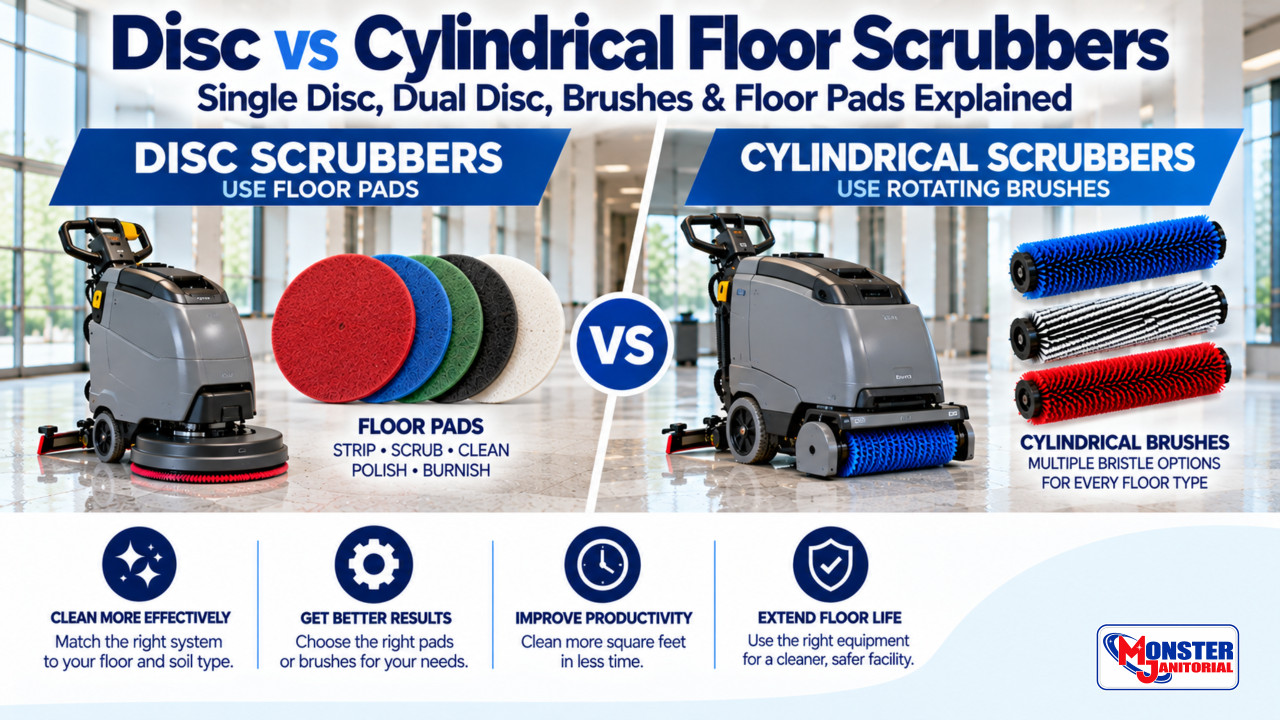
Disc vs Cylindrical Floor Scrubbers: Single Disc, Dual Disc, Brushes & Floor Pads Explained

Disc vs Cylindrical Floor Scrubbers: Single Disc, Dual Disc, Brushes & Floor Pads Explained

Posted by Monster Janitorial Sales Team on Mar 15, 2026

Choosing the right automatic floor scrubber requires more than selecting a machine size. The scrub deck, number of discs, brush or pad setup, floor texture, debris level, and cleaning goals all affect performance.

A disc scrubber may be the best choice for routine cleaning on smooth finished floors, while a cylindrical scrubber may perform better in facilities with textured surfaces, grout lines, sand, or light debris. Within the disc category, buyers must also choose between single-disc and dual-disc machines and decide whether brushes or floor pads are best for the floor.

This guide explains each scrubber-deck system and helps schools, healthcare facilities, warehouses, retail stores, government buildings, and commercial cleaning teams choose the correct setup.

Quick Answer: Choose a disc scrubber for general cleaning, smooth finished floors, pad flexibility, and routine maintenance. Choose a cylindrical scrubber for textured floors, grout lines, sand, grit, and light debris pickup. Choose a single-disc scrubber for tighter spaces and lower cost, or a dual-disc scrubber for wider cleaning paths and higher productivity.

What Is a Floor Scrubber Deck?

The scrub deck is the section underneath the machine that holds the brushes, pad drivers, or cylindrical rollers. It applies mechanical agitation to the floor while the machine dispenses cleaning solution.

The main scrubber-deck categories are:

  • Single-disc decks
  • Dual-disc decks
  • Cylindrical roller-brush decks
  • Orbital or rectangular decks

This guide focuses primarily on disc and cylindrical systems, including the brush and pad choices used with disc scrubbers.

Scrubber Cleaning Systems at a Glance

Cleaning Need Recommended Setup
Smooth finished VCT Disc scrubber with floor pads
Routine daily maintenance Single- or dual-disc scrubber with compatible pads
Tight rooms and narrow aisles Compact single-disc scrubber
Large open floor areas Dual-disc scrubber
Textured or uneven floors Disc brushes or cylindrical brushes
Grout lines Brush-equipped disc deck or cylindrical system
Sand and small debris Cylindrical scrubber
Heavy debris Dedicated floor sweeper before scrubbing
Appearance-focused maintenance Disc deck with pads and pad drivers

What Is a Disc Floor Scrubber?

A disc floor scrubber uses one or more circular brushes or pad drivers. The discs rotate flat against the floor, creating consistent surface contact.

Disc scrubbers are the most common automatic scrubbers in schools, hospitals, retail stores, offices, government buildings, and other facilities with smooth hard floors.

Advantages of Disc Scrubbers

  • Excellent for routine hard-floor cleaning
  • Compatible with many floor pads and brush types
  • Strong surface contact on smooth floors
  • Good for finished VCT, tile, terrazzo, and sealed concrete
  • Simple and familiar maintenance
  • Available in compact, walk-behind, stand-on, and ride-on configurations

Common Disc-Scrubber Applications

  • Schools and universities
  • Healthcare facilities
  • Retail stores
  • Office buildings
  • Government facilities
  • Hotels and hospitality spaces
  • Finished commercial flooring

What Is a Cylindrical Floor Scrubber?

A cylindrical floor scrubber uses long roller brushes that rotate horizontally. Many systems use two counter-rotating brushes that scrub the floor while directing light debris into a collection tray.

This design can reduce pre-sweeping in facilities with small debris, sand, grit, or packaging material.

Advantages of Cylindrical Scrubbers

  • Scrubs and collects light debris in one pass
  • Provides strong agitation on textured floors
  • Can reach into grout lines and surface irregularities
  • Useful where sand and grit are common
  • May reduce pre-sweeping in some facilities
  • Strong fit for warehouses, cafeterias, manufacturing, and industrial spaces

Important: A cylindrical scrubber can collect light debris, but it is not a replacement for a dedicated floor sweeper in areas with heavy litter, large debris, pallets, packaging waste, or large amounts of dust.

Disc vs Cylindrical Floor Scrubbers

Feature Disc Scrubber Cylindrical Scrubber
Cleaning System Circular pads or brushes Horizontal roller brushes
Best Floor Type Smooth and finished floors Textured, uneven, or debris-prone floors
Debris Pickup Usually requires pre-sweeping Collects some light debris
Pad Compatibility Wide selection of pads and brushes Uses cylindrical roller brushes
Grout Cleaning Good with the correct brush Often very effective
Common Facilities Schools, healthcare, offices, retail Warehouses, cafeterias, manufacturing, industrial areas
Maintenance Simple pad or brush replacement Brushes and debris tray require cleaning

What Is a Single-Disc Floor Scrubber?

A single-disc scrubber uses one circular brush or pad driver. These machines are typically more compact and maneuverable than dual-disc machines.

Compact Design

Fits classrooms, restrooms, offices, retail aisles, and smaller storage spaces.

Easy Maneuverability

Turns more easily around furniture, fixtures, walls, and narrow corridors.

Lower Initial Cost

Often costs less than a larger dual-disc machine.

Best Uses for Single-Disc Scrubbers

  • Classrooms
  • Restrooms
  • Small healthcare areas
  • Retail aisles
  • Offices
  • Restaurants
  • Tight hallways
  • Smaller cleaning routes

What Is a Dual-Disc Floor Scrubber?

A dual-disc scrubber uses two circular brushes or pad drivers. The wider deck covers more floor with each pass and can reduce total cleaning time.

Wider Cleaning Path

Covers more floor per pass in long hallways and open spaces.

Higher Productivity

Helps reduce labor time on larger daily cleaning routes.

Large-Facility Fit

Ideal for gyms, warehouses, cafeterias, lobbies, and public corridors.

Best Uses for Dual-Disc Scrubbers

  • Large schools and universities
  • Warehouses
  • Retail stores
  • Airports
  • Healthcare corridors
  • Government buildings
  • Cafeterias and gyms
  • Large open floor plans

Single Disc vs Dual Disc Scrubbers

Feature Single Disc Dual Disc
Cleaning Width Narrower Wider
Maneuverability Excellent in tight areas Better in open areas
Productivity Moderate Higher
Storage Space Requires less space Requires more space
Upfront Cost Usually lower Usually higher
Best For Small rooms and tight layouts Large open cleaning routes

Cleaning-quality note: A dual-disc scrubber does not automatically clean better than a single-disc machine. Its primary advantage is wider coverage and improved productivity.

Scrubber Brushes Explained

Scrubber brushes use bristles to agitate soil and reach into surface texture. Brush performance depends on bristle material, stiffness, design, brush speed, machine pressure, and floor condition.

Advantages of Scrubber Brushes

  • Reach into grout lines and textured surfaces
  • Provide strong agitation on rough floors
  • Often last longer than disposable pads
  • Work well on concrete and slip-resistant flooring
  • Available in different bristle materials and aggressiveness levels

Use Brushes For

  • Tile and grout
  • Textured flooring
  • Slip-resistant flooring
  • Rough concrete
  • Warehouses
  • Food-service areas
  • Heavier soil
  • Floors where pads cannot maintain even contact

Floor Pads and Pad Drivers Explained

A pad driver attaches to the scrub deck and holds a removable floor pad. Floor pads are available in different materials and aggressiveness levels for daily scrubbing, deep cleaning, polishing, stripping, and specialty floor-care programs.

Advantages of Floor Pads

  • Consistent contact on smooth surfaces
  • Wide range of cleaning aggressiveness
  • Useful for daily maintenance and appearance programs
  • Easy to replace
  • Compatible with many finished-floor systems
  • Available for specialty polishing and diamond-pad programs

Use Floor Pads For

  • VCT
  • Smooth tile
  • Terrazzo
  • Polished concrete
  • Finished floors
  • Retail and healthcare floors
  • Schools and office buildings
  • Appearance-focused maintenance

Brushes vs Floor Pads

Feature Floor Pads Scrubber Brushes
Best Floor Type Smooth and finished floors Textured, uneven, or rough floors
Cleaning Action Flat friction contact Bristle agitation
Grout Cleaning Limited Better
Appearance Maintenance Excellent Depends on brush type
Durability Requires regular replacement Often longer lasting
Best Use Routine smooth-floor maintenance Texture, grout, rough floors, and heavier soil

Best Setup for Smooth Finished Floors

For smooth VCT, finished tile, terrazzo, polished concrete, and similar surfaces, a disc scrubber with a compatible pad is often the best choice.

This setup provides:

  • Even surface contact
  • Consistent appearance
  • Wide pad availability
  • Routine cleaning flexibility
  • Lower risk of uneven agitation

Best Setup for Textured or Slip-Resistant Floors

Textured and slip-resistant floors can prevent a flat pad from making full contact with the surface. Brushes or cylindrical decks usually provide better agitation.

Consider:

  • Disc scrubber with an approved brush
  • Cylindrical scrubber with roller brushes
  • Appropriate bristle stiffness
  • Compatible chemical and dwell time
  • Multiple controlled passes for heavy soil

Best Setup for Grout Lines

Brush bristles can reach below the surface level of tile and improve cleaning inside grout lines.

Good options include:

  • Disc brush with appropriate bristle material
  • Cylindrical roller-brush deck
  • Specialty grout brush
  • Compatible alkaline or neutral cleaner based on floor requirements

Best Setup for Sand, Grit and Light Debris

Cylindrical scrubbers are often preferred when small particles are present because the roller brushes can direct light debris into a tray while scrubbing.

This may help in:

  • School entrances
  • Cafeterias
  • Warehouses
  • Manufacturing areas
  • Loading zones
  • Facilities in sandy or winter-weather regions

Large debris should still be removed before scrubbing.

Best Setup for Heavy Soil

Heavy soil does not always require the most aggressive brush. The correct setup depends on the floor material and contamination.

Consider:

  • Correct chemical selection
  • Proper dilution
  • Adequate dwell time
  • Appropriate brush or pad aggressiveness
  • Machine down pressure
  • Slower travel speed
  • Multiple passes when necessary

Floor-protection warning: Test aggressive brushes, pads, and chemicals in an inconspicuous area before cleaning the entire floor.

Cleaning Width and Productivity

Cleaning-path width affects how much floor the scrubber can cover per pass. Wider machines generally improve productivity in open areas but may be difficult to use in narrow layouts.

Narrow Decks

Better for restrooms, classrooms, small aisles, elevators, and tight turns.

Wide Decks

Better for corridors, gyms, warehouses, cafeterias, and open public areas.

A wider deck does not always save time if the machine cannot fit through doors, elevators, storage areas, or narrow aisles.

Maneuverability and Turning Radius

Before purchasing a scrubber, measure:

  • Doorway widths
  • Elevator entrances
  • Janitorial storage areas
  • Turning space at hallway ends
  • Aisle widths
  • Ramps and narrow corridors
  • Furniture and fixture spacing

A compact single-disc scrubber may outperform a wider machine in a facility with many obstacles because it spends less time repositioning.

Pre-Sweeping Requirements

Disc scrubbers generally require floors to be swept before scrubbing. Loose debris can interfere with pad contact, damage squeegees, clog recovery systems, and leave streaks.

Cylindrical scrubbers may reduce pre-sweeping when the floor contains:

  • Sand
  • Small paper scraps
  • Light packaging debris
  • Food particles
  • Small grit

Heavy debris still requires a sweeper or manual removal.

Maintenance and Replacement Costs

Disc Scrubber Costs

  • Floor pads
  • Pad drivers
  • Disc brushes
  • Brush skirts
  • Mounting hardware

Cylindrical Scrubber Costs

  • Roller brushes
  • Debris trays
  • Brush-drive components
  • Side skirts
  • Brush bearings or mounting hardware

Questions to Ask Before Buying

  • How often will pads or brushes need replacement?
  • Are replacement parts readily available?
  • Can operators change the floor-contact components without tools?
  • How easy is the deck to rinse and clean?
  • Does the facility need multiple brush or pad types?
  • Are the accessories stocked locally or manufacturer-specific?

Recommended Setup by Facility Type

Facility Recommended Starting Setup
Schools Disc pads for smooth VCT; brushes or cylindrical decks for entrances, cafeterias, and textured areas
Healthcare Disc scrubber with pads for smooth finished floors and controlled appearance maintenance
Retail Disc pads for sales floors; brushes for back rooms and textured service areas
Warehouses Cylindrical scrubber or heavy-duty brush setup where grit and light debris are present
Government Buildings Disc scrubber with pads for offices and corridors; brushes for entryways and textured surfaces
Manufacturing Cylindrical or heavy-duty brush system based on debris, soil, and floor texture
Restaurants & Food Service Brush-equipped scrubber for textured and slip-resistant kitchen floors

Common Scrubber-Deck Selection Mistakes

  • Choosing a machine based only on cleaning width
  • Using pads on rough floors where they cannot maintain contact
  • Using an overly aggressive brush on finished flooring
  • Assuming cylindrical scrubbers replace sweepers in debris-heavy areas
  • Ignoring doorway and storage dimensions
  • Choosing a dual-disc machine when the layout requires tighter maneuverability
  • Using pads or brushes that are not approved for the machine
  • Ignoring replacement-part availability
  • Using the wrong chemical for the floor surface

How to Choose the Right Scrubber Setup

Step 1: Identify the Floor

Determine whether the floor is smooth, finished, textured, uneven, porous, or slip-resistant.

Step 2: Identify the Soil

Determine whether the facility deals with routine soil, grease, sand, grit, food debris, packaging material, or embedded dirt.

Step 3: Evaluate the Layout

Measure doors, aisles, turning areas, elevators, and storage space.

Step 4: Set the Productivity Goal

Compare the cleanable square footage with the available cleaning window.

Step 5: Choose the Deck

Select disc for routine smooth-floor maintenance or cylindrical for textured and light-debris applications.

Step 6: Choose Single or Dual Disc

Select single disc for compact maneuverability or dual disc for wider coverage.

Step 7: Choose Brushes or Pads

Use pads for smooth finished floors and brushes for texture, grout, rough surfaces, or heavier soil.

Recommended Disc and Cylindrical Floor Scrubbers

Recommended Scrubber Equipment

Commercial Disc and Cylindrical Scrubbers

Compare compact disc scrubbers, wider dual-disc machines, and cylindrical brush scrubbers for different floor types, facility layouts, debris levels, and cleaning goals.

TASKI swingo 455B compact single disc auto scrubber

Compact Single Disc

TASKI swingo 455B

Compact disc scrubber for classrooms, offices, healthcare spaces, and smaller routes.

View Scrubber →
TASKI ULTIMAXX 1900 commercial dual disc scrubber

Commercial Disc Scrubber

TASKI ULTIMAXX 1900 Disc

Walk-behind disc scrubber for daily hard-floor cleaning and larger commercial routes.

View Disc Scrubber →
TASKI ULTIMAXX 1900 RB cylindrical floor scrubber

Cylindrical Scrubber

TASKI ULTIMAXX 1900 RB

Cylindrical brush scrubber for textured floors, grout, and light debris pickup.

View Cylindrical Scrubber →

Frequently Asked Questions

Is a disc or cylindrical scrubber better?

Disc scrubbers are usually better for smooth finished floors and pad-based maintenance. Cylindrical scrubbers are often better for textured floors, grout lines, sand, grit, and light debris.

Does a cylindrical scrubber eliminate pre-sweeping?

It may reduce pre-sweeping when only light debris is present. Heavy debris and large litter still require sweeping or manual removal.

Does a dual-disc scrubber clean better than a single-disc scrubber?

Not necessarily. Dual-disc scrubbers primarily provide a wider cleaning path and higher productivity. Cleaning quality depends on the floor, soil, chemical, brushes or pads, pressure, and operating technique.

Should I use brushes or floor pads?

Use pads on smooth finished floors and brushes on textured, rough, uneven, or heavily soiled surfaces.

Are brushes always more aggressive than pads?

No. Brush aggressiveness depends on bristle material, stiffness, design, machine pressure, and speed. Some brushes are designed for gentle daily cleaning.

What is the best setup for VCT?

A disc scrubber with a compatible floor pad is commonly used for daily VCT maintenance.

What is the best scrubber for tile and grout?

A brush-equipped disc scrubber or cylindrical scrubber can provide better contact in grout lines than a flat pad.

What scrubber is best for warehouses?

Cylindrical scrubbers are often useful in warehouses with sand, grit, and small debris. Disc scrubbers can still work well when floors are swept before cleaning.

How do I know which pad or brush fits my scrubber?

Use the machine manufacturer’s approved diameter, mounting system, deck type, and accessory specifications.

Can I switch between brushes and pads?

Many disc scrubbers can use either brushes or pad drivers, but compatibility varies by machine and configuration.

Need Help Choosing a Scrubber Deck?

Monster Janitorial can help compare disc, cylindrical, single-disc, dual-disc, brush, and pad configurations based on your floor type, cleaning route, debris level, facility layout, and productivity requirements.

Email: sales@monsterjanitorial.com
Phone: 956-772-4842

Institutional Purchasing Support

Monster Janitorial supports schools, universities, government agencies, municipalities, healthcare facilities, and institutional buyers.

  • Purchase-order support for approved organizations
  • Tax-exempt account setup
  • Equipment and accessory quotes
  • Bid and specification support
  • Brush, pad, and replacement-part assistance

D-U-N-S Number: 080901706
UEI Number: U4TYL7A5LEN9

Tax-Exempt Purchasing

Schools, government agencies, and qualifying tax-exempt organizations can create an account and submit an exemption certificate for review.

Create an Account and email the tax exemption certificate to sales@monsterjanitorial.com.

MJ University Learning Center

Explore automatic floor scrubber guidance, brush and pad selection tips, equipment comparisons, maintenance advice, and commercial floor-care resources from Monster Janitorial.

Visit MJ University