
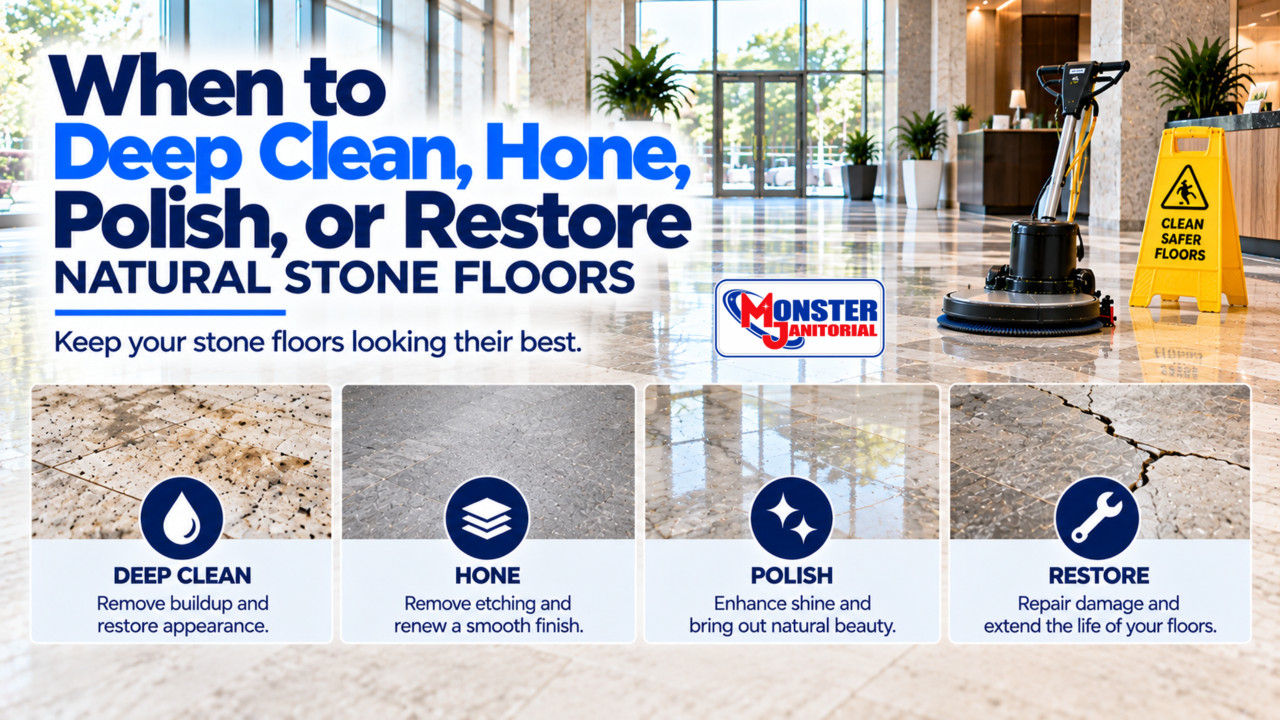
When to Deep Clean, Hone, Polish, or Restore Natural Stone Floors
Commercial natural stone floors may lose their appearance because of soil, residue, stains, scratches, etching, worn traffic lanes, damaged filler, moisture, or failed surface treatments.
Choosing the correct treatment begins by separating removable contamination from physical stone damage. Deep cleaning removes soil and residue, while honing, polishing, repairs, and restoration mechanically change or rebuild the surface.
Deep clean when the problem is soil or residue. Hone when the surface is etched, scratched, or uneven. Polish when the intended gloss needs to be restored.
Full restoration may be required when the floor has widespread wear, deep damage, uneven gloss, failed filler, cracked repairs, stains, lippage, or several problems that cannot be corrected with one maintenance procedure.
Identify the Stone, Finish, Treatment, and Damage
A dull floor does not automatically need polishing. It may be dirty, hazy, scratched, etched, coated, stained, or simply designed to have a honed finish.
Read: How to Identify Commercial Stone Floors Before Cleaning →
Which Natural Stone Treatment Is Needed?
Start with the least invasive treatment capable of correcting the confirmed problem.
When Routine Cleaning Is Enough
Routine cleaning is appropriate when the stone is structurally sound, the intended finish is still present, and the main problem is light removable soil.
Routine-Cleaning Conditions
- Loose dust and grit
- Light footprints
- Small recent spills
- Normal daily traffic soil
- No visible etching or deep scratches
- Uniform finish after cleaning
Recommended Process
- Vacuum or dust-mop loose grit.
- Use properly diluted neutral cleaner.
- Use microfiber or a soft approved pad.
- Control solution flow.
- Recover water immediately.
- Inspect the floor after drying.
When to Deep Clean Natural Stone
Deep cleaning is appropriate when the stone surface is intact but routine cleaning no longer removes embedded soil, residue, grease, dirty grout, or contamination held in texture.
Signs Deep Cleaning Is Needed
- Embedded traffic soil
- Greasy or sticky buildup
- Dirty grout lines
- Soil held in textured stone
- Cleaner or maintenance residue
- Discoloration that improves when scrubbed
Deep-Cleaning Process
- Remove all loose grit.
- Test compatible cleaning chemistry.
- Allow controlled dwell time.
- Agitate with an approved pad or brush.
- Recover dirty solution before it dries.
- Rinse when required.
- Allow complete drying before evaluation.
When Honing Is Required
Honing uses controlled abrasive steps to remove or reduce surface damage and produce a consistent matte or satin finish. It is a restoration process rather than normal cleaning.
Signs Honing May Be Needed
- Acid etching
- Visible scratches
- Swirl marks
- Uneven surface texture
- Worn traffic lanes
- Patchy previous restoration
- Uneven gloss that cleaning cannot correct
What Honing Does
- Mechanically refines the stone surface
- Reduces shallow scratches and etching
- Creates a uniform honed appearance
- Prepares stone for polishing
- Produces slurry requiring complete recovery
- Requires a verified abrasive sequence
When Polishing Is Required
Polishing restores or increases surface clarity and gloss on compatible stone. It is commonly performed after honing or as part of an approved maintenance process.
Signs Polishing May Be Needed
- Intended polished finish has lost clarity
- Honing has removed surface damage
- Traffic lanes have lower gloss
- Previous polishing is inconsistent
- Surface is clean but lacks reflectivity
- Approved maintenance system calls for polishing
What Polishing Does
- Refines the honed surface
- Increases gloss and clarity
- Improves light reflection
- Restores the intended polished appearance
- Requires controlled machine speed and pressure
- May require polishing powder or fine diamonds
When Stain Treatment or Poulticing Is Needed
A stain changes the color of the stone because a substance has penetrated or chemically discolored the surface. Stain treatment depends on identifying the material that caused the discoloration.
Common Stain Types
- Oil and grease
- Rust or metal staining
- Food and beverage
- Organic material
- Ink, dye, or pigment
- Moisture darkening
- Construction adhesive or sealant
Before Treating a Stain
- Identify the staining material.
- Determine whether the stone is still wet.
- Inspect the sealer and joints.
- Test an approved treatment.
- Avoid mixing stain-removal chemicals.
- Use professional poulticing when appropriate.
When Travertine Filler and Stone Repairs Are Needed
Repairs should be completed before aggressive machine cleaning, honing, polishing, or sealing when the floor contains unstable filler, cracks, loose tiles, open holes, or failed previous repairs.
When Full Natural Stone Restoration Is Required
Full restoration is appropriate when the floor has widespread damage or several conditions that cannot be corrected through routine maintenance or one isolated treatment.
A Full Restoration May Include
Deep Cleaning vs. Honing vs. Polishing
Deep Cleaning
Removes: Soil, grease, residue, and embedded contamination.
Does not repair: Etching, scratches, worn polish, or cracks.
Honing
Corrects: Etching, shallow scratches, uneven texture, and wear.
Produces: A controlled matte or satin finish.
Polishing
Restores: Gloss, clarity, reflection, and polished appearance.
Usually follows: Honing or an approved maintenance sequence.
Equipment for Cleaning, Honing, Polishing, and Recovery
Machine selection depends on the stone, finish, floor condition, process, abrasive system, and operator training.
Begin With Neutral, Low-Foam Cleaning Products
Stronger chemistry should only be used after the stone, finish, sealer, filler, soil, equipment, and test area have been evaluated.
Problems That Should Not Be Corrected With More Chemical
Natural Stone Cleaning and Restoration Mistakes
Natural Stone Floor Care Learning Library
Continue learning about commercial marble, granite, limestone, travertine, polished stone, honed stone, textured stone, cleaning chemicals, equipment, pads, sealing, troubleshooting, and restoration.
Identify the Stone & Finish
Cleaning Equipment, Chemicals & Pads
Diamond Pad & Stone Maintenance Guides
Problems, Restoration & Protection
Should Natural Stone Floors Be Sealed? Learn when natural stone may benefit from sealing and what a penetrating sealer can and cannot protect against.
Related Commercial Floor-Care Guides
Need help with a natural stone floor? Contact Monster Janitorial at sales@monsterjanitorial.com or 956-772-4842.
Deep Cleaning, Honing, Polishing, and Restoration FAQs
How can I tell whether a stone floor needs deep cleaning or honing?
Deep cleaning is appropriate when soil or residue improves during a controlled test. Honing may be required when dullness, etching, or scratches remain after the floor is clean and dry.
Can deep cleaning restore polished marble?
Deep cleaning may remove soil and residue, but it cannot repair etched areas, scratches, or physically worn polish.
Is honing the same as polishing?
No. Honing refines or levels the stone and produces a matte or satin surface. Polishing continues the process to create greater clarity and gloss.
Can polishing remove deep scratches?
Deep scratches usually require honing with an appropriate abrasive sequence before polishing.
Should stone be sealed after restoration?
Some stone benefits from a compatible penetrating sealer, but the stone, porosity, finish, previous treatment, and intended use must be evaluated first.
Can an auto scrubber hone or polish natural stone?
Some auto scrubbers may support approved maintenance diamond systems, but professional honing and restoration usually require verified tooling, controlled sequences, slurry recovery, and trained operation.
Need Help Choosing a Natural Stone Cleaning or Restoration Process?
Monster Janitorial can help compare commercial vacuums, auto scrubbers, low-speed machines, orbital machines, wet vacuums, pads, brushes, diamond systems, and cleaning chemicals for natural stone maintenance.