
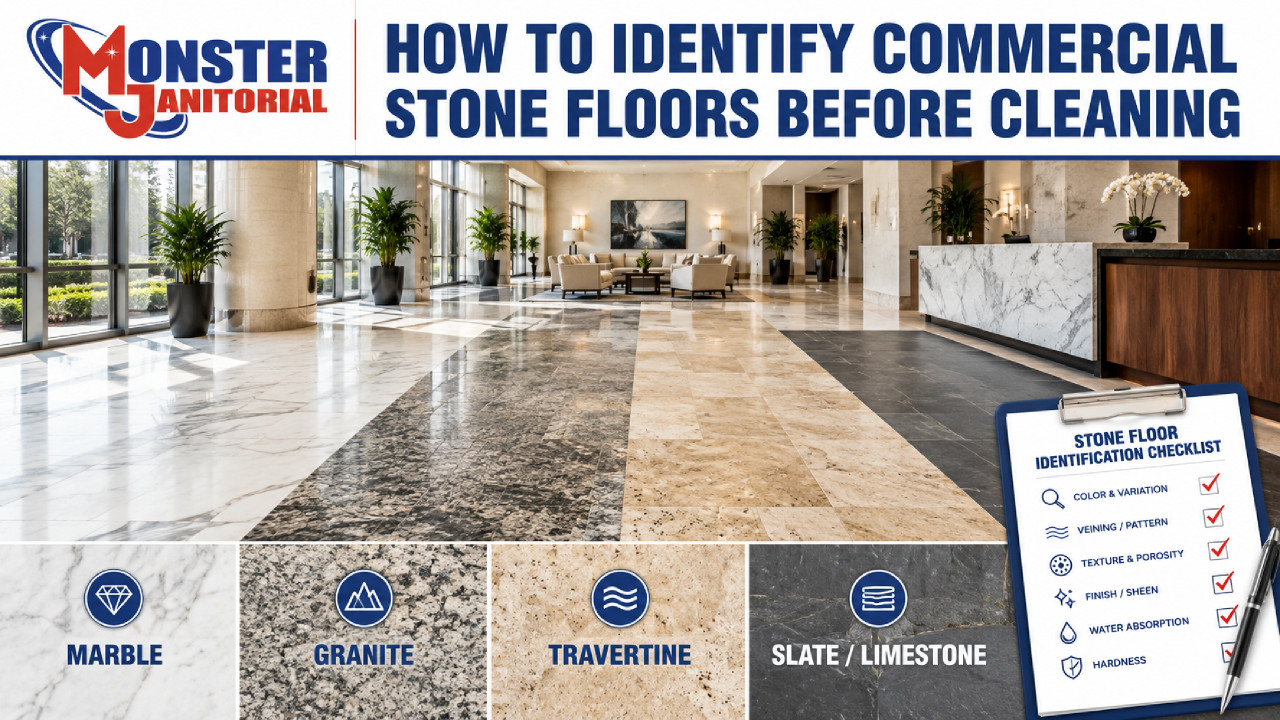
How to Identify Commercial Stone Floors Before Cleaning
Commercial stone floors can look similar even when they require very different cleaning chemicals, pads, brushes, sealers, and restoration procedures.
Before cleaning marble, granite, limestone, travertine, slate, sandstone, quartzite, or another natural stone surface, identify the stone type, surface finish, porosity, existing treatment, acid sensitivity, and current condition.
Do not select a cleaner, pad, brush, scrubber, sealer, or restoration method based only on the floor’s color or appearance.
Confirm the stone type and finish, check for coatings or sealers, inspect porosity and damage, review previous maintenance products, and test the proposed cleaning process in an inconspicuous area.
Incorrect Identification Can Cause Permanent Damage
The same chemical or pad that works on one stone may dull, scratch, stain, or etch another.
Start With Facility and Installation Records
Documents are usually safer and more reliable than visual identification alone.
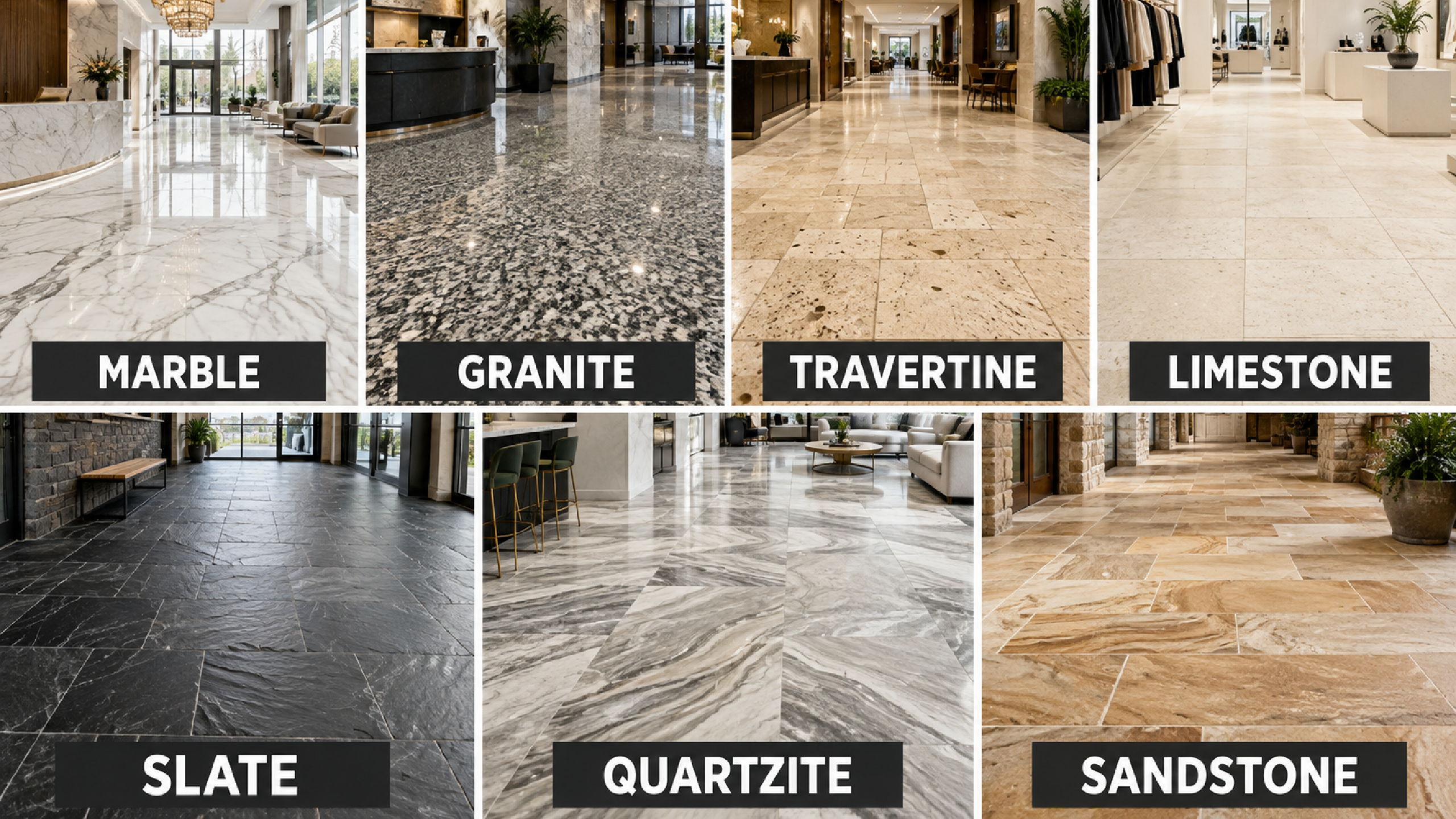
Common Commercial Natural Stone Types
Visual clues can help narrow the possibilities, but they should be supported by records or professional confirmation when the identification is uncertain.
Marble
Marble often has visible veins, flowing patterns, or cloudy color variation and is commonly installed with a polished or honed finish.
- Calcium based and acid sensitive
- Can scratch and etch
- Common in lobbies, hotels, and public buildings
- May resemble quartzite or engineered surfaces
Granite
Granite usually contains visible mineral crystals or speckles and often has a dense, polished surface.
- Generally harder than marble or limestone
- Usually less acid sensitive
- May still stain through unsealed areas
- Can develop residue or sealer haze
Limestone
Limestone is often beige, cream, gray, or tan and may contain fossils, shell fragments, or subtle natural markings.
- Porous and commonly honed
- Calcium based and acid sensitive
- Can stain, scratch, and darken
- May resemble travertine without visible voids
Travertine
Travertine is a form of limestone known for natural holes, channels, or voids that may be filled or left open.
- May be polished, honed, tumbled, or textured
- Acid sensitive
- Soil can collect in pits and failed filler
- Repairs may react differently from the stone
Slate
Slate often has a layered, cleft, or uneven texture and may show gray, black, green, red, or multicolored tones.
- Can flake or split along layers
- Texture traps soil and dirty solution
- May have topical coatings or enhancers
- Brushes often contact the surface better than pads
Sandstone
Sandstone often has a visibly grainy appearance and may feel slightly rough or porous.
- Often absorbs moisture and stains quickly
- May shed fine particles
- Requires controlled moisture
- Strong cleaners should be tested carefully
Quartzite
Quartzite is a hard crystalline stone that can resemble marble because of its veining and color.
- Generally harder and more scratch resistant
- May be confused with marble
- Can vary in porosity
- Records or professional confirmation may be needed
Identify How the Stone Surface Was Finished
Surface finish changes how the floor reflects light, traps soil, shows scratches, accepts pads or brushes, and releases dirty solution.
Check for Sealers, Coatings, Wax, and Polish
The visible floor surface may be a coating or treatment rather than bare stone.
Use a Careful Water-Drop Observation
A small amount of clean water can provide limited information about absorption, but it does not identify the stone by itself.
Do Not Perform Destructive Acid Tests
Marble, limestone, and travertine are calcium-based stones that can permanently etch when exposed to acids.
Do not test the floor with:
Use installation records or a qualified stone professional when acid sensitivity is uncertain.
Inspect Existing Damage Before Cleaning
Record existing defects so they are not mistaken for cleaning damage or removable soil.
Inspect Grout, Joints, Fillers, and Previous Repairs
Grout and repair materials may react differently from the surrounding stone.
Review Previous Cleaning and Restoration Products
Ask facility staff, contractors, and previous service providers what products or processes were used.
Ten Steps Before Cleaning a Commercial Stone Floor
When to Stop and Request Professional Identification
Do not proceed with aggressive cleaning, honing, polishing, sealing, or coating removal when identification remains uncertain.
Natural Stone Floor Cleaning & Maintenance Guides
Learn how to identify, clean, maintain, troubleshoot, seal, hone, polish, and restore commercial marble, granite, limestone, travertine, and other natural stone floors.
Identify the Stone & Surface
Marble vs. Granite vs. Limestone vs. Travertine Compare chemical sensitivity, porosity, finishes, equipment, and maintenance needs →
Equipment, Pads & Cleaning Chemicals
Troubleshooting, Restoration & Protection
Unknown floor? Start with identification. Dirty floor? Review chemicals and equipment. Dull or damaged floor? Start with the troubleshooting and restoration guides.
Commercial Stone Identification FAQs
Can marble and quartzite look alike?
Yes. Some quartzite has veining and color patterns similar to marble, so installation records or professional confirmation may be needed.
Does water beading prove that a stone is nonporous?
No. Water may bead because a penetrating sealer, topical coating, wax, or other treatment is present.
Can vinegar be used to identify marble?
No. Vinegar can permanently etch marble, limestone, and travertine and should not be used as an identification test.
How can you tell whether stone has a coating?
Look for peeling, yellowing, uneven shine, surface-film scratches, haze, and water beading, then review maintenance records.
What should you do when the stone type is uncertain?
Use only a cautious test process and request professional identification before using aggressive chemistry, diamond pads, honing, polishing, or coating-removal methods.
Need Help Choosing Stone-Floor Cleaning Equipment?
Monster Janitorial can help compare scrubbers, floor machines, wet vacuums, pads, brushes, neutral cleaners, and maintenance equipment after the stone type and surface finish have been identified.