
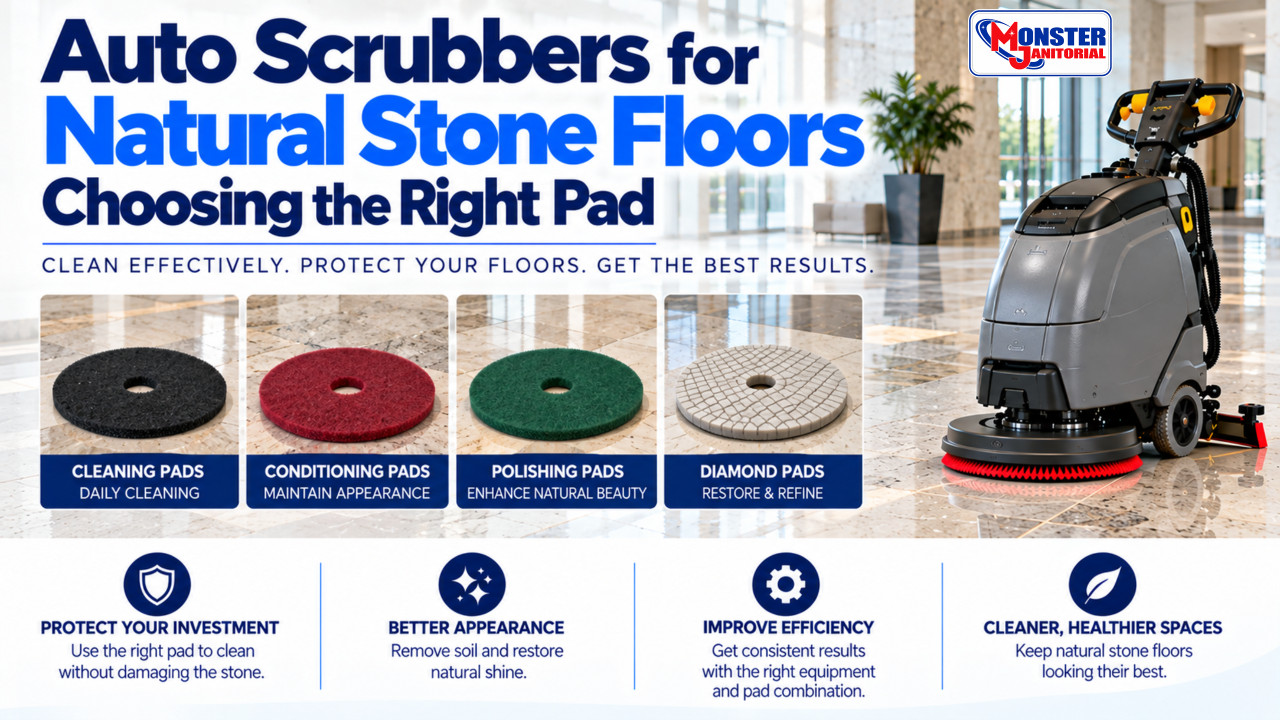
Auto Scrubbers for Natural Stone Floors: Choosing the Right Pad
Auto scrubbers can safely and efficiently maintain many commercial marble, granite, limestone, travertine, slate, sandstone, quartzite, and other natural stone floors.
The correct setup depends on the stone type, surface finish, soil level, existing sealer or coating, pad or brush, machine pressure, cleaning chemical, solution flow, and water-recovery performance.
Use the least aggressive pad or brush capable of removing the soil without changing the appearance or texture of the stone.
Polished stone usually requires white, microfiber, or other soft manufacturer-approved pads. Honed stone may tolerate a red pad when approved. Textured stone often cleans better with a soft nylon or cylindrical brush. Diamond pads should only be used when the pad, grit, machine, stone, and maintenance goal are fully understood.
Can You Use an Auto Scrubber on Natural Stone Floors?
Yes, but the machine and agitation system must match the floor. More pressure, stronger chemistry, and a more aggressive pad do not automatically produce a better result.
Identify the Stone and Surface Finish
Do not choose a pad based only on the floor’s color or visible gloss. Confirm the stone, finish, treatment, and condition first.
Read: How to Identify Commercial Stone Floors Before Cleaning →
Choose the Pad or Brush by Surface Finish
The surface finish determines how much abrasion the floor can tolerate and whether a flat pad can contact the full surface.
Polished Stone
Polished stone reflects light and makes scratches, haze, etching, residue, and uneven abrasion highly visible.
Recommended starting tools:- White cleaning pads
- Microfiber pads
- Soft manufacturer-approved pads
- Fine stone-maintenance pads
- Black stripping pads
- Aggressive green pads
- Coarse brushes
- Unknown diamond-pad grits
Honed Stone
Honed stone has a matte or satin finish and may tolerate slightly more agitation than polished stone when the process is approved and tested.
Recommended starting tools:- White pads
- Microfiber pads
- Red pads when approved
- Fine nylon brushes for light texture
- Compatible maintenance diamond pads
Textured Stone
Flat pads may ride across raised areas while leaving dirt in grooves, pits, grout lines, or natural clefts.
Recommended starting tools:- Soft nylon brushes
- Cylindrical brushes
- Soft grit brushes when approved
- Detail brushes around grout and edges
- Additional vacuum-only recovery passes
What Floor-Pad Colors Mean for Natural Stone
Pad colors generally indicate aggressiveness, but performance can vary by manufacturer. Always confirm the pad specification and test it before cleaning the full floor.
Diamond Pads for Natural Stone Floors
Diamond pads are not all interchangeable. A fine maintenance pad and a coarse restoration diamond can produce completely different results.
Pads vs. Brushes on Natural Stone
Floor Pads
Pads provide consistent contact across smooth, flat stone surfaces.
Best for:- Polished stone
- Honed stone
- Smooth granite or marble
- Uniform floor surfaces
- Compatible diamond-pad maintenance
Scrub Brushes
Bristles reach into uneven surfaces, grout lines, voids, pits, and recessed texture.
Best for:- Slate and cleft stone
- Flamed granite
- Textured limestone
- Unfilled travertine
- Sandblasted or rough stone
Disc vs. Orbital vs. Cylindrical Scrubbers
Auto-Scrubber Settings That Affect Stone Safety
Safe stone-floor cleaning requires more than selecting the correct pad.
Neutral and Low-Foam Cleaners Sold by Monster Janitorial
Confirm compatibility with the stone and any existing sealer or coating. Follow the chemical label, dilution instructions, machine requirements, and test-area procedure.
Pioneer Eclipse 301 Eclipse Neutral Cleaner
Neutral cleaner for routine damp mopping, auto scrubbing, and compatible commercial floor surfaces including marble.
Shop Eclipse 301Pioneer Eclipse 303 Helios Daily Neutral Cleaner
Daily neutral-cleaning option for compatible commercial floors maintained with an auto scrubber or damp-mop system.
Shop Helios H303Pioneer Eclipse 302 Eclipse Low-Foam Neutral Cleaner
Low-foam neutral cleaner for compatible floors where dependable solution recovery and residue control are important.
Shop Eclipse 302Pioneer Eclipse 350 Lumen Neutral All-Purpose Cleaner
Neutral all-purpose cleaner for compatible washable floors and facilities using a multi-surface cleaning program.
Shop Lumen L350Do not use vinegar, acidic restroom cleaners, acidic descalers, harsh stripping chemicals, strong solvents, or an unapproved degreaser on marble, limestone, travertine, or unknown stone. Do not allow dirty solution or cleaner residue to dry on the floor.
Ten Steps for Auto Scrubbing Natural Stone
Common Auto-Scrubber and Pad Mistakes
When an Auto Scrubber Is Not Enough
Auto scrubbing removes soil and residue. It does not repair physical stone damage.
Starting Pad or Brush by Floor Condition
Natural Stone Floor Care Learning Library
Continue learning about commercial marble, granite, limestone, travertine, polished stone, honed stone, textured stone, cleaning chemicals, equipment, pads, sealing, troubleshooting, and restoration.
Identify the Stone & Finish
Cleaning Equipment, Chemicals & Pads
Diamond Pad & Stone Maintenance Guides
Problems, Restoration & Protection
Related Commercial Floor-Care Guides
Need help with a natural stone floor? Contact Monster Janitorial at sales@monsterjanitorial.com or 956-772-4842.
Auto Scrubbers and Stone Floor Pads FAQs
Can you use a red pad on marble?
A red pad may be suitable for some compatible honed, sealed, or previously maintained marble floors, but it should not be assumed safe for every polished or soft marble surface. Test first.
What is the safest starting pad for polished stone?
A white or microfiber pad is usually the safest low-aggression starting point after confirming stone and sealer compatibility.
Should textured stone be cleaned with a pad or brush?
Textured stone usually cleans better with a soft nylon or cylindrical brush because the bristles reach into recessed areas that a flat pad may miss.
Can a diamond pad remove etching?
Some controlled honing or polishing systems can correct etching, but this is a restoration process rather than routine auto scrubbing. The correct grit progression and professional process may be required.
Why does an auto scrubber leave streaks on stone?
Common causes include cleaner residue, excessive chemical, worn squeegees, dirty pads, insufficient recovery, hard-water deposits, or allowing dirty solution to dry.
Need Help Choosing a Stone-Floor Scrubber, Pad, or Brush?
Monster Janitorial can help compare compact, walk-behind, ride-on, disc, orbital, and cylindrical scrubbers along with neutral cleaners, microfiber pads, floor pads, soft brushes, and compatible stone-maintenance systems.