
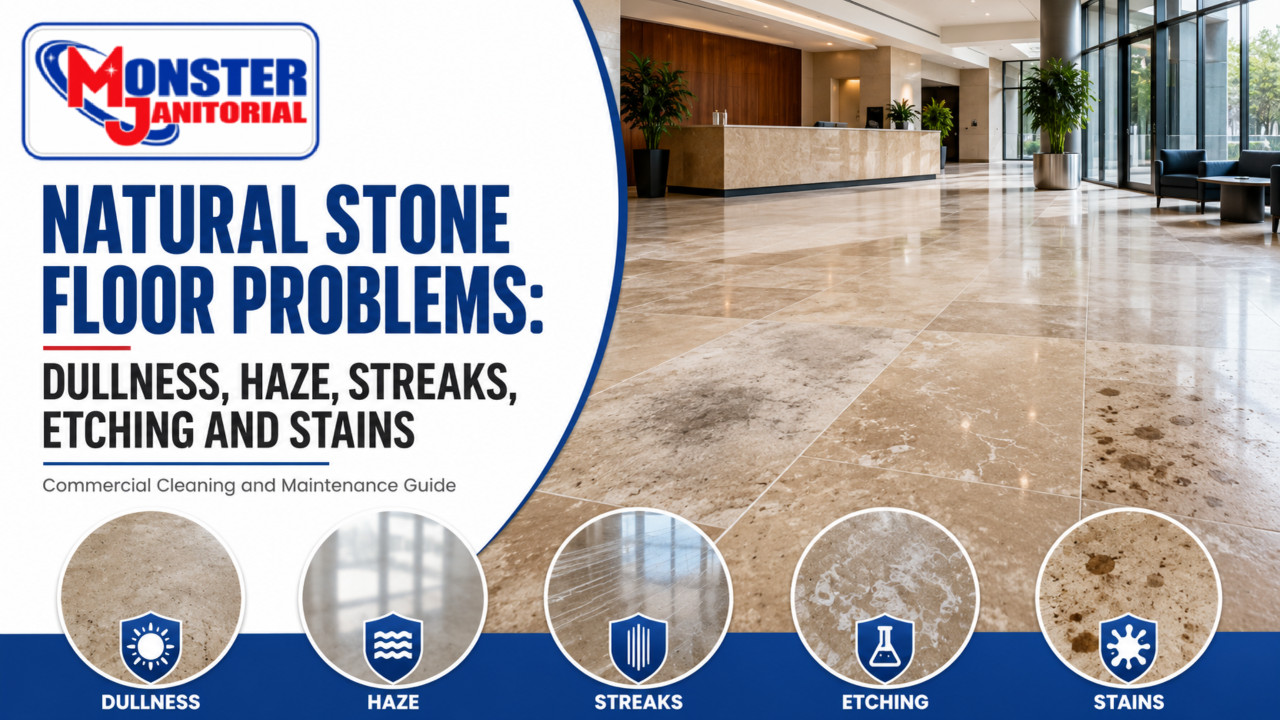
Natural Stone Floor Problems: Dullness, Haze, Streaks, Etching and Stains
A natural stone floor that looks dull, cloudy, streaked, stained, or uneven does not always need the same correction. Some appearance problems are caused by removable soil or residue, while others are physical damage that cleaning cannot repair.
Correct diagnosis prevents repeated chemical use, aggressive scrubbing, unnecessary polishing, damaged sealers, and costly restoration mistakes.
Dullness, haze, and streaks may be cleaning problems. Etching, deep scratches, worn polish, and damaged filler usually require repair or restoration.
Begin with a small controlled test using properly diluted neutral cleaner, a clean soft pad or microfiber tool, complete solution recovery, and adequate drying time. When the appearance remains unchanged, stop adding chemical and evaluate the floor for physical damage.
Identify the Stone, Finish, Treatment, and Problem
The same visible symptom can have several causes. A dull marble floor may be dirty, etched, scratched, worn, coated, or covered with residue.
Read: How to Identify Commercial Stone Floors Before Cleaning →
Start With the Least Invasive Test
Do not begin with aggressive chemistry, coarse pads, diamond tools, or high machine pressure.
Match the Appearance Problem to the Likely Cause
Dull Natural Stone Floors
Dullness describes a loss of clarity, reflectivity, depth, or uniform appearance. It may cover the entire floor or appear mainly in entrances and traffic lanes.
Possible Causes
- Loose grit creating fine scratches
- Accumulated soil film
- Cleaner or detergent residue
- Worn polish in traffic lanes
- Acid etching
- Abrasive pad or brush damage
- Old coating or sealer buildup
Recommended Response
- Vacuum all loose grit.
- Test-clean with neutral chemistry.
- Rinse and recover completely.
- Inspect the dry test area.
- Check for scratches or etching.
- Request restoration when gloss does not return.
Hazy or Cloudy Stone Floors
Haze often appears as a cloudy film that reduces color and reflection. It may be removable residue, but it can also indicate moisture, sealer problems, or physical surface damage.
Possible Causes
- Excess cleaner concentration
- Incomplete rinsing
- Dirty mop water or scrubber solution
- Dried slurry
- Old floor finish or coating
- Sealer residue left on the surface
- Moisture trapped below a treatment
Recommended Response
- Confirm the cleaner and dilution.
- Use fresh water and clean tools.
- Test a neutral cleaning and rinse process.
- Recover all solution immediately.
- Allow the floor to dry thoroughly.
- Evaluate the sealer or coating if haze remains.
Streaks, Mop Marks, and Uneven Drying
Streaks are usually associated with cleaning technique, solution concentration, dirty tools, poor recovery, or uneven drying rather than permanent stone damage.
Possible Causes
- Too much cleaning chemical
- Dirty mop heads or pads
- Contaminated rinse water
- Worn or damaged squeegees
- Incorrect scrubber solution flow
- Overlapping wet and dry areas
- Airflow drying solution unevenly
Recommended Response
- Replace or clean contaminated tools.
- Correct the chemical dilution.
- Inspect and rotate squeegee blades.
- Reduce unnecessary solution flow.
- Use overlapping recovery passes.
- Rinse with fresh water when required.
Acid Etching
Etching occurs when an acidic substance reacts with acid-sensitive stone such as marble, limestone, or travertine. The reaction changes the surface itself and may leave a dull, light, rough, or ring-shaped mark.
Common Sources
- Acidic restroom cleaner
- Vinegar or acidic descaler
- Citrus beverages
- Soft drinks and wine
- Food acids
- Incorrect grout-cleaning chemicals
- Acid tracked from nearby work
Recommended Response
- Remove and neutralize the spill safely.
- Clean the area with approved neutral chemistry.
- Allow the area to dry.
- Inspect the surface at several angles.
- Do not continue aggressive cleaning.
- Request honing or polishing when needed.
Dark, Colored, and Discolored Stains
Natural stone can absorb liquids through the surface, joints, cracks, holes, grout lines, or damaged sealer. Correct treatment depends on the substance that caused the stain.
Possible Stain Types
- Oil and grease
- Food and beverage
- Organic material
- Rust or metal staining
- Ink, dye, or pigment
- Moisture darkening
- Construction adhesive or sealant
Recommended Response
- Identify the staining substance.
- Determine whether it is surface or absorbed.
- Check the sealer and moisture condition.
- Test the approved treatment.
- Avoid mixing stain-removal chemicals.
- Use professional poulticing when appropriate.
Scratches, Swirl Marks, and Abrasion
Scratching is common near entrances, loading areas, transition zones, and anywhere abrasive grit becomes trapped beneath pads, wheels, furniture, or footwear.
Uneven Gloss and Traffic Lanes
Uneven gloss may appear as dull walkways, shiny edges, visible machine paths, patchy repairs, or isolated spots with a different finish.
White Deposits, Mineral Residue, and Moisture Problems
White or powdery deposits may be associated with dried cleaning solution, hard-water minerals, grout residue, salt movement, moisture transmission, or construction-related contamination.
Damaged Travertine Filler, Cracks, and Grout
Missing filler, loose repairs, cracked grout, and open voids can collect soil and water. Aggressive brushes or machine pressure may worsen unstable areas.
Separate Removable Soil From Physical Stone Damage
Cleaning May Correct
- Loose soil and grit
- Detergent film
- Dirty mop residue
- Some streaking
- Surface grease
- Dried cleaning solution
Restoration May Be Required
- Acid etching
- Deep scratches
- Worn polish
- Uneven gloss
- Failed filler
- Damaged coating or sealer
Equipment for Controlled Cleaning and Diagnosis
Begin with equipment that supports gentle cleaning, complete recovery, and accurate evaluation.
Begin With Neutral, Low-Foam Cleaning
Confirm compatibility with the stone, finish, grout, filler, sealer, coating, pad, brush, and machine before full-floor use.
Common Troubleshooting Mistakes
Natural Stone Floor Care Learning Library
Explore our complete commercial natural stone care library covering stone identification, surface finishes, chemicals, cleaning equipment, pads, sealing, troubleshooting, honing, polishing, restoration, and related floor-care systems.
Identify the Stone & Finish
Cleaning Equipment, Chemicals & Pads
Diamond Pad & Stone Maintenance Guides
Problems, Restoration & Protection
When to Deep Clean, Hone, Polish, or Restore Natural Stone Floors Determine whether a floor needs soil removal, surface correction, polishing, repair, or full restoration. Should Natural Stone Floors Be Sealed? Learn when natural stone may benefit from sealing and what penetrating sealers can and cannot protect against.
Related Commercial Floor-Care Guides
Need help with a natural stone floor? Contact Monster Janitorial at sales@monsterjanitorial.com or 956-772-4842.
Natural Stone Floor Problem FAQs
Why does my natural stone floor still look dull after cleaning?
The floor may be scratched, etched, worn, coated, or unevenly polished rather than simply dirty. Perform a controlled test before using stronger chemistry.
What causes a cloudy film on stone?
Common causes include excess cleaner, incomplete rinsing, dirty solution, dried slurry, sealer residue, hard-water deposits, or moisture.
Can an auto scrubber remove stone floor haze?
It may remove soil or cleaner residue when configured correctly, but it will not repair etching, scratches, worn polish, failed sealer, or moisture problems.
How can I tell the difference between etching and a stain?
Etching changes the surface texture or gloss. A stain changes the color because a substance has penetrated or discolored the stone.
Can neutral cleaner remove marble etching?
No. Neutral cleaner can remove soil and residue, but etched marble normally requires honing, polishing, or another restoration procedure.
Should a cloudy floor be sealed?
Not until the cause has been identified. Sealing over residue, moisture, stains, or failed treatments may trap the problem and make correction more difficult.
Need Help Diagnosing a Natural Stone Floor Problem?
Monster Janitorial can help compare neutral cleaning chemicals, auto scrubbers, low-speed machines, orbital machines, wet vacuums, pads, brushes, and troubleshooting processes for commercial natural stone floors.