null
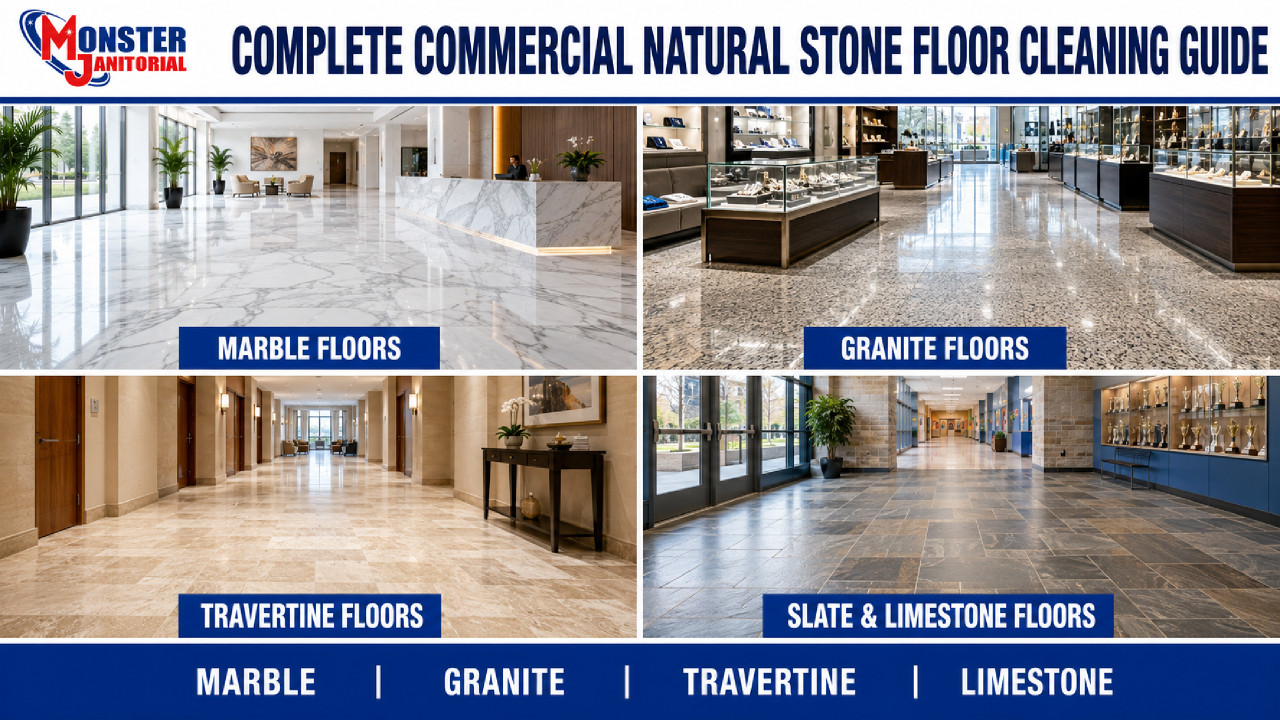
Complete Commercial Natural Stone Floor Cleaning Guide

Complete Commercial Natural Stone Floor Cleaning Guide

Posted by Monster Janitorial Tech Team on Aug 05, 2026

MJ University Hard-Floor Care

Complete Commercial Natural Stone Floor Cleaning Guide

Natural stone floors are used in hotels, office buildings, schools, universities, healthcare facilities, retail stores, government buildings, transportation facilities, restaurants, and high-traffic commercial lobbies.

Marble, granite, limestone, travertine, slate, sandstone, and quartzite can differ in porosity, acid sensitivity, scratch resistance, texture, and restoration requirements. The cleaning process must match the stone type, finish, soil, and existing sealer or coating.

Quick Answer

Commercial natural stone floors should be dry-soil cleaned first, washed with compatible stone-safe chemistry, agitated with the correct pad or brush, and completely recovered before the solution dries.

Always identify the stone and surface finish before cleaning. Acidic chemicals, aggressive pads, dirty solution, and incorrect restoration methods can permanently dull, scratch, stain, or etch the surface.

Stone Types Covered

Commercial Natural Stone Floors

Cleaning and restoration requirements vary according to the stone, finish, porosity, traffic, and existing treatment.

Marble Polished or honed calcium-based stone that is sensitive to acids and visible scratching.
Granite Dense stone that is generally more resistant to scratching and acidic spills than marble.
Limestone Porous calcium-based stone that can stain, scratch, and etch when cleaned incorrectly.
Travertine Limestone with natural voids that may be filled, polished, honed, or textured.
Slate Layered stone commonly installed with a textured finish that may hold soil in recessed areas.
Sandstone and Quartzite Stone surfaces that can vary considerably in porosity, hardness, texture, and chemical sensitivity.
Before Cleaning

Identify the Stone and Surface Finish

Do not select chemicals, pads, brushes, or restoration methods based only on color. Different stone materials can look similar while reacting very differently to cleaning chemistry and abrasion.

Stone Type Determine whether the floor is marble, granite, limestone, travertine, slate, sandstone, quartzite, or another material.
Surface Finish Identify polished, honed, brushed, flamed, cleft, tumbled, or textured surfaces.
Sealer or Coating Check whether the stone has a penetrating sealer, topical coating, wax, polish, or other surface treatment.
Acid Sensitivity Marble, limestone, and travertine can etch when exposed to acidic cleaners or spills.
Scratch Risk Polished surfaces show grit scratches, pad marks, and abrasion more easily than textured surfaces.
Test Area Test chemistry and agitation in an inconspicuous area before cleaning the full floor.
Correct Cleaning Process

Routine Commercial Stone-Floor Cleaning

Follow a controlled process that removes soil without scratching, etching, staining, or leaving residue.

1. Place warning signs and protect surrounding materials.
2. Sweep or vacuum loose grit before wet cleaning.
3. Identify and spot treat spills or stains.
4. Apply properly diluted stone-safe cleaner.
5. Allow controlled dwell time without drying.
6. Agitate with a compatible soft pad or brush.
7. Recover dirty solution completely.
8. Rinse when required by the cleaner or soil.
9. Inspect the floor after it is fully dry.
Chemical Selection

Best Cleaning Chemicals for Natural Stone

Select chemistry according to the stone, finish, soil, sealer, and manufacturer recommendations.

Neutral Cleaners Appropriate for routine maintenance on many sealed and unsealed natural stone floors.
Low-Foam Scrubber Chemicals Designed for machine cleaning and dependable solution recovery.
Stone-Safe Alkaline Cleaners May be used for heavier soil when confirmed compatible with the stone and sealer.
Compatible Degreasers Useful for oil and food soils on stone that can tolerate the product and required rinsing.
Approved Disinfectants Use only when the disinfectant is compatible with the stone, grout, sealer, and maintenance program.
Specialty Stain Treatments Poultices and specialty treatments may be needed for oil, rust, organic, or deeply absorbed stains.
Avoid: Acidic restroom cleaners, vinegar, acidic descalers, harsh stripping chemicals, strong solvents, abrasive powders, and unapproved disinfectants on acid-sensitive or polished stone.
Agitation Selection

Pads and Brushes by Stone Finish

Begin with the least aggressive pad or brush that can contact the surface and remove the soil.

Polished Stone White pads, microfiber pads, soft red pads when approved, and fine maintenance diamond pads designed for the stone.
Honed Stone Soft cleaning pads, compatible red pads, microfiber pads, or fine brushes for lightly textured surfaces.
Textured Stone Soft nylon brushes, cylindrical brushes, grout brushes, and additional vacuum-only recovery passes.
Diamond Pads Use only as part of a compatible maintenance, honing, or polishing system with the correct grit and machine.

Browse Brushes, Floor Pads and Pad Drivers →

Cleaning Differences

Cleaning Differences by Stone Type

Marble Avoid acids and aggressive abrasion. Remove grit carefully and protect polished surfaces from scratching and etching.
Granite Generally more durable, but residue, oily buildup, scratches, and incompatible sealers can still affect appearance.
Limestone Use neutral chemistry and controlled moisture because porous limestone can stain and acid-sensitive surfaces can etch.
Travertine Pay attention to filled voids, grout, pits, and recessed areas where soil and dirty water may remain.
Slate Textured surfaces often benefit from brush agitation and additional water recovery around cleft areas and grout lines.
Sandstone and Quartzite Confirm porosity and chemical compatibility before using stronger cleaners or high-moisture processes.

Common Natural Stone Floor Problems

Dull or uneven appearance
Haze and cleaner residue
Acid etching
Oil, food, rust, or organic stains
Scratches and traffic-lane wear
Sealer haze or coating buildup
Mineral and hard-water deposits
Dirty grout and recessed texture
Slippery residue or excess moisture
Surface Diagnosis

Etching vs. Staining

Staining

A stain changes the color of the stone when oil, liquid, rust, food, or another contaminant penetrates the surface. Specialty stain treatments or a poultice may be required.

Etching

Etching physically changes the stone surface and often appears as a dull, rough, or lighter area. Normal cleaning will not restore etched marble, limestone, or travertine.

Corrective Maintenance

Deep Cleaning Natural Stone Floors

Deep cleaning should remove embedded soil and residue without being confused with honing, polishing, or structural stone restoration.

Remove all loose soil and grit before adding solution.
Pretreat compatible oily or heavily soiled areas.
Use controlled dwell time without allowing chemistry to dry.
Double scrub when additional agitation is required.
Rinse when needed to remove cleaner and suspended soil.
Inspect after drying to separate soil from permanent damage.
Restoration Basics

Honing, Polishing, and Stone Restoration

Routine cleaning removes soil. Honing and polishing mechanically change the stone surface and should be completed with the correct diamond system, machine, grit progression, and restoration process.

Honing Removes minor surface damage and creates a more uniform matte or satin finish.
Polishing Refines the surface to improve clarity, reflectivity, and gloss on compatible stone.
Professional Restoration May be required for deep scratches, severe etching, lippage, cracks, uneven tiles, and extensive wear.
Stone Protection

Should Natural Stone Floors Be Sealed?

Some porous stone floors benefit from a penetrating or impregnating sealer, while dense stone may absorb very little. A sealer helps resist staining but does not make the floor stain-proof, scratch-proof, or acid-proof.

Confirm the stone type and porosity.
Identify existing sealer or coating.
Clean and completely dry the floor first.
Test for absorption in an inconspicuous area.
Follow the sealer manufacturer’s application directions.
Evaluate traction and appearance after treatment.
Maintenance Schedule

Basic Commercial Stone-Floor Maintenance Program

Daily Sweep, vacuum, dust mop, inspect entrances, and spot clean spills.
Routine Damp mop or auto scrub according to traffic and soil levels.
Monthly Inspect grout, residue, scratches, stains, sealer condition, pads, brushes, and squeegees.
As Needed Deep clean high-soil areas and treat compatible stains.
Periodically Evaluate gloss, etching, wear, grout, sealer performance, and restoration needs.
Professional Review Assess deep scratches, lippage, cracks, major stains, and uneven polish.

Natural Stone Floor Cleaning Mistakes

Using acidic cleaners on marble, limestone, or travertine
Scrubbing over loose grit and sand
Using black stripping pads or aggressive brushes
Overdosing chemicals and leaving residue
Allowing dirty solution to dry on the floor
Treating etching as a removable stain
Applying wax or topical coatings without approval
Skipping a chemical and pad test area
Using the same process on every stone type and finish
Equipment Selection

Recommended Equipment by Facility Size

Small Areas Microfiber systems, compact scrubbers, wet vacuums, and low-speed or dual-speed floor machines.
Medium Facilities Walk-behind scrubbers, orbital machines, floor machines, and stone-compatible pads or brushes.
Large Facilities Ride-on scrubbers, robotic scrubbers, high-productivity equipment, sweepers, and professional polishing systems.
MJ University Natural Stone Care

Natural Stone Floor Care Learning Library

Explore commercial natural stone care guides covering identification, surface finishes, cleaning chemicals, equipment, pads, sealing, troubleshooting, honing, polishing, restoration, and related floor-care systems.

Identify the Stone & Finish

Cleaning Equipment, Chemicals & Pads

Diamond Pad & Stone Maintenance Guides

Problems, Restoration & Protection

Related Commercial Floor-Care Guides

Need help with a natural stone floor? Contact Monster Janitorial at sales@monsterjanitorial.com or 956-772-4842.

Frequently Asked Questions

Commercial Natural Stone Floor Care FAQs

Can you use an auto scrubber on natural stone floors?

Yes. Use compatible chemistry and a soft pad or brush matched to the stone type, finish, and condition.

What cleaner should be used on natural stone?

A neutral stone-safe cleaner is usually the best starting point. Stronger cleaners should be tested and confirmed compatible first.

Can vinegar be used on marble or limestone?

No. Vinegar is acidic and can etch calcium-based stone such as marble, limestone, and travertine.

Can normal cleaning remove etching?

No. Etching changes the stone surface and generally requires honing, polishing, or professional restoration.

Should all natural stone floors be sealed?

Not necessarily. Sealing depends on stone porosity, use, stain exposure, existing treatments, and manufacturer recommendations.

Need Help Choosing Natural Stone Floor-Care Equipment?

Monster Janitorial can help compare scrubbers, floor machines, wet vacuums, pads, brushes, neutral cleaners, and specialty maintenance equipment for commercial marble, granite, limestone, travertine, slate, and other stone floors.