
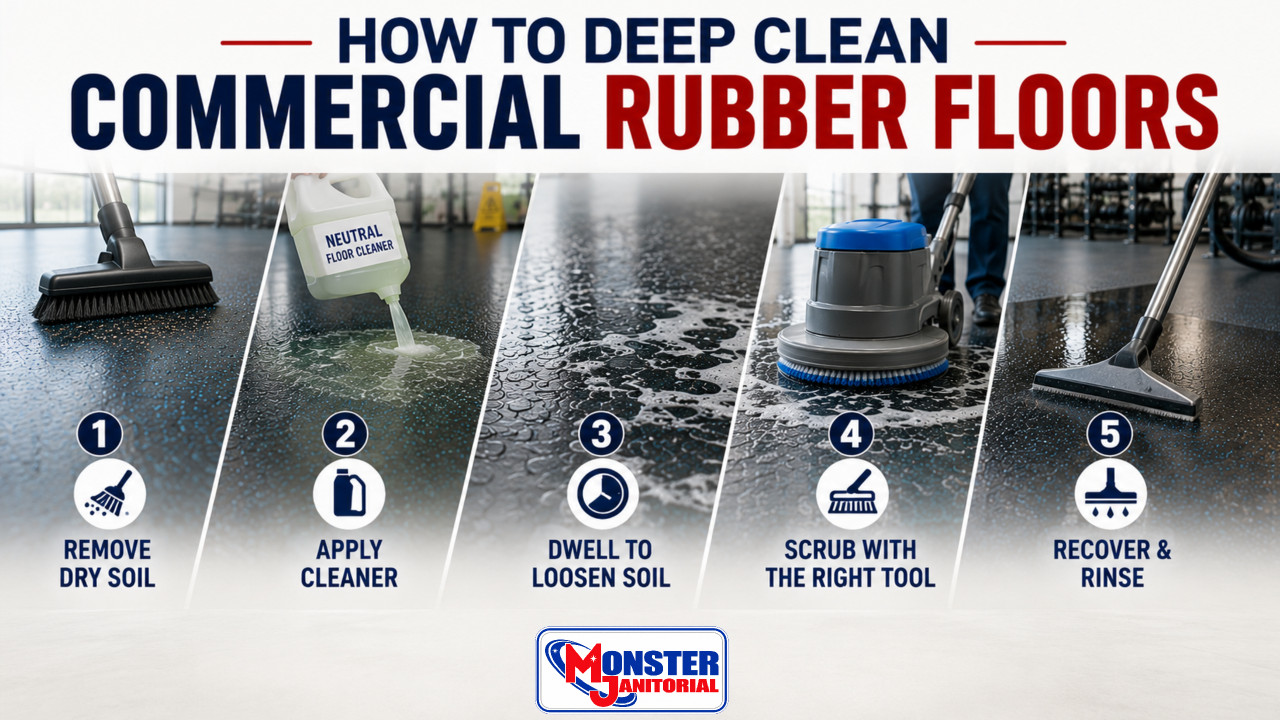
How to Deep Clean Commercial Rubber Floors
Deep cleaning removes embedded soil, oils, residue, and buildup that routine maintenance no longer removes effectively.
A successful deep-cleaning process depends on choosing compatible chemistry, allowing proper dwell time, matching the brush or pad to the floor profile, and completely recovering the dirty solution.
What Is the Best Way to Deep Clean Rubber Flooring?
Remove all loose soil first. Apply compatible cleaner at the correct dilution, keep the floor wet for the required dwell time, agitate with the least aggressive effective brush or pad, and recover the dirty solution completely. Rinse or make a clean-water recovery pass when required by the chemical or flooring manufacturer.
Does the Floor Actually Need Deep Cleaning?
Identify the Rubber Flooring Before Deep Cleaning
Sheet rubber, rubber tile, smooth rubber, textured rubber, studded flooring, recycled gym flooring, and coated rubber do not all respond the same way to water, brushes, pads, or chemicals.
Rubber Floor Identification Guide →6 Things to Check Before Deep Cleaning
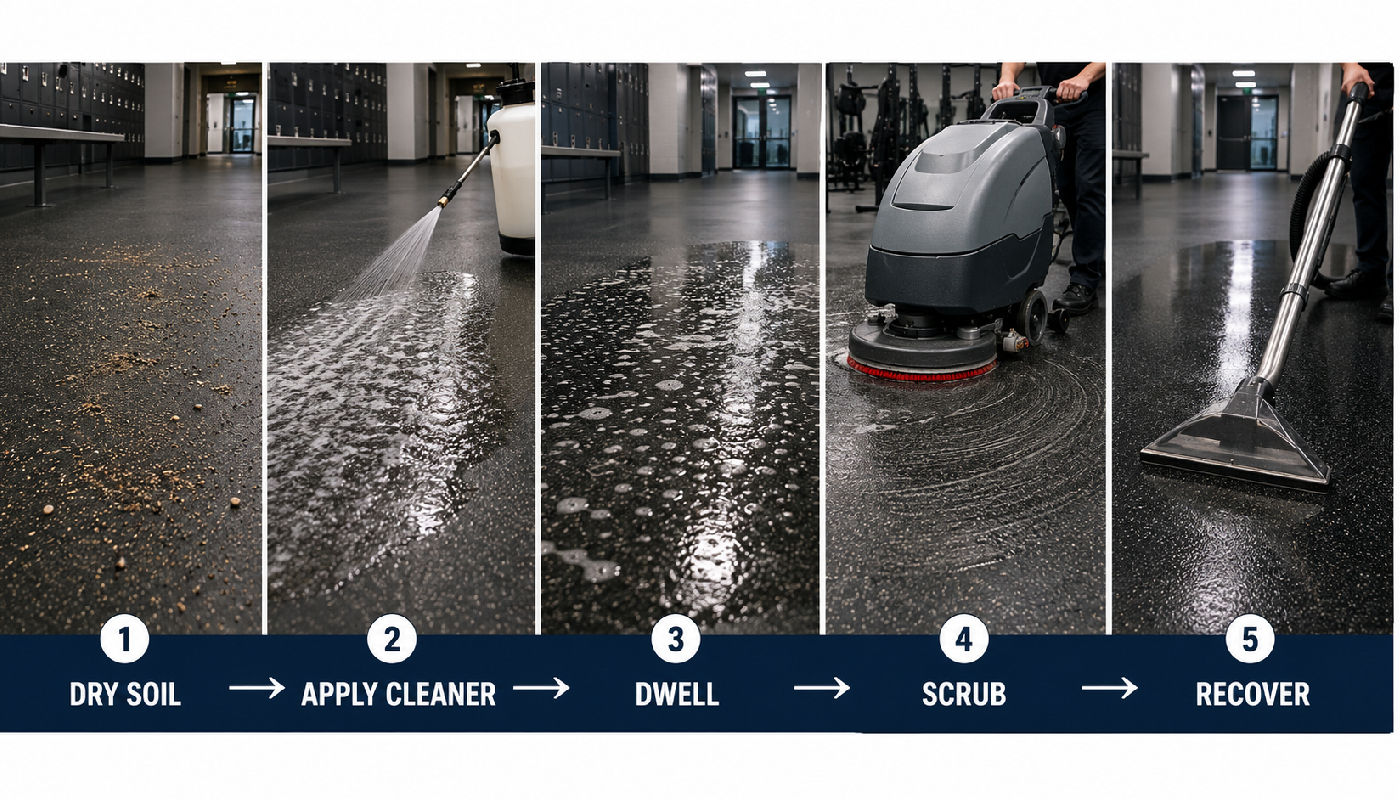
The core process is simple: remove dry soil, apply cleaner, allow dwell time, agitate, and recover the dirty solution.
Remove Dry Soil Before Adding Water
Loose grit, sand, hair, dust, and debris should be removed before wet cleaning. Otherwise, loose particles remain in the cleaning solution and can interfere with agitation and recovery.
Vacuuming is especially useful on textured, studded, recessed, and recycled rubber where debris can settle below the highest points of the floor.
Match the Cleaner to the Soil
Do not choose chemistry based only on how dirty the floor looks. Identify what is actually on the surface.
More Cleaner Can Make the Floor Harder to Clean
Over-concentrated cleaner can increase residue, foam, haze, stickiness, and rinsing requirements. Follow the product label and flooring manufacturer's instructions instead of automatically increasing chemical concentration.
Give the Cleaner Proper Dwell Time
Deep cleaning works more effectively when compatible chemistry has time to loosen and suspend embedded soil before mechanical agitation.
Follow the cleaner's labeled dwell instructions. Keep the surface wet during the intended dwell period and do not allow cleaning solution to dry on the floor.
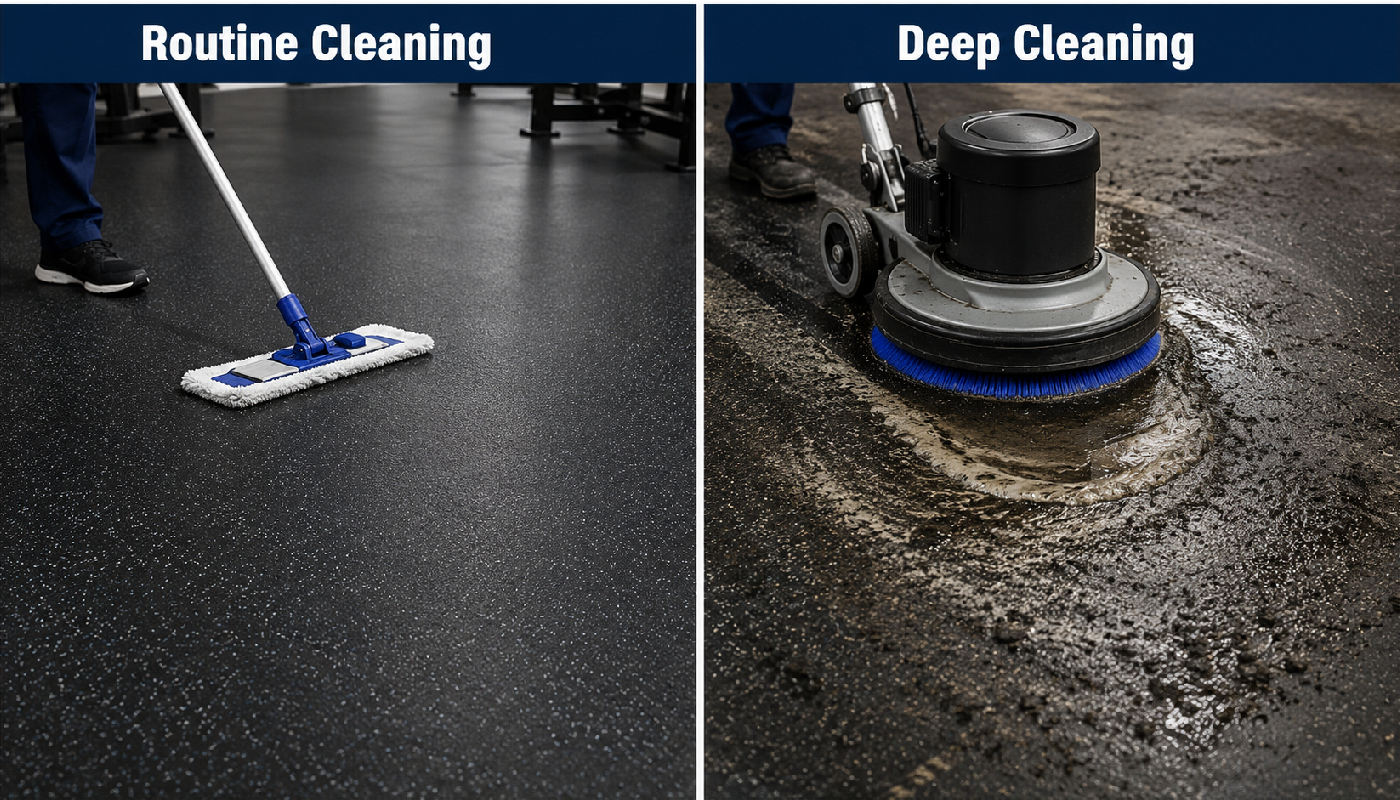
Deep cleaning uses additional chemistry, dwell time, and mechanical agitation to remove buildup that routine cleaning leaves behind.
Match the Brush or Pad to the Rubber Surface
Floor profile matters more than simply choosing a more aggressive pad.
Need Help Choosing the Machine, Brush or Pad?
Compare disc scrubbers, cylindrical scrubbers, low-speed floor machines, brushes, and pads for different commercial rubber surfaces.
Rubber Floor Equipment Guide →Let Chemistry and Contact Do the Work
- Use controlled passes instead of immediately increasing pad aggression.
- Keep the cleaning solution wet while scrubbing.
- Overlap passes enough to avoid missed strips.
- Slow down in heavily contaminated areas rather than applying excessive pressure.
- Inspect the test section before expanding the process to the full floor.
Recover the Dirty Solution Completely
Agitation only loosens contamination. The floor is not fully cleaned until the dirty solution is physically removed.
Use the auto scrubber's recovery system or an appropriate wet vacuum. Allowing contaminated solution to remain can redeposit soil and contribute to streaking, haze, residue, odor, and tackiness.
If Dirty Water Is Left Behind, Check the Machine
Rinse When the Cleaning System Requires It
Some low-residue maintenance cleaners may not require a separate rinse, while other products or contamination levels may require a clean-water recovery pass.
Follow the chemical label and flooring manufacturer's guidance. If the dried floor feels tacky or has visible film, review dilution, rinsing, and recovery before cleaning again.
Avoid Excessive Water on Recycled Rubber Without Verification
Recycled rubber flooring can vary in porosity, seams, adhesive systems, and subfloor exposure. Avoid flooding or unrestricted solution use unless the flooring manufacturer permits it. Apply controlled moisture and recover solution promptly.
Do Not Accidentally Remove or Damage a Surface Treatment
Factory-applied treatments and field-applied coatings can react differently to strong chemistry, stiff brushes, aggressive pads, or increased machine pressure. Confirm the approved maintenance system before attempting restorative scrubbing.
How Do You Know the Deep Cleaning Worked?
What if the Floor Still Looks Bad After Deep Cleaning?
A floor that remains dull, stained, sticky, or uneven after proper deep cleaning may not still be dirty.
The remaining problem may be permanent staining, traffic wear, coating failure, cuts, gouges, loose seams, delamination, or material deterioration.
Troubleshooting Guide → Restoration Guide →Rubber Floor Deep Cleaning Mistakes to Avoid
- Skipping dry-soil removal.
- Using strong chemistry before identifying the soil.
- Over-concentrating cleaner.
- Allowing solution to dry during dwell time.
- Using aggressive pads or brushes without testing.
- Using flat pads that cannot reach recessed texture.
- Failing to recover dirty solution completely.
- Leaving chemical residue behind.
- Using excessive water on moisture-sensitive flooring systems.
- Repeating aggressive cleaning when the remaining problem is physical damage.
Equipment for Deep Cleaning Commercial Rubber Floors
Continue Learning About Commercial Rubber Floors
How to Identify Commercial Rubber Flooring Before Cleaning
Identify sheet, tile, recycled, textured, studded, coated, and uncoated rubber.
Read Identification Guide →Best Cleaning Chemicals for Commercial Rubber Floors
Compare routine, low-foam, degreasing, and odor-control chemistry.
Read Chemical Guide →Auto Scrubbers, Floor Machines, Brushes & Pads for Commercial Rubber Floors
Match the cleaning machine and contact tool to the floor profile.
Read Equipment Guide →How to Deep Clean Commercial Rubber Floors
Current Guide
Commercial Rubber Floor Problems
Diagnose dullness, haze, streaks, marks, odors, stickiness, wear, and damage.
Read Troubleshooting Guide →Commercial Rubber Floor Restoration Guide
Determine when to deep clean, scrub, recoat, repair, or replace.
Read Restoration Guide →Complete Commercial Rubber Floor Cleaning & Maintenance Guide
Use the complete guide for identification, chemistry, equipment, deep cleaning, troubleshooting, restoration, and ongoing maintenance.
Read Complete Guide →Commercial Rubber Floor Deep Cleaning FAQs
How often should commercial rubber floors be deep cleaned?
There is no universal schedule. Deep-cleaning frequency depends on traffic, soil load, facility use, routine maintenance quality, and the flooring manufacturer's recommendations.
Can you use an auto scrubber to deep clean rubber floors?
Many commercial rubber floors can be cleaned with an appropriately configured auto scrubber. Match the chemistry, brush or pad, water use, and recovery setup to the specific flooring.
Should cleaner sit on rubber flooring before scrubbing?
Proper dwell time can help loosen embedded soil. Follow the chemical label and flooring manufacturer's directions and never allow the solution to dry on the floor.
Should rubber flooring be rinsed after deep cleaning?
That depends on the product and flooring system. Follow the cleaner label and floor-care instructions. A clean-water recovery pass may be appropriate when residue remains or rinsing is required.
What if deep cleaning does not restore the floor?
The remaining problem may be staining, wear, coating failure, physical damage, loose seams, delamination, or material deterioration rather than removable soil.
Need Help Deep Cleaning Commercial Rubber Floors?
Monster Janitorial can help you compare cleaning chemicals, auto scrubbers, floor machines, brushes, pads, and wet-recovery equipment for commercial rubber flooring.
Tax-exempt purchasing and purchase-order support are available for qualifying schools, universities, government agencies, healthcare facilities, municipalities, and other institutional customers.