
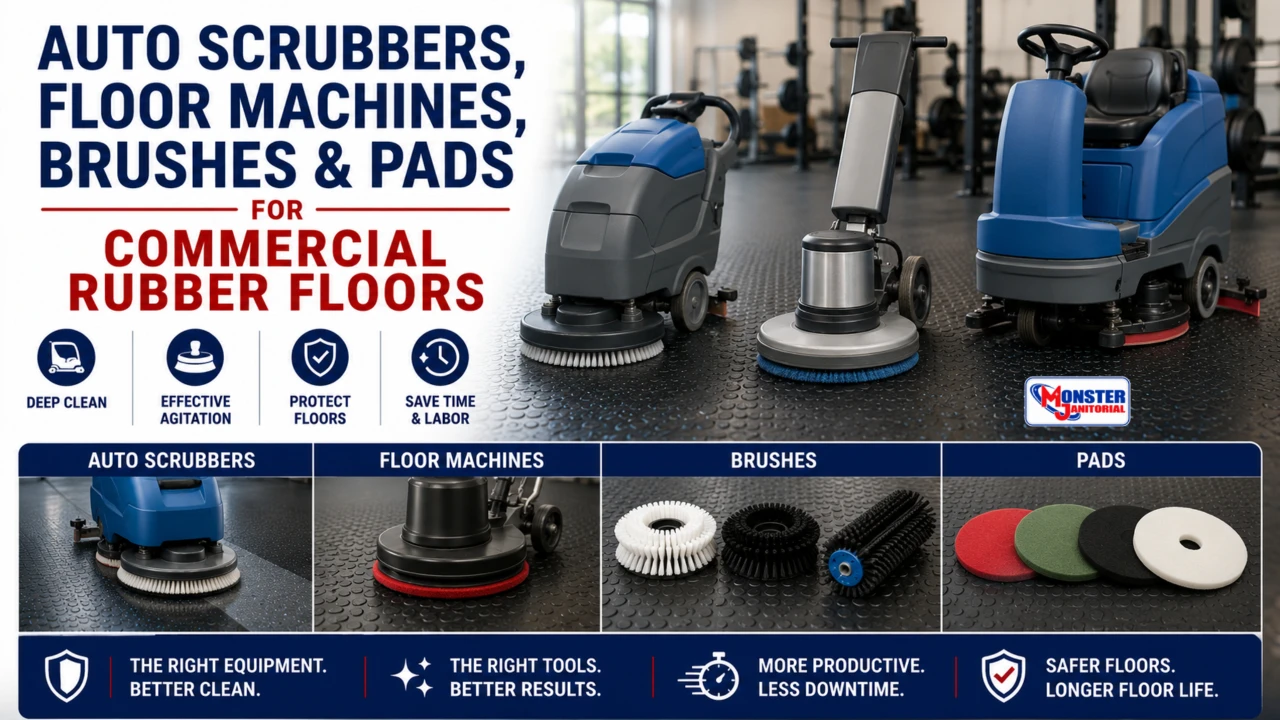
Auto Scrubbers, Floor Machines, Brushes & Pads for Commercial Rubber Floors
Match the machine and floor-contact tool to the rubber flooring's texture, condition, and cleaning requirements.
Smooth rubber may work well with a compatible pad or brush, while textured and studded rubber often benefit from brush contact that reaches recessed areas.
What Machine Is Best for Commercial Rubber Floors?
For routine cleaning of large smooth rubber floors, a walk-behind auto scrubber can provide consistent agitation and dirty-water recovery. Textured and studded rubber may benefit from brush-equipped or cylindrical scrubbers that can reach into the floor profile.
A low-speed floor machine is useful for controlled periodic scrubbing, detail work, and deep cleaning when paired with a compatible brush or pad.
Identify the Rubber Floor First
Determine whether the floor is smooth, textured, studded, coated, uncoated, sheet rubber, rubber tile, or recycled rubber before choosing brushes, pads, or machine settings.
Rubber Floor Identification Guide →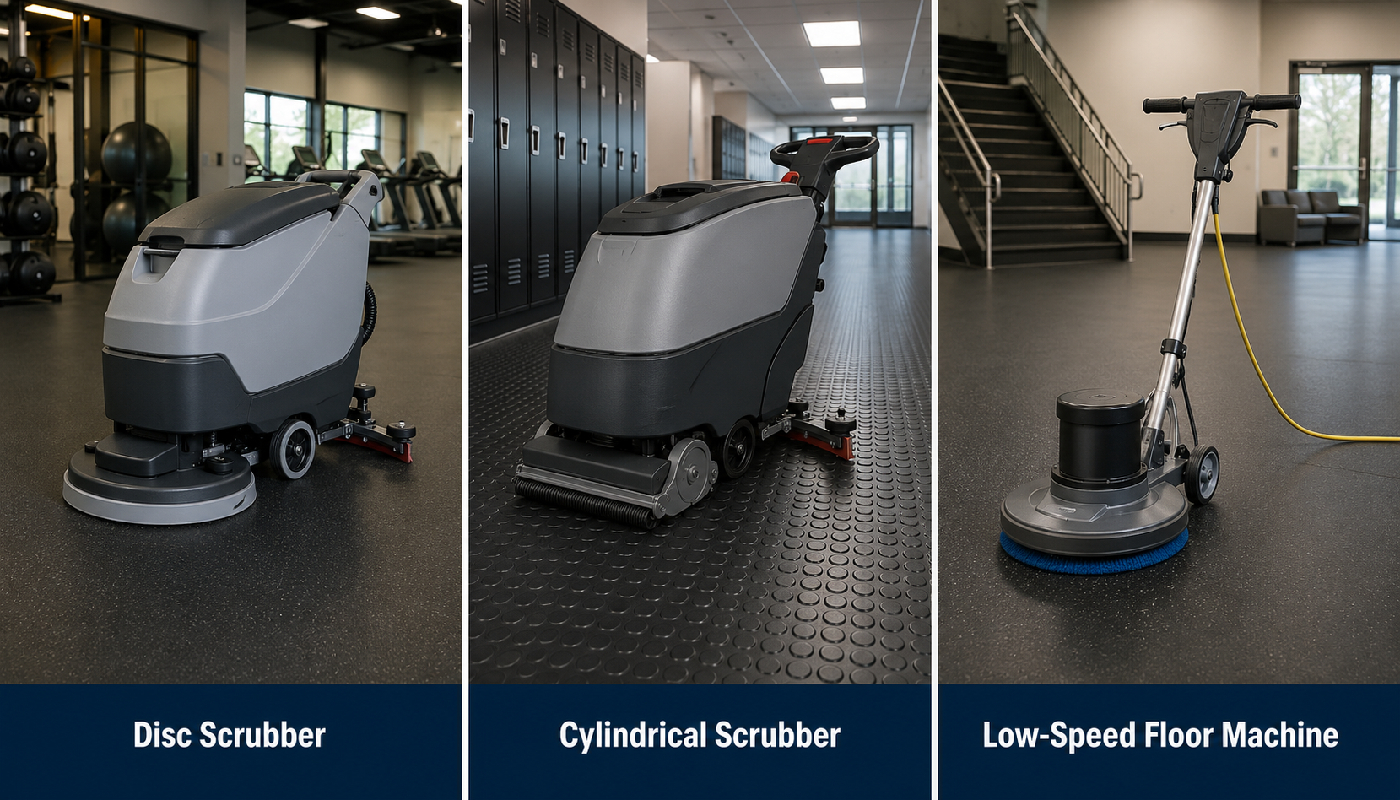
Disc scrubbers, cylindrical scrubbers, and low-speed floor machines each have different strengths depending on floor texture, facility size, and cleaning frequency.
Disc Scrubber vs. Cylindrical Scrubber vs. Low-Speed Floor Machine
There is no single machine that is best for every rubber floor.
Commercial Machines to Consider for Rubber Floors
These machines represent three useful cleaning approaches. Final machine, brush, and pad selection should match the specific flooring manufacturer's maintenance requirements.
TASKI ULTIMAXX 360
19.3-inch dual-disc walk-behind scrubber with lithium-ion battery power.
A strong option for routine maintenance in gyms, schools, healthcare facilities, corridors, fitness centers, and other commercial areas with compatible smooth or lightly textured rubber flooring.
View TASKI ULTIMAXX 360 →Karcher BR 85/100 W Bp Classic
Large walk-behind cylindrical scrubber designed for productive commercial floor cleaning.
A useful machine to consider for larger textured and profiled rubber floors where cylindrical brush contact can provide better access to recessed surface areas.
View Karcher BR 85/100 →Viper Venom VN1715 / VN2015
17-inch or 20-inch, 175 RPM low-speed commercial floor machine.
A practical option for periodic deep cleaning, controlled agitation, and smaller areas when paired with a compatible rubber-floor brush or pad.
View Viper Venom →
Match the floor-contact tool to the surface profile. Smooth rubber may allow good pad contact, while textured and studded rubber often benefit from brushes.
Smooth vs. Textured vs. Studded Rubber
Surface profile can be just as important as machine type because the pad or brush must physically contact the soil.

Flat pads mainly contact the upper surface, while brush bristles can reach farther into texture and recessed areas.
Choosing Between a Brush and Floor Pad
Floor Pad
Pads provide broad surface contact and may work well on smooth or lightly textured rubber when the pad is compatible with the flooring.
Best suited for:- Relatively smooth surfaces
- Routine cleaning
- Even surface contact
- Compatible coated floors
Scrub Brush
Brush bristles can flex into texture, seams, depressions, and recessed areas that a flat pad may pass over.
Best suited for:- Textured rubber
- Studded rubber
- Recessed surface profiles
- Embedded soil
Do Not Choose a Pad by Color Alone
Floor-pad aggressiveness varies by manufacturer and product line. A pad that is acceptable on one rubber floor may be too aggressive for another.
Confirm flooring and pad compatibility, start with the least aggressive tool likely to perform the job, and test an inconspicuous area before widespread use.
Be More Careful on Coated Rubber Floors
If a rubber floor has a factory treatment, field-applied coating, or other surface finish, aggressive pads or brushes may affect that treatment before they damage the rubber underneath.
Determine what is on the floor before increasing brush stiffness, pad aggressiveness, machine pressure, or chemical strength.
Match the Chemical to the Machine and Floor
Mechanical agitation is only one part of the cleaning process. Use compatible chemistry, correct dilution, adequate dwell time when appropriate, and thorough dirty-water recovery.
Best Cleaning Chemicals for Rubber Floors →Routine Cleaning vs. Deep Cleaning
Agitation Only Works if the Dirty Solution Is Removed
Brushes and pads loosen soil. The next step is removing that soil from the floor.
Auto scrubbers provide built-in recovery. When using a low-speed floor machine, use an appropriate wet vacuum or extraction method to recover dirty cleaning solution before it dries back onto the rubber.
Commercial Rubber Floor Cleaning Equipment
Compare commercial floor-cleaning equipment and contact Monster Janitorial if you need help matching a machine and floor-contact tool to your rubber flooring.
Rubber Floor Equipment Mistakes to Avoid
- Using a flat pad on heavily textured flooring without checking whether it reaches recessed areas.
- Choosing an aggressive pad or stiff brush before testing a less aggressive option.
- Increasing machine pressure to compensate for incorrect brush or pad selection.
- Using aggressive tools on coated rubber without confirming finish compatibility.
- Leaving dirty cleaning solution behind after scrubbing.
- Assuming every rubber floor can be stripped, coated, polished, or burnished.
- Skipping an inconspicuous test area when the floor construction or surface treatment is uncertain.
Continue Learning About Commercial Rubber Floors
Follow the series from floor identification through chemistry, equipment, deep cleaning, troubleshooting, restoration, and long-term maintenance.
How to Identify Commercial Rubber Flooring Before Cleaning
Identify sheet rubber, rubber tile, studded, textured, coated, and uncoated flooring.
Read Identification Guide →Best Cleaning Chemicals for Commercial Rubber Floors
Compare neutral, low-foam, degreasing, and odor-control chemistry.
Read Chemical Guide →Auto Scrubbers, Floor Machines, Brushes & Pads for Commercial Rubber Floors
Current Guide
How to Deep Clean Commercial Rubber Floors
Remove embedded soil using compatible chemistry, agitation, dwell time, and recovery.
Commercial Rubber Floor Problems: Dullness, Haze, Streaks, Black Marks, Odors & Sticky Floors
Diagnose residue, cleaning problems, soil, wear, odors, and surface damage.
Commercial Rubber Floor Restoration Guide
Determine when to deep clean, restore, recoat, repair, or replace.
Complete Commercial Rubber Floor Cleaning & Maintenance Guide
Use the complete guide as the central reference for rubber-floor identification, chemistry, equipment, deep cleaning, troubleshooting, restoration, and maintenance.
Rubber Floor Equipment FAQs
Can you use an auto scrubber on commercial rubber floors?
Many commercial rubber floors can be maintained with an appropriately configured auto scrubber. Confirm machine, brush or pad, chemical, and surface compatibility with the flooring manufacturer's maintenance requirements.
Is a brush or pad better for rubber flooring?
It depends on the surface. Pads can work well on smooth rubber, while brushes may provide better contact on textured, studded, or recessed flooring.
Are cylindrical scrubbers good for studded rubber floors?
Cylindrical brushes can be useful on some studded and textured rubber surfaces because the bristles can contact areas between raised features. Compatibility should still be confirmed for the specific floor.
Can you use a low-speed floor machine on rubber?
A low-speed machine can be useful for controlled scrubbing when equipped with a compatible brush or pad. Avoid assuming aggressive pads or high pressure are appropriate for every rubber floor.
Should rubber flooring be burnished?
Do not treat burnishing as a universal rubber-floor maintenance step. Some flooring systems have specific manufacturer-approved maintenance programs, while others should not be burnished or coated.
Need Help Choosing Equipment for Commercial Rubber Floors?
Monster Janitorial can help you compare auto scrubbers, floor machines, brushes, pads, and cleaning chemistry for smooth, textured, and studded commercial rubber flooring.
Tax-exempt purchasing and purchase-order support are available for qualifying schools, universities, government agencies, healthcare facilities, municipalities, and other institutional customers.