
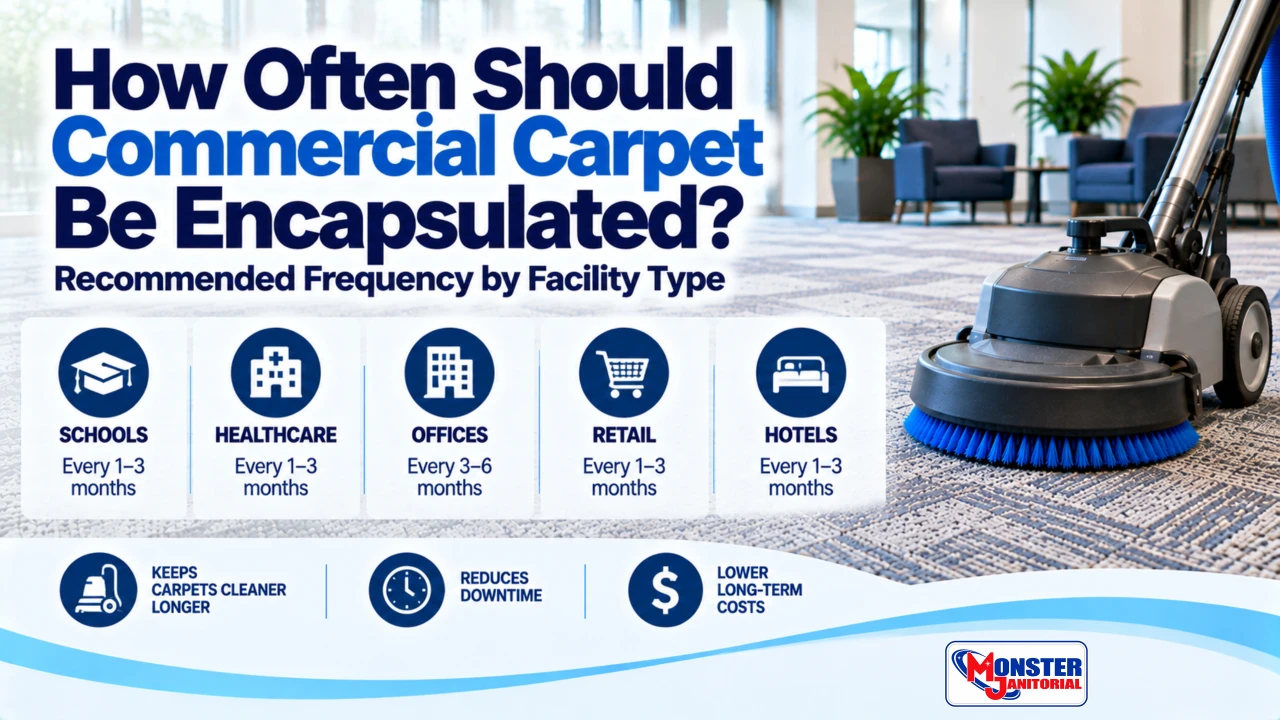
How Often Should Commercial Carpet Be Encapsulated?
Commercial carpet should be encapsulated according to traffic, soil load, carpet construction, vacuuming quality, weather, and facility appearance standards.
High-traffic areas may need low-moisture maintenance every few weeks or months, while lower-traffic spaces may only need encapsulation several times per year.
Use Traffic & Carpet Condition to Set the Schedule
As a planning range, high-traffic commercial carpet may need encapsulation about every 2 to 12 weeks. Moderate-traffic areas may fall around 3 to 6 months, while lower-traffic areas may only need service every 6 to 12 months. Adjust the schedule based on actual appearance, soil load, vacuuming performance, and facility requirements.
Commercial Carpet Encapsulation Frequency Guide
These are general starting points. Increase or decrease frequency based on visible soil, weather, traffic, carpet construction, facility standards, and maintenance performance.
Entrances & Main Traffic Lanes
About every 2–6 weeks when traffic is continuous or soil becomes visible quickly.
Busy Offices & Schools
About every 1–3 months in hallways, reception areas, libraries, and shared spaces.
Hotels & Public Areas
About every 1–3 months in lobbies, corridors, meeting rooms, and heavily used guest areas.
General Office Areas
About every 3–6 months when routine vacuuming maintains acceptable appearance.
Private or Light-Use Rooms
About every 6–12 months or when appearance begins to decline.
Visible Appearance Decline
Clean as needed when routine vacuuming no longer restores a consistent appearance.
What Determines Encapsulation Frequency?
Why Traffic Lanes Need More Frequent Cleaning
Entrances, hallways, elevator lobbies, waiting areas, service counters, and primary walking paths receive concentrated soil and wear. Repeated foot traffic can push dry soil deeper into the pile and flatten carpet before the rest of the room looks dirty.
Encapsulation by Facility Type
Schools & Universities
Focus on entrances, hallways, libraries, administrative spaces, and other heavily used carpet.
Offices
Prioritize reception areas, corridors, conference rooms, break rooms, and employee entrances.
Hotels
Monitor lobbies, guest corridors, elevators, meeting rooms, and public carpeted areas.
Healthcare Facilities
Use low-moisture cleaning only in compatible areas while following facility-specific procedures.
Retail Facilities
Watch entrances, checkout approaches, service counters, and primary customer routes.
Government Buildings
Focus on public entrances, waiting rooms, counters, corridors, and frequently used offices.
Vacuuming Can Change the Encapsulation Schedule
Frequent, effective vacuuming removes abrasive dry soil before it becomes embedded. A strong vacuuming program may extend the interval between encapsulation cycles and improve low-moisture cleaning results.
Encapsulation Does Not Replace Vacuuming
Carpet that is not thoroughly vacuumed before and after the process may remain dull or develop appearance problems. Encapsulation chemistry is intended to support a maintenance program, not replace dry-soil removal.
How Carpet Type Affects Frequency
Carpet appearance does not always reflect the actual soil load. Some constructions hide soil well, while others show traffic and pile distortion quickly.

Signs Carpet Is Ready for Encapsulation
Signs Encapsulation May Be Scheduled Too Often
When Encapsulation Is Not Enough
Hot-water extraction or another restorative process may be necessary when carpet contains heavy soil, chemical buildup, contamination, odors, or moisture below the visible surface.
Recommended Commercial Carpet-Maintenance Cycle
Example Commercial Carpet-Maintenance Schedules
These are planning examples only. Adjust them to the actual carpet, facility, weather, traffic, and cleaning results.
High-Traffic Facility
- Vacuum daily
- Spot clean daily
- Encapsulate about monthly
- Consider restorative extraction several times per year based on condition
Moderate-Traffic Facility
- Vacuum several times per week
- Spot clean as needed
- Encapsulate every 3–6 months
- Consider restorative extraction based on soil and residue
Low-Traffic Facility
- Vacuum weekly or as needed
- Spot clean promptly
- Encapsulate every 6–12 months
- Extract restoratively based on carpet condition
Increase maintenance during winter weather, construction, special events, unusually heavy traffic, or periods of poor entrance-mat performance.
Equipment Used for Encapsulation Maintenance
Encapsulation Cleaners for Commercial Carpet
These products are designed for compatible low-moisture and interim carpet-maintenance applications. Always verify carpet and equipment compatibility before use.
TASKI Dry Foam Shampoo & Encapsulation Cleaner
For compatible dry-foam and low-moisture commercial carpet-cleaning applications.
View TASKI Cleaner →Karcher Red Carpet iCapsol OA
Encapsulating interim cleaner for compatible commercial carpet-maintenance programs.
View Karcher iCapsol OA →Related Carpet-Care Guides
Learn More About Commercial Carpet Care
Explore guides covering encapsulation, hot-water extraction, carpet chemistry, fibers, spotting, drying, vacuums, and maintenance planning.
Explore Carpet Care Learning →Need Help Building a Carpet-Maintenance Schedule?
Monster Janitorial can help compare encapsulation chemicals, orbital machines, CRB systems, commercial vacuums, extractors, and drying equipment based on your carpet type, traffic level, facility size, and maintenance goals.
- #carpet appearance maintenance
- #carpet cleaning schedule
- #carpet soil removal
- #carpet traffic lanes
- #commercial carpet encapsulation
- #commercial carpet maintenance
- #commercial carpet vacuuming
- #counter-rotating-brush machine
- #cylindrical-brush carpet machine
- #encapsulation chemicals
- #encapsulation cleaning frequency
- #high-traffic carpet cleaning
- #hotel carpet cleaning
- #how often to encapsulate carpet
- #interim carpet cleaning
- #low-moisture carpet cleaning
- #MJ University
- #Monster Janitorial
- #office carpet maintenance
- #orbital carpet cleaning machine
- #restorative carpet extraction
- #school carpet cleaning