
MJ University Carpet Chemistry Guide
Encapsulation Chemicals Explained: How They Work and When to Use Them
Learn how commercial carpet encapsulation chemicals loosen soil, dry around residue, support low-moisture maintenance, and reduce downtime between restorative extractions.
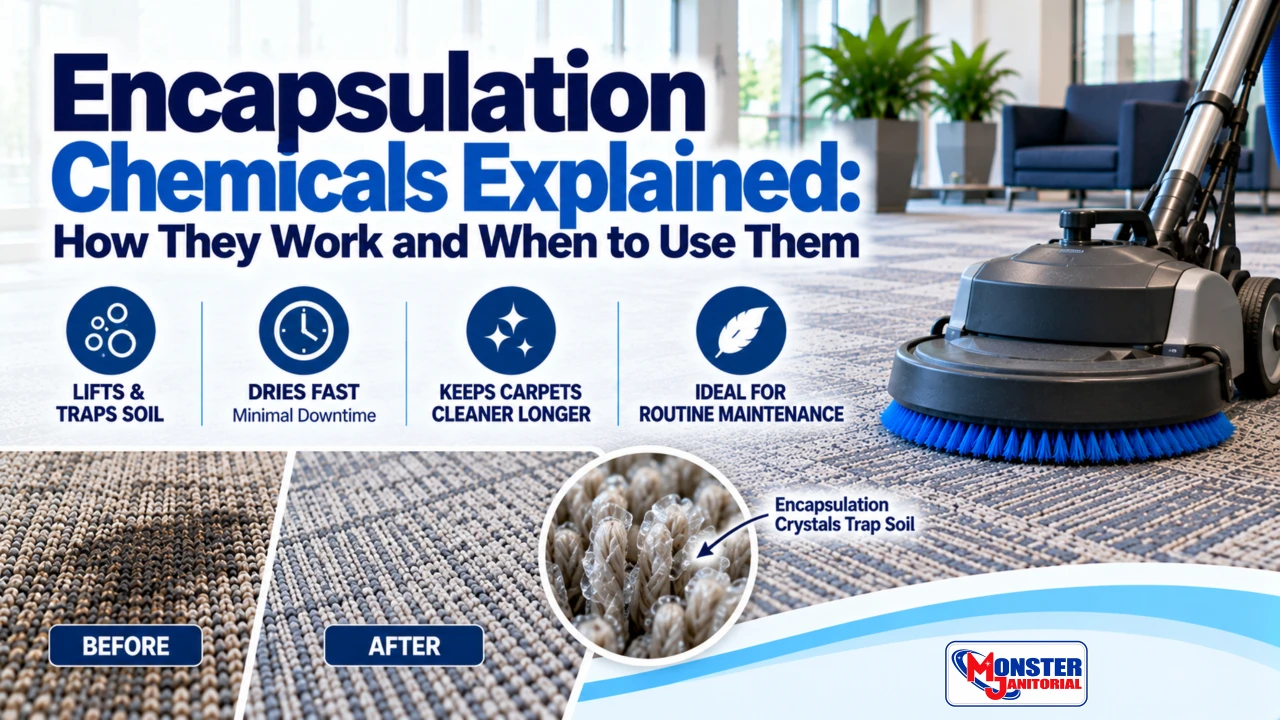
Encapsulation cleaning is a low-moisture commercial carpet-maintenance method. The chemical is applied to the carpet, distributed through controlled agitation, and allowed to dry. As it dries, the encapsulating polymer surrounds loosened soil and residue so the dried material can be removed during later vacuuming.
Encapsulation is especially useful for interim appearance maintenance in occupied facilities, but it does not replace restorative extraction in every situation. Carpet type, soil conditions, product instructions, equipment, drying, and post-vacuuming all affect the result.
The Main Encapsulation Rule
A true encapsulation product is generally designed to dry around loosened soil and be removed through vacuuming rather than immediately rinsed away. Always follow the product label because some low-moisture products may also support extraction or combination-cleaning methods.
What Is Encapsulation Carpet Cleaning?
Encapsulation is commonly used as an interim cleaning method between restorative hot-water extractions. It uses less moisture than extraction and can help improve carpet appearance with shorter drying times and less disruption.

How Encapsulation Chemistry Works
Encapsulation vs. Hot-Water Extraction
Encapsulation Cleaning
- Uses less moisture
- Supports faster drying
- Useful for interim maintenance
- Causes less facility disruption
- Requires post-vacuuming after drying
- Does not deeply flush carpet backing or cushion
Hot-Water Extraction
- Uses solution application and vacuum recovery
- Removes suspended soil immediately
- Better suited for restorative cleaning
- Can address deeper contamination
- Requires stronger moisture recovery
- May require more drying time and airflow
When Is Encapsulation a Good Choice?
Encapsulation works especially well where appearance must be maintained with limited moisture and short drying times.
When Encapsulation Is Not Enough
Encapsulation should not automatically replace restorative extraction when contamination extends below the visible carpet surface or when heavy residue must be flushed and recovered.
Encapsulation Chemicals vs. Dry-Foam Shampoo
Encapsulation and dry-foam products may overlap, but the terms are not always interchangeable. Product formulation and label instructions determine the approved equipment and cleaning method.
- Encapsulation cleaner
- Dry-foam shampoo
- Crystallizing cleaner
- Low-moisture detergent
- Interim carpet cleaner
- CRB agitation
- Orbital cleaning
- Rotary shampooing
- Bonnet or pad cleaning
- Extraction or combination cleaning
What Equipment Is Used for Encapsulation Cleaning?
Why Pre-Vacuuming Matters
Dry particulate soil should be removed before liquid chemistry is introduced. Commercial carpet can hold a large amount of loose soil below the visible surface.
Correct Dilution and Application
Encapsulation products must be measured and applied according to the label. Applying more chemical than needed does not automatically improve cleaning.
Too Little Product
- Incomplete soil suspension
- Uneven cleaning
- Poor encapsulation
- Visible traffic-lane differences
Too Much Product
- Excess residue
- Longer drying time
- Stiff carpet texture
- Increased vacuum loading
- Possible rapid resoiling
Agitation and Brush Selection
Agitation distributes the encapsulation product, improves fiber contact, and helps loosen soil. The safest brush or pad depends on the carpet’s construction and condition.

Drying and Post-Vacuuming Complete the Process
Encapsulation cleaning is not complete when the carpet merely looks dry. The dried polymer and encapsulated soil must be removed through thorough vacuuming.
- Keep traffic off the carpet during drying.
- Use airflow when faster drying is required.
- Vacuum after the product has dried as directed.
- Use a brush-type commercial vacuum where appropriate.
- Make multiple passes in traffic lanes.
- Empty vacuum bags or bins as needed.
- Continue removing remaining residue during later maintenance cycles.
Does Encapsulation Chemical Need to Be Rinsed?
A true encapsulation product is usually designed to dry and be removed through later vacuuming rather than immediate rinsing. That is one of the main differences between encapsulation chemistry and conventional pre-spray-and-extraction cleaning.
Encapsulation by Carpet Type
Recommended Monster Janitorial Chemicals
Encapsulation and Dry-Foam Carpet Cleaners
These low-moisture products support commercial interim carpet maintenance. Review each product label for approved dilution, equipment, carpet compatibility, drying, and vacuuming instructions.
Dry-Foam & Encapsulation
TASKI Dry Foam Shampoo & Encapsulation Cleaner
A commercial low-moisture carpet cleaner for compatible dry-foam, shampoo, and encapsulation maintenance systems.
View TASKI 9BP92017Interim Encapsulation Cleaner
Red Carpet iCapsol OA Encapsulating Interim Cleaner
A dedicated low-moisture encapsulation product for interim commercial carpet cleaning and appearance maintenance.
View Karcher 8.760-135.0Common Encapsulation Cleaning Mistakes
Encapsulation Cleaning Checklist
- Identify the carpet fiber and construction.
- Inspect seams, backing, adhesive, and existing damage.
- Vacuum thoroughly before applying chemistry.
- Review the product label and approved methods.
- Measure the correct dilution.
- Test an inconspicuous area.
- Apply chemistry evenly.
- Use approved agitation equipment.
- Avoid excessive moisture.
- Keep traffic off the carpet while drying.
- Use airflow when needed.
- Vacuum thoroughly after drying.
- Schedule restorative extraction when conditions require it.
- Document the successful procedure.
Continue Learning
Need Help Choosing an Encapsulation Chemical?
Monster Janitorial can help match low-moisture carpet chemistry to your carpet type, soil conditions, facility schedule, agitation equipment, drying requirements, and maintenance program.
Phone: 956-772-4842
Email: sales@monsterjanitorial.com