
MJ University Carpet Care Guide
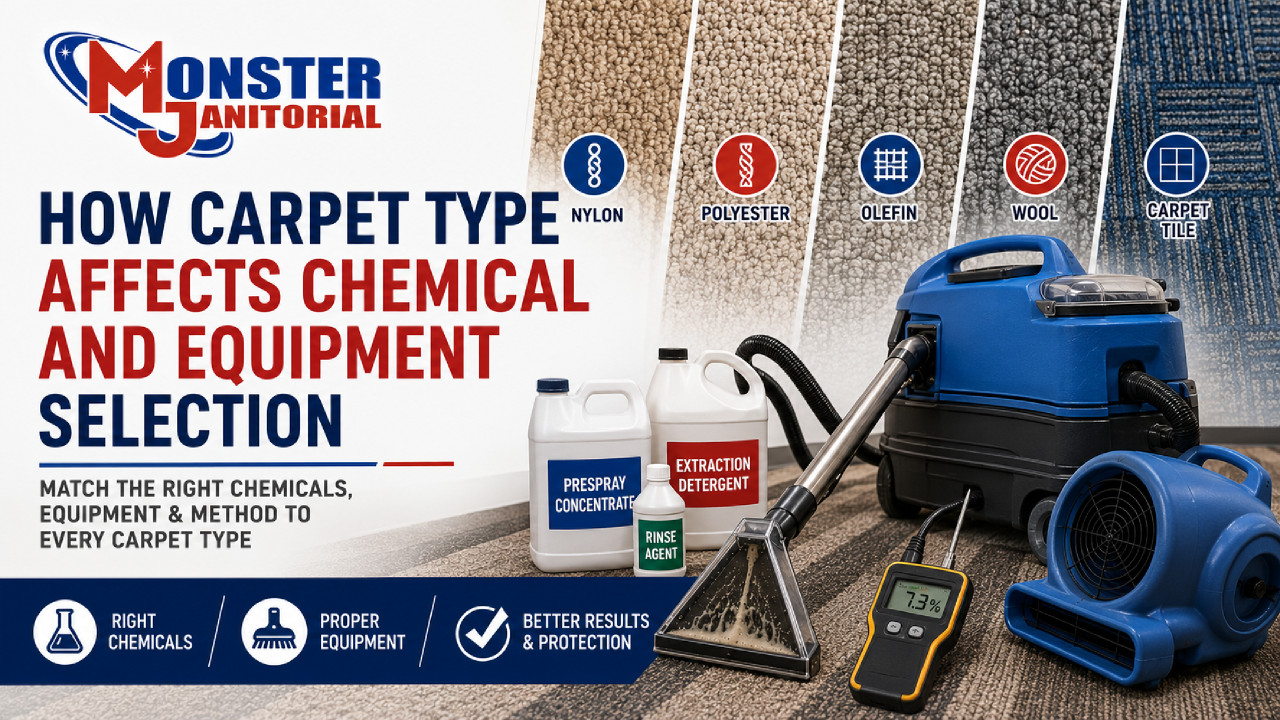
How Commercial Carpet Type Affects Chemical and Equipment Selection
Learn how carpet fiber, construction, backing, installation, soil conditions, and drying requirements affect the chemicals, agitation systems, vacuums, extractors, and drying equipment used for commercial carpet care.
The Most Important Selection Rule
Do not select carpet chemicals or equipment based only on visible soil. Confirm the carpet fiber, construction, backing, installation method, manufacturer requirements, and existing condition before choosing chemistry, agitation, extraction pressure, heat, moisture, or drying procedures.
Why Carpet Type Changes the Cleaning Plan
Commercial carpet that looks similar may respond very differently to alkalinity, solvents, heat, agitation, moisture, and extraction. The wrong chemical-and-equipment combination can leave residue, distort fibers, damage backing, soften adhesive, cause color loss, or extend drying time.
Fiber Type
Nylon, polyester, olefin, wool, blends, and specialty fibers respond differently to chemistry, heat, and agitation.
Carpet Construction
Loop pile, cut pile, broadloom, carpet tile, woven, and needle-punched carpet require different agitation and recovery procedures.
Backing & Installation
Direct glue-down, double glue-down, stretch-in, cushion, and modular tile installations tolerate moisture differently.
Soil & Facility Conditions
Dry particulate soil, oils, food spills, salt, residue, odors, and traffic patterns affect both chemistry and machine selection.
Inspect Before Selecting Chemicals or Equipment
Document stains, color loss, loose seams, delamination, ripples, adhesive residue, previous browning, wicking, odor, and worn fibers before cleaning. Existing damage may become more visible after soil is removed.
Nylon Commercial Carpet
Nylon is durable, resilient, and widely used in offices, schools, hotels, healthcare facilities, and other high-traffic commercial spaces. It can usually support routine vacuuming, encapsulation, and restorative extraction when manufacturer requirements are followed.
Chemical Selection
- Commercial carpet pre-sprays
- Low-residue extraction detergents
- Compatible rinse agents
- Encapsulation products
- Fiber-safe spotters
Equipment Selection
- Commercial upright or backpack vacuum
- CRB or orbital agitation system
- Portable or self-contained extractor
- Carpet grooming equipment
- Air movers for drying
Polyester Commercial Carpet
Polyester offers strong color clarity and resistance to many water-based stains, but it may attract and retain oily soil. Traffic lanes often require chemistry that targets oils without leaving sticky detergent residue.
Chemical Selection
- Preconditioners designed for oily soil
- Low-residue extraction detergents
- Compatible grease and oil spotters
- Encapsulation chemistry
- Controlled rinse products
Equipment Selection
- Strong commercial vacuum
- Controlled-agitation machine
- Extractor with effective vacuum recovery
- Carpet grooming equipment
- Air movers for rapid drying
Olefin Commercial Carpet
Olefin, also called polypropylene, is common in loop-pile carpet and commercial carpet tile. It resists moisture but often attracts oily soil and may flatten or distort under heavy traffic.
Chemical Selection
- Products effective on oily soil
- Low-residue encapsulation products
- Controlled extraction detergents
- Compatible grease spotters
- Low-foaming rinse agents
Equipment Selection
- Vacuum with strong dry-soil pickup
- CRB or gentle agitation system
- Extractor with controlled temperature
- Low-moisture orbital equipment
- Air movers for fast drying
Wool Commercial Carpet
Wool is a premium natural fiber found in hotels, executive areas, historic buildings, and specialty installations. It requires conservative chemistry, gentle agitation, controlled moisture, and careful drying.
Chemical Selection
- Wool-approved cleaning solutions
- Mild preconditioners
- Wool-safe spotters
- Controlled-pH rinse agents
- Low-moisture products approved for wool
Equipment Selection
- Gentle commercial vacuum
- Soft-brush or approved agitation system
- Extractor with adjustable pressure
- Controlled water temperature
- Air movers positioned for gentle airflow
Blended and Specialty Carpet Fibers
Blended and proprietary carpet systems may combine fibers, specialty treatments, recycled content, or manufacturer-specific backing. Use the most conservative cleaning requirement for the materials present.
- Confirm the manufacturer and fiber percentages.
- Review warranty and maintenance requirements.
- Test chemistry, heat, agitation, and moisture.
- Protect the most sensitive fiber or component.
- Document the successful cleaning procedure.
Carpet Tile and Direct Glue-Down Carpet
Carpet tile and direct glue-down carpet are common in offices, schools, healthcare facilities, and public buildings. Their low-profile construction often supports efficient low-moisture maintenance, but excess water may affect adhesive and seams.
Recommended Methods
- Routine commercial vacuuming
- Encapsulation cleaning
- Low-moisture orbital cleaning
- Controlled hot-water extraction
Equipment Priorities
- Controlled solution delivery
- Gentle or moderate agitation
- Strong vacuum recovery
- Immediate airflow
Stretch-In and Cushioned Carpet
Stretch-in carpet is installed over cushion and secured around the perimeter. Moisture that reaches the cushion may increase drying time, odor, shrinkage risk, and wicking.
Recommended Approach
- Controlled pre-spray application
- Moderate extraction pressure
- Multiple dry extraction passes
- Immediate airflow and drying
Inspect Before Cleaning
- Loose seams or edges
- Existing ripples
- Moisture-sensitive cushion
- Previous water damage
Loop-Pile vs. Cut-Pile Equipment Selection
Loop-Pile Carpet
Loop-pile carpet is durable but may fuzz, unravel, or distort when aggressive agitation is used.
- Use controlled brush pressure
- Avoid overly aggressive rotary agitation
- Inspect loops and seams before cleaning
- Use manufacturer-approved grooming
Cut-Pile Carpet
Cut-pile carpet may hold soil deeper in the pile and often benefits from thorough vacuuming, controlled preconditioning, extraction, and grooming.
- Vacuum slowly in multiple directions
- Use appropriate pile agitation
- Extract embedded soil thoroughly
- Groom the pile after cleaning
Match Equipment to the Cleaning Goal
Match Chemistry to the Soil as Well as the Carpet
Carpet type determines what chemistry is safe, while soil type determines what chemistry is needed. Both must be considered before selecting a product.
Common Chemical and Equipment Selection Mistakes
Chemical and Equipment Selection Checklist
- Confirm the carpet fiber and manufacturer.
- Identify the construction, backing, and installation method.
- Inspect seams, edges, carpet tiles, and existing damage.
- Identify the dominant soil type.
- Select chemistry approved for both the fiber and cleaning method.
- Test colorfastness, residue, and texture response.
- Use the least aggressive effective agitation.
- Confirm extractor pressure, heat, and vacuum recovery.
- Plan airflow and drying before applying moisture.
- Document the successful process for future maintenance.
Continue Learning
Need Help Matching Carpet Chemicals and Equipment?
Monster Janitorial can help match your carpet type, soil conditions, maintenance schedule, chemicals, vacuum, agitation system, extractor, and drying equipment.
Phone: 956-772-4842
Email: sales@monsterjanitorial.com