
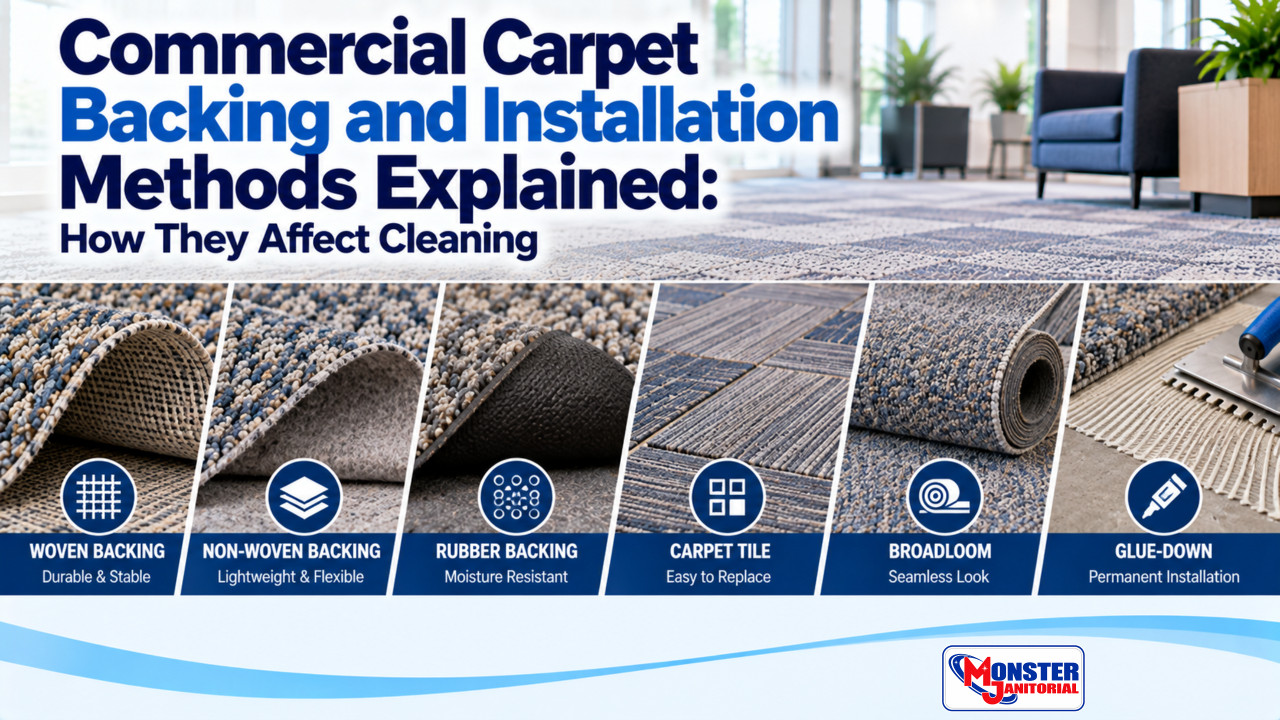
MJ University Carpet Care Guide
How Carpet Backing and Installation Method Affect Commercial Carpet Cleaning
Carpet fiber is only one part of the cleaning decision. The backing, adhesive, cushion, seams, and installation method also affect how much moisture, heat, agitation, and extraction pressure can be used safely.
Why Backing and Installation Matter
Two carpets made from the same fiber may require different cleaning procedures if one is direct-glued to concrete and the other is stretched over cushion.
Moisture that is easily recovered from one installation may become trapped beneath another, increasing the risk of wicking, odor, seam damage, adhesive failure, or extended drying.
Do Not Assume the Installation Is Dry Underneath
Carpet can feel dry at the surface while moisture remains in the backing, adhesive, cushion, seams, or subfloor. Plan drying around the complete installation—not only the face fiber.
Four Details to Identify Before Cleaning
Carpet Fiber
Identify whether the face fiber is nylon, polyester, olefin, wool, or a blend.
Carpet Construction
Determine whether the carpet is loop pile, cut pile, broadloom, woven, needle-punched, or modular tile.
Backing System
Inspect the primary backing, secondary backing, cushion layer, moisture barrier, and visible condition.
Installation Method
Confirm whether the carpet is direct glue-down, double glue-down, stretch-in, modular tile, or another specialty installation.
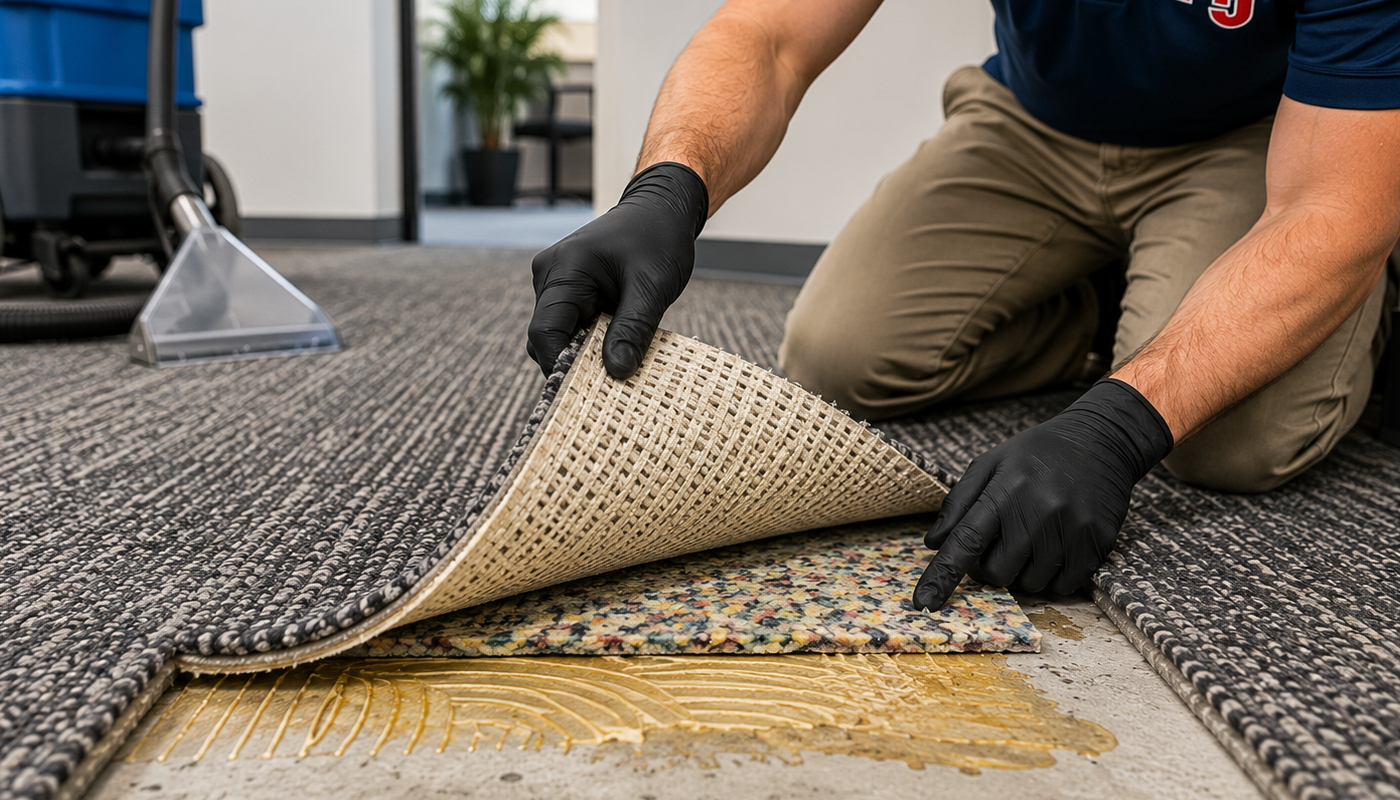
Inspect the backing, cushion, adhesive, seams, and subfloor before selecting the cleaning method and moisture level.
How to Identify the Carpet Installation Method
- Review flooring records, project specifications, invoices, or maintenance documents.
- Look for spare carpet tiles, attic stock, backing labels, or manufacturer information.
- Inspect edges near thresholds, floor vents, transition strips, or utility openings.
- Check whether the carpet lifts slightly, remains tightly bonded, or has cushion underneath.
- Inspect seams, corners, perimeter tack strips, and tile edges.
- Ask the facility manager about prior repairs, water damage, adhesive issues, or replacement sections.
Inspection Tip
Photograph seams, loose edges, damaged tiles, ripples, discoloration, and existing delamination before cleaning.
Common Commercial Carpet Backing Types
Primary and Secondary Backing
Tufted carpet typically uses a primary layer that holds the yarn and a secondary layer that adds dimensional stability. Excess moisture or harsh chemistry can weaken the bond between these layers and contribute to delamination.
PVC-Backed Carpet Tile
PVC-backed tile is common in offices, schools, healthcare facilities, and public buildings. It provides dimensional stability but may trap moisture beneath the tile when overwet.
Bitumen-Backed Carpet Tile
Bitumen-backed systems may be sensitive to excessive heat, solvents, or moisture migration. Follow manufacturer recommendations for chemistry and extraction temperature.
Cushion-Backed Carpet Tile
Cushion-backed tile can improve comfort and sound control but may retain more moisture than hard-backed tile. Use conservative solution application and strong drying procedures.
Woven or Specialty Backing
Woven, wool, historic, and specialty carpet systems may use natural fibers, latex, or proprietary backing materials that require conservative chemistry, moisture, heat, and agitation.
Moisture-Barrier Backing
Moisture-barrier backing helps limit liquid penetration but can also slow downward drying. Surface recovery and horizontal airflow become especially important.
Common Commercial Carpet Installation Methods
Direct Glue-Down Carpet
Direct glue-down carpet is bonded directly to concrete, wood, or another prepared substrate. It is common in offices, schools, corridors, retail stores, and high-traffic facilities.
Stable installation, limited movement, and generally good compatibility with controlled low-moisture cleaning and extraction.
Adhesive softening, moisture migration, wicking from the subfloor, seam lifting, and delayed drying beneath the carpet.
Double Glue-Down Carpet
Double glue-down carpet uses a cushion bonded to the subfloor with carpet bonded over the cushion. It provides comfort and stability but creates additional layers that can hold moisture.
Reduce solution application, make multiple recovery passes, monitor seams, and begin drying immediately.
Moisture retained in the cushion, adhesive failure between layers, odor, extended drying, and recurring stains.
Stretch-In Carpet Over Cushion
Stretch-in carpet is secured around the perimeter and installed over a separate cushion. It is often found in hotels, offices, meeting rooms, and hospitality spaces.
Avoid overwetting, control extraction pressure, recover moisture thoroughly, groom the pile, and dry both carpet and cushion.
Cushion saturation, rippling, shrinkage, seam stress, browning, odor, and trapped moisture.
Modular Carpet Tile
Carpet tile is widely used in commercial facilities because damaged sections can often be replaced individually. Tile may use permanent adhesive, releasable adhesive, or specialty connectors.
Limit moisture around seams, use controlled agitation, inspect loose corners, and dry quickly.
Tile curling, seam lifting, adhesive transfer, moisture beneath tiles, uneven drying, and edge discoloration.
Match the Cleaning Method to the Installation
Routine Vacuuming
Removes abrasive dry soil without adding moisture and should be the foundation of every carpet program.
Encapsulation
Useful for carpet tile, direct glue-down carpet, occupied facilities, and interim appearance maintenance.
Hot-Water Extraction
Use controlled solution flow, sufficient recovery, multiple dry passes, and immediate airflow.
Spot Treatment
Use the least moisture needed, avoid flooding seams, and rinse or neutralize residues as directed.
How Installation Changes Extraction Procedures
Solution Flow
Use only enough solution to loosen and suspend soil. Avoid repeatedly saturating the same area.
Recovery Passes
Make slow, overlapping extraction passes followed by additional dry-only passes.
Water Temperature
Confirm temperature limits for the fiber, backing, adhesive, and carpet manufacturer.
Agitation
Match brush stiffness and agitation level to the carpet construction, seam condition, and installation.
Edge Control
Apply less solution near thresholds, seams, walls, damaged edges, outlets, and transitions.
Drying Plan
Position air movers before cleaning is complete so airflow can begin immediately.
Common Problems Caused by Overwetting
Drying Carpet Based on Installation Method
Drying should begin immediately after cleaning. Move dry air across the carpet surface, remove moisture from the room, and prevent moisture from remaining in the backing, cushion, adhesive, or subfloor.
- Use multiple dry extraction passes.
- Groom the carpet to improve appearance and airflow.
- Position air movers so air travels across the carpet surface.
- Use dehumidification when indoor humidity is high.
- Open doors between rooms when appropriate to improve air movement.
- Check seams, edges, cushion, and problem areas before removing drying equipment.
Common Carpet Backing and Installation Mistakes
Pre-Cleaning Backing and Installation Checklist
- Confirm the carpet manufacturer, fiber, construction, and backing.
- Identify the installation and adhesive system.
- Inspect seams, edges, tiles, ripples, and existing delamination.
- Check for prior water damage, odor, browning, or recurring stains.
- Select chemistry approved for the fiber and backing.
- Test the cleaning method in an inconspicuous area.
- Control solution flow, heat, agitation, and extraction pressure.
- Prepare air movers and dehumidification before cleaning.
- Document the procedure and drying results.
Continue Learning
Need Help Choosing Carpet Cleaning Equipment or Chemicals?
Monster Janitorial can help match the carpet fiber, backing, installation method, facility conditions, cleaning chemistry, extractor, vacuum, and drying equipment.
Phone: 956-772-4842
Email: sales@monsterjanitorial.com
- #Carpet Adhesive
- #Carpet Backing
- #Carpet Delamination
- #Carpet Drying
- #Carpet Installation Methods
- #Carpet Tile
- #Carpet Wicking
- #Commercial Carpet Care
- #Commercial Carpet Extraction
- #Direct Glue-Down Carpet
- #Double Glue-Down Carpet
- #Low-Moisture Carpet Cleaning
- #MJ University
- #Modular Carpet Tile
- #Stretch-In Carpet