
MJ University Carpet Care
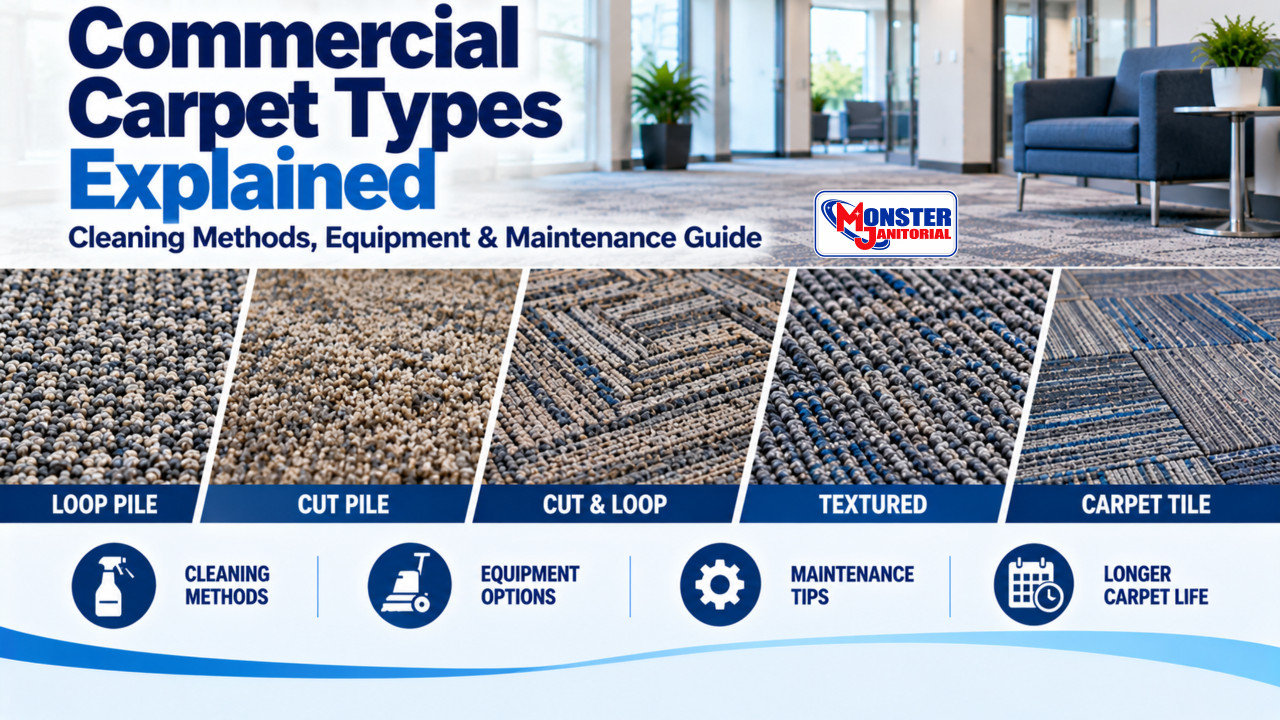
Commercial Carpet Types Explained: Cleaning Methods, Equipment & Maintenance by Carpet Style
Learn how carpet construction, fiber type, backing, and installation method affect commercial carpet cleaning. This guide explains carpet tile, broadloom, loop pile, cut pile, nylon, olefin, polyester, wool, and the cleaning methods commonly used for each type.
Why Commercial Carpet Type Matters
Commercial carpet is not a single flooring system. Two carpets may look similar while using different fibers, pile constructions, backings, adhesives, and installation methods.
These differences affect how the carpet holds soil, responds to agitation, tolerates moisture, releases stains, and dries after cleaning. Identifying the carpet type before selecting chemicals or equipment helps reduce the risk of texture damage, color changes, wicking, slow drying, and poor cleaning results.
Quick Answer: Which Cleaning Method Is Best for Commercial Carpet?
There is no single cleaning method that is best for every carpet. Carpet tile and low-profile commercial carpet often respond well to encapsulation and controlled-moisture cleaning. Broadloom carpet may require periodic hot-water extraction. Wool requires compatible chemistry and careful temperature control, while olefin often needs stronger oily-soil removal.

Four Carpet Details to Identify Before Cleaning
Fiber Type
Nylon, olefin, polyester, wool, and blended fibers respond differently to chemicals, heat, stains, and agitation.
Pile Construction
Loop pile, cut pile, patterned carpet, and low-profile carpet require different agitation and grooming approaches.
Backing System
The backing influences moisture tolerance, dimensional stability, drying time, and the risk of adhesive problems.
Installation Method
Direct-glue carpet, carpet tile, stretch-in carpet, and cushion-backed systems may require different moisture controls.

Commercial Carpet Construction Types
Carpet construction affects appearance, soil retention, agitation requirements, moisture tolerance, and the cleaning equipment that can be used safely.
Carpet Tile
Carpet tile is common in offices, schools, airports, healthcare facilities, and modular commercial spaces. Individual tiles can often be replaced when damaged.
Cleaning considerations
- Control moisture around seams and adhesive
- Avoid over-wetting the backing
- Use repeated dry extraction passes
- Encapsulation can support interim maintenance
Common methods: Encapsulation, low-moisture cleaning, spot extraction, and controlled hot-water extraction.
Broadloom Carpet
Broadloom carpet is installed in large rolls and is often found in hotels, offices, conference rooms, healthcare facilities, theaters, and hospitality environments.
Cleaning considerations
- Inspect seams and backing before extraction
- Use proper solution control
- Allow adequate drying time
- Groom cut-pile carpet when appropriate
Common methods: Hot-water extraction, low-moisture maintenance, spot cleaning, and routine vacuuming.
Loop-Pile Carpet
Loop-pile carpet uses yarn loops that remain uncut. It is durable and common in high-traffic commercial buildings.
Cleaning considerations
- Avoid aggressive brushes that may damage loops
- Inspect for pulled or damaged yarn
- Use controlled agitation
- Vacuum thoroughly before wet cleaning
Common methods: Encapsulation, controlled extraction, low-moisture cleaning, and regular commercial vacuuming.
Cut-Pile Carpet
Cut-pile carpet has yarn loops cut at the top, creating a softer surface. It is commonly used in hotels, executive offices, lounges, and hospitality spaces.
Cleaning considerations
- May show traffic patterns and shading
- Can retain fine soil below the surface
- May benefit from grooming after extraction
- Requires strong vacuum preparation
Common methods: Hot-water extraction, interim low-moisture cleaning, spotting, and grooming.
Commercial Carpet Fiber Types
Fiber type influences stain resistance, oil attraction, durability, chemical tolerance, heat sensitivity, and how easily soil can be removed.
Nylon Carpet
Durable and resilient, making it one of the most common fibers in commercial carpet.
Watch for: Dye damage from improper chemistry and residue that attracts soil.
Olefin or Polypropylene
Resists many water-based stains but can attract oily soil and show crushing in traffic lanes.
Watch for: Grease, oil, filtration soil, and aggressive heat.
Polyester Carpet
Offers good color and stain resistance but may flatten faster in heavily trafficked areas.
Watch for: Oily soil and permanent traffic-lane distortion.
Wool Carpet
A natural fiber used in premium hospitality, institutional, and decorative environments.
Watch for: Excess heat, high alkalinity, over-wetting, color bleeding, and shrinkage.
Solution-Dyed Carpet
Color is added during fiber manufacturing, generally providing strong colorfastness and resistance to fading.
Watch for: Backing limitations and chemical restrictions still apply.
Cleaning Method by Commercial Carpet Type
Carpet Tile
Use controlled moisture, strong recovery, dry passes, and fast drying. Encapsulation is often useful for interim maintenance.
Broadloom Carpet
Combine routine vacuuming, spot cleaning, low-moisture maintenance, and scheduled restorative extraction.
Loop Pile
Use gentle agitation and inspect brush compatibility before using aggressive mechanical action.
Cut Pile
Vacuum thoroughly, extract evenly, control moisture, and groom the pile when recommended.
Olefin Carpet
Use chemistry suited for oily soil, provide adequate dwell time, and rinse thoroughly to reduce residue.
Wool Carpet
Use wool-compatible products, lower temperatures, controlled moisture, and test before cleaning large areas.
Commercial Carpet-Care Equipment
Choose Equipment Based on Carpet Type and Cleaning Method
Equipment should match the carpet construction, fiber, soil level, facility size, and moisture restrictions.
Carpet Extractors
For scheduled deep cleaning, rinsing, soil removal, and restorative carpet maintenance.
Shop Carpet Extractors →Carpet Spotters
For spills, stains, upholstery, stairs, small areas, and fast-response cleaning.
Shop Carpet Spotters →Carpet Chemicals
Presprays, extraction detergents, encapsulation products, rinses, spotters, and defoamers.
Shop Carpet Chemicals →Air Movers
Increase airflow and reduce carpet drying time after extraction or spot cleaning.
Shop Air Movers →Common Carpet-Type Cleaning Mistakes
Different fibers, backings, and constructions require different cleaning methods.
Excess moisture may affect adhesive, seams, backing, and drying time.
Aggressive agitation may pull, fuzz, or distort looped yarn.
Incompatible chemistry can damage natural fibers or affect color.
Olefin can resist water-based stains while holding oily contamination.
Test chemicals and agitation in a hidden area before full-scale cleaning.
Commercial Carpet Type FAQs
What is the most common commercial carpet fiber?
Nylon is widely used in commercial carpet because it provides durability, resilience, and strong performance in high-traffic environments.
Is carpet tile safe to extract?
Many carpet tile systems can be extracted, but moisture should be controlled and the carpet manufacturer’s maintenance recommendations should be followed.
What carpet is best for low-moisture cleaning?
Low-profile commercial carpet and many carpet tile systems are commonly maintained with encapsulation or other controlled-moisture methods.
How can I identify commercial carpet fiber?
Check manufacturer documentation, installation records, product labels, or consult the flooring supplier. Avoid relying only on appearance.
Need Help Choosing Carpet-Care Equipment?
Monster Janitorial can help you choose the right extractor, spotter, carpet chemical, cleaning method, and drying equipment for your commercial carpet type.
Phone: 956-772-4842
Email: sales@monsterjanitorial.com
- #Broadloom Carpet
- #Carpet Care
- #Carpet Cleaning Chemicals
- #Carpet Cleaning Methods
- #Carpet Extractors
- #Carpet Spotters
- #Carpet Tile
- #Commercial Carpet Cleaning
- #Commercial Carpet Types
- #Commercial Floor Care
- #Cut Pile Carpet
- #Encapsulation Cleaning
- #Hot-Water Extraction
- #Loop Pile Carpet
- #Low-Moisture Carpet Cleaning
- #MJ University
- #Nylon Carpet
- #Olefin Carpet
- #Polyester Carpet
- #Solution-Dyed Carpet
- #Wool Carpet