
MJ University Carpet-Chemistry Guide
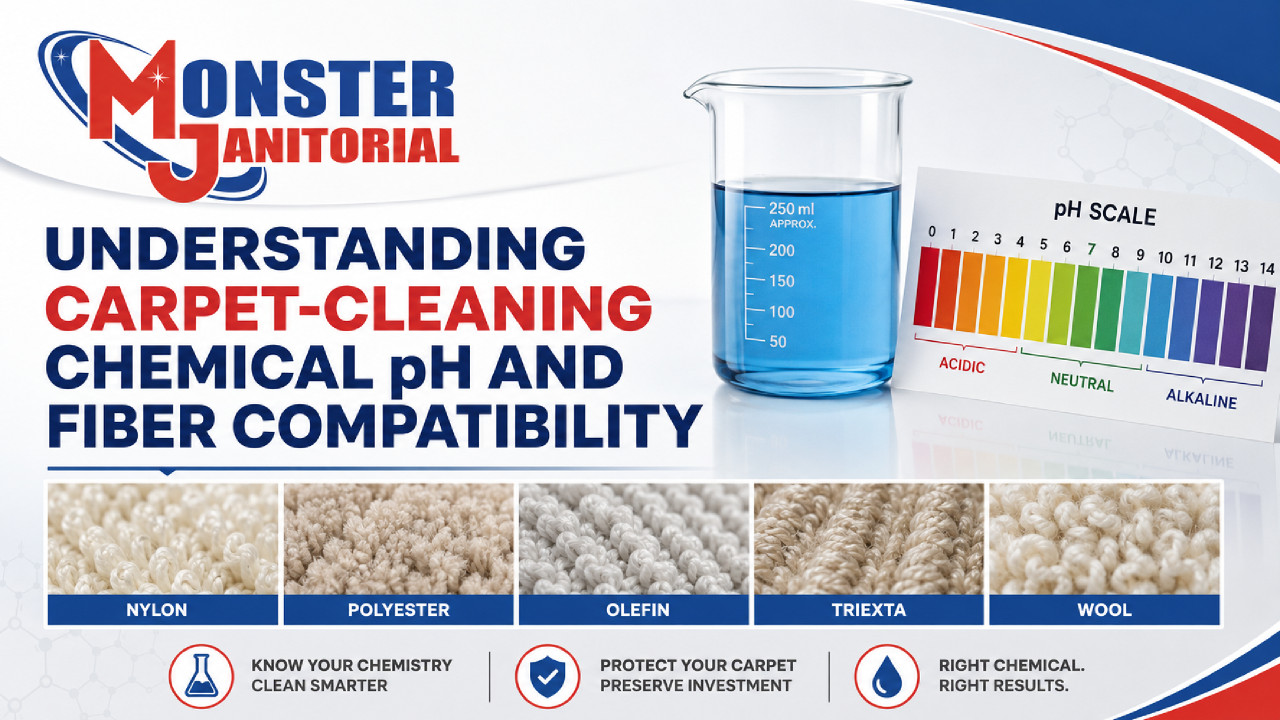
Understanding Carpet-Cleaning Chemical pH and Fiber Compatibility
Carpet-cleaning chemical pH helps explain whether a solution is acidic, neutral, or alkaline, but pH alone does not determine whether a product is compatible with a carpet. Fiber type, dye method, buffering, concentration, dwell time, temperature, agitation, backing, adhesive, residue, and drying conditions all affect the final result.
The Most Important Rule
Do not select a carpet-cleaning chemical by pH alone. Identify the carpet fiber, dye method, construction, backing, installation, soil type, and existing condition before choosing the chemical and cleaning process.
What Does Carpet-Cleaning Chemical pH Mean?
The pH scale describes the acidity or alkalinity of a water-based solution. The scale generally runs from 0 to 14, with 7 considered neutral.
pH Does Not Measure Cleaning Strength by Itself
A higher-pH product is not automatically a better cleaner. Cleaning performance depends on the complete formulation and the way the product is used.
Concentrate pH vs. Use-Dilution pH
The pH of the concentrated product may differ from the pH of the cleaning solution after it is diluted. Water quality, dilution rate, temperature, minerals, and buffering can all affect the final solution.
- Review the product at its intended use dilution.
- Measure chemicals accurately rather than estimating.
- Account for water quality and temperature.
- Do not assume dilution always moves the pH close to neutral.
- Follow the product label and carpet manufacturer’s guidance.
What Is Chemical Buffering?
Buffering describes how strongly a solution resists a change in pH. Two products may have similar measured pH values but behave very differently during cleaning, rinsing, and neutralization.
Lightly Buffered Product
Its pH may change more readily during dilution, rinsing, or neutralization.
Strongly Buffered Product
It may remain acidic or alkaline longer and may require more controlled rinsing and residue removal.
Why Carpet Fiber Compatibility Matters
Carpet fibers differ in how they attract oil, absorb moisture, hold dye, tolerate heat, respond to solvents, retain texture, and react to chemical residue.
Nylon Carpet and Chemical Compatibility
Nylon is widely used in commercial carpet because it offers strong resilience and texture retention. It generally responds well to professional extraction and encapsulation, but chemistry should still be selected carefully.
- May have stain-resistant or soil-resistant treatments.
- Strong alkalinity may reduce stain protection.
- Acid-based stains may attach to available dye sites.
- Thorough rinsing helps control residue.
- Test when the treatment history is unknown.
Polyester Carpet and Chemical Compatibility
Polyester generally resists many water-based stains but can attract and retain oily soil.
- Use effective preconditioning for oily soil.
- Do not assume extra detergent will improve cleaning.
- Sticky residue may increase rapid resoiling.
- Test solvent-based spotters.
- Use thorough rinsing and multiple dry passes.
Olefin or Polypropylene Compatibility
Olefin absorbs little moisture but has a strong attraction to oils. It is common in loop-pile carpet, carpet tile, and glued-down commercial installations.
- Oil-based contamination may be difficult to remove.
- Excessive heat may affect the fiber.
- Aggressive agitation may distort the pile.
- Solution may reach backing and adhesive even though the fiber absorbs little water.
- Use good rinsing and rapid drying.
Triexta Carpet and Chemical Compatibility
Triexta is a synthetic fiber with stain-resistance and performance characteristics that vary by product line and manufacturer.
- Review the carpet manufacturer’s maintenance instructions.
- Do not automatically clean it exactly like nylon or polyester.
- Select chemistry according to soil type and approved procedures.
- Test specialty spotters and solvents.
- Control residue, temperature, moisture, and agitation.
Wool and Wool-Blend Compatibility
Wool is a natural protein fiber that requires more conservative chemistry and moisture control than many synthetic carpets.
- Strong alkalinity may affect dyes and fiber condition.
- Oxidizers and reducers require great caution.
- Moisture and water temperature must be controlled.
- Wool-compatible chemistry is preferred.
- Colorfastness and full-process testing are essential.
Solution-Dyed vs. Conventionally Dyed Carpet
Fiber type and dye method are separate compatibility considerations.
Solution-Dyed Fiber
Color is incorporated during fiber production. This may improve resistance to some stains and chemicals, but the backing, adhesive, seams, and installation still require protection.
Conventionally Dyed Carpet
Color is applied later in production and may be more vulnerable to certain stain removers, oxidizers, reducers, solvents, and extreme pH.
Fiber Type Is Not the Only Compatibility Issue
Matching Chemistry to Soil Type
Pre-Spray pH and Compatibility
A heavily soiled carpet does not automatically require the strongest available pre-spray. Use the lowest effective chemical strength that is compatible with the carpet and soil.
- Identify the fiber and dye method.
- Confirm compatibility with backing and installation.
- Dilute accurately.
- Avoid excessive application.
- Provide the labeled dwell time.
- Do not allow pre-spray to dry in the carpet.
- Rinse or extract as directed.
Extraction Detergent and Rinse-Agent pH
Extraction Detergent
Provides cleaning action through compatible extraction equipment. It should be low foaming and appropriate for the fiber, dye, soil, backing, and machine.
Acidic Rinse Agent
May help remove compatible alkaline residue and improve the final carpet condition. It should not be used to compensate for uncontrolled detergent use.
Spotter pH and Specialty Chemistry
Specialty spotters may fall outside the pH range used for routine carpet cleaning because they target specific stains.
Correct Chemical-Compatibility Testing Process
Use a controlled test procedure before applying the chemical or cleaning system to the full carpeted area.
Test the Complete Cleaning Process
Do not test only the chemical. A compatible product may still create problems when combined with excessive heat, aggressive agitation, long dwell time, overwetting, poor recovery, or another incompatible product.
Signs of Chemical Incompatibility
Stop the cleaning process when unexpected color, texture, residue, odor, backing, or adhesive changes appear. Continuing the same procedure may increase permanent damage.
How to Measure Carpet-Cleaning Chemical pH
- Wear the required personal protective equipment.
- Use clean measuring containers and tools.
- Prepare the product at its intended use dilution.
- Use a calibrated pH meter or suitable test strip.
- Test the solution according to the instrument instructions.
- Record the water source, dilution, temperature, and result.
- Rinse the testing equipment after use.
- Compare the result with the product label and carpet requirements.
A field pH reading is useful for documentation and troubleshooting, but it does not replace manufacturer approval, fiber identification, colorfastness testing, or full-process testing.
Carpet-Cleaning Chemicals by Application
No single product is appropriate for every fiber, dye system, stain, or cleaning method. Review the current product label and technical documentation before use.
Common pH and Compatibility Mistakes
Carpet-Chemical Selection Checklist
- Identify the carpet fiber and dye method.
- Confirm carpet construction and installation.
- Inspect backing, adhesive, seams, and existing damage.
- Identify the soil or stain type.
- Read the chemical label and technical documentation.
- Review use-dilution pH.
- Consider buffering, alkalinity, solvents, oxidizers, and reducers.
- Test a hidden area.
- Test the complete cleaning process.
- Use the lowest effective chemical strength.
- Control dwell time, heat, moisture, and agitation.
- Rinse or extract as directed.
- Perform multiple dry passes.
- Dry the carpet promptly.
- Reinspect after complete drying.
- Document the chemistry, procedure, and results.
Continue Learning
Need Help Choosing Carpet-Cleaning Chemicals?
Monster Janitorial can help match pre-sprays, extraction detergents, rinse agents, spotters, enzyme products, defoamers, carpet extractors, and drying equipment to your carpet fiber, facility, soil conditions, and cleaning process.
Email: sales@monsterjanitorial.com
Call: 956-772-4842