
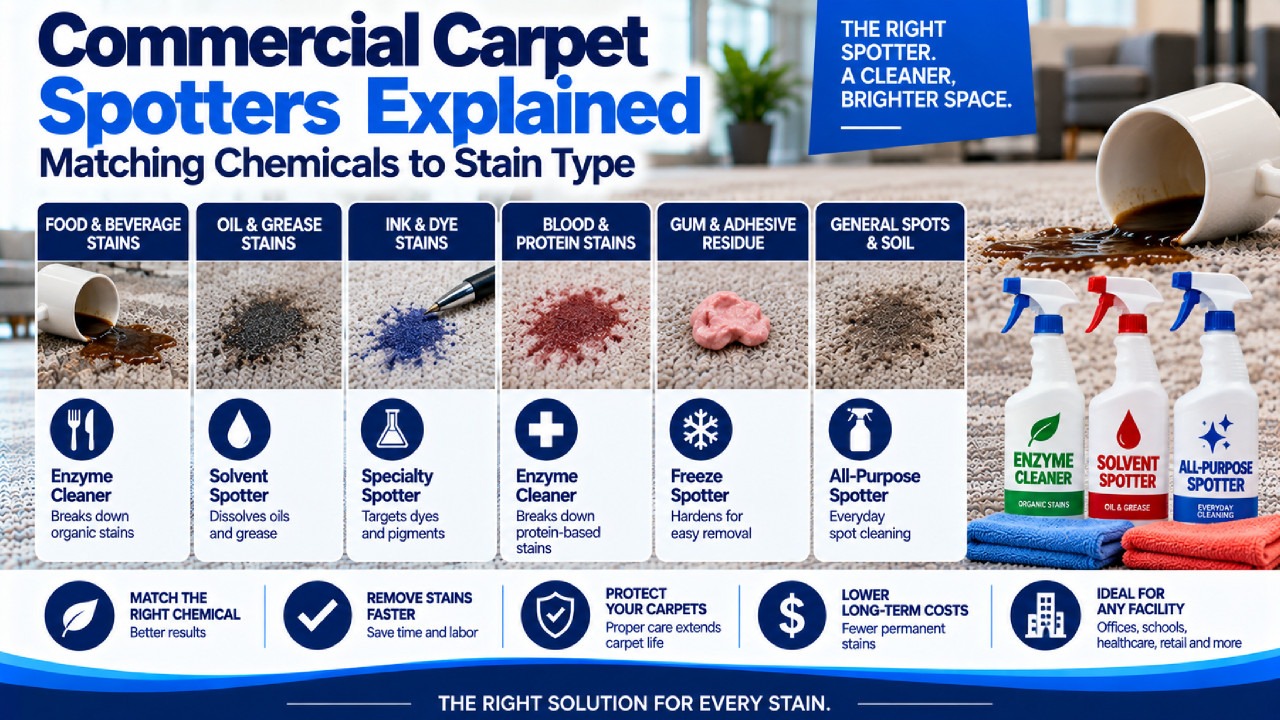
Commercial Carpet Spotters Explained: Matching Chemicals to Stain Type
Learn how to match commercial carpet spotters to food, grease, protein, ink, dye, gum, adhesive, rust, paint and odor-related contamination while reducing the risk of damage to carpet fibers, dyes, backing and adhesive.
Match the Spotter to the Stain
Identify the stain source and carpet fiber first. Use the smallest effective amount of compatible chemistry, follow labeled dwell time, agitate gently, blot or extract as required and remove residue when the product instructions call for rinsing.
What Is a Commercial Carpet Spotter?
A carpet spotter is a targeted chemical used on a limited area before, during or after carpet cleaning. Routine extraction chemistry may handle general soil, but specialty stains often require products designed for a specific type of contamination.
Identify the Stain First
A dark or discolored area may be soil, oil, detergent residue, dye transfer or permanent damage. Appearance alone does not always identify the cause.

Water-Based Food & Beverage Stains
Coffee, tea, soda, juice, wine, sauces and food spills may contain tannins, sugar, artificial dye, protein or oil in addition to water-based residue.
Possible Chemistry
- General-purpose carpet spotter
- Tannin spotter
- Mild detergent solution
- Compatible rinse agent
Main Cautions
- Test colorfastness first
- Avoid excessive heat on unknown stains
- Remove sugar and detergent residue
- Blot rather than aggressively scrub
Oil & Grease Stains
Cooking oil, automotive grease, lotion, makeup, asphalt and oily tracked-in residue may require chemistry designed to loosen or suspend oil-based contamination.
Protein-Based Stains
Blood, milk, egg, food residue and some bodily-fluid contamination may require protein-specific or enzyme-based treatment.
- Use a compatible protein spotter or enzyme treatment.
- Follow labeled temperature requirements.
- Allow the recommended dwell time.
- Remove loosened contamination through controlled extraction.
- Repeat treatment rather than overapplying chemistry.
Dye, Ink & Pigment Stains
Ink, marker, printer toner, food coloring, cosmetics and artificial beverage dyes may require specialty chemistry and careful testing.
Gum, Adhesive & Sticky Residue
Chewing gum, tape adhesive, glue, sticker residue and wax may require controlled physical removal combined with compatible chemistry.
Rust & Mineral Stains
Rust stains generally require dedicated rust-removal chemistry rather than ordinary carpet detergent.
- Test carpet and dye compatibility first.
- Protect nearby metal, stone and flooring.
- Follow labeled dwell time.
- Rinse or neutralize as directed.
- Never mix rust remover with incompatible chemistry.
Paint, Tar & Specialty Residue
Water-based paint, oil-based paint, dried coatings, tar, asphalt, nail polish and industrial residue may require different products and procedures.
Inspect First
- Wet or fully cured?
- Water-based or solvent-based?
- Surface residue or deep penetration?
- What fiber and backing are present?
Know When to Stop
Some contamination may require specialty restoration products or referral when removal attempts could damage fibers, dye, backing or adhesive.
Enzyme & Odor Treatments
Odor treatments and stain removers are not always interchangeable. A fragrance may mask an odor temporarily, while enzyme-based products are designed for compatible organic contamination.
Effective odor treatment usually requires reaching the actual contamination source. Surface application alone may not address contamination in backing, cushion or subfloor.
When Does a Carpet Spotter Need to Be Rinsed?
Many spotters should be removed after treatment to reduce sticky residue, resoiling and interference with later cleaning.
- The label directs rinsing or extraction.
- A strong detergent or solvent was used.
- The area feels sticky or stiff.
- Several chemicals were applied.
- Visible residue remains.
- Neutralization is required.

Correct Commercial Carpet Spot-Treatment Process
Why Blotting Direction Matters
Work from the outside edge of the stain toward the center to help reduce spreading.
Match the Spotter to Carpet Fiber
Broad compatibility, but protect dyes and stain-resistant treatments.
Often requires attention to oily contamination and residue removal.
Can attract oily soils; manage solvent, heat and agitation carefully.
Use wool-compatible chemistry and conservative moisture, pH and agitation.
Follow the requirements of the most sensitive fiber present.
Identify and test before using aggressive chemistry.
When a Stain Is Actually Carpet Damage
Some marks cannot be removed because the carpet itself has changed rather than simply becoming soiled.
Carpet Spotters & Related Treatments
Always verify stain type, carpet fiber and product-label compatibility before use.
Red Carpet Pro Spotter
General-purpose carpet spotter for compatible localized stain treatment.
View Karcher 8.695-222.0 →Red Carpet Enzyme Deodorizer
Enzyme-based treatment for compatible organic contamination and odor applications.
View Karcher 8.695-218.0 →Red Carpet Odor Neutralizer
Odor-treatment option for compatible commercial carpet applications.
View Karcher 8.695-219.0 →Red Carpet Expert All-In-One Cleaner
Multipurpose carpet-care chemistry for compatible spotting, prespray, extraction and deodorizing applications.
View Karcher 8.695-230.0 →Red Carpet Wool & Natural Fiber Cleaner
Specialty chemistry for compatible wool and natural-fiber installations.
View Karcher 8.695-211.0 →Red Carpet Super Conditioning Rinse
Companion rinse for compatible prespray, spotter and extraction-cleaning systems.
View Karcher 8.695-209.0 →Common Carpet Spot-Treatment Mistakes
Related Carpet Chemistry Guides
Explore More Carpet Care Guides
Need Help Choosing a Commercial Carpet Spotter?
Monster Janitorial can help match spotters, enzyme treatments, odor products, rinse agents and carpet-cleaning chemistry to the stain type, carpet fiber, facility and cleaning process.