
MJ University Carpet-Chemistry Guide
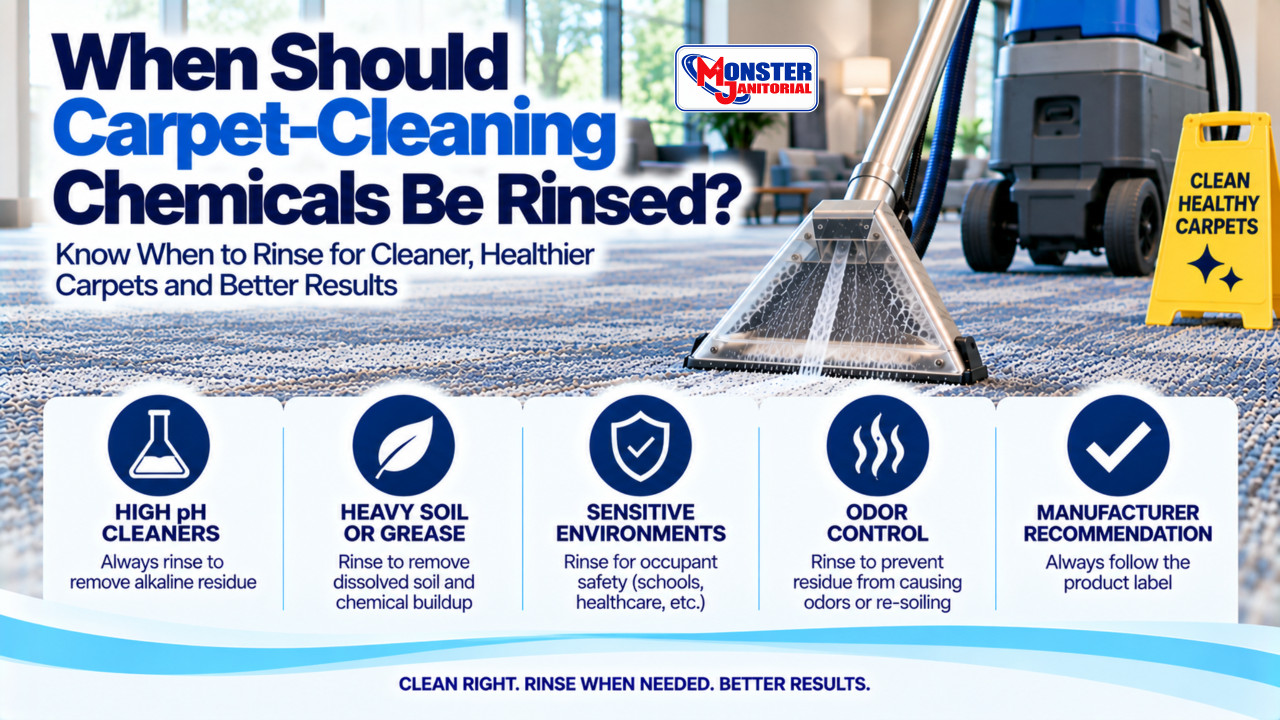
When Should Carpet-Cleaning Chemicals Be Rinsed?
Carpet-cleaning chemicals should be rinsed or extracted when the product label requires removal, when loosened soil and contamination must be recovered, or when residue could cause stiffness, rapid resoiling, odor, discoloration, recurring spots, or interference with later treatments.
The Most Important Rule
The product label controls whether a carpet chemical should be rinsed, extracted, blotted, vacuumed after drying, or left in place. Do not assume every carpet chemical is used the same way.
Why Carpet-Chemical Rinsing Matters
Rinsing does more than remove cleaning chemistry. It also helps recover the soil, grease, organic contamination, spotter residue, and suspended material that the product loosened during cleaning.
The Product Label Controls the Procedure
- Review the intended application method.
- Measure the correct use dilution.
- Follow the required dwell time.
- Check extraction or rinse instructions.
- Confirm carpet-fiber compatibility.
- Follow water-temperature limits.
- Review drying and post-treatment directions.
- Determine whether the product is leave-on or rinse-required.

Chemicals That Usually Require Rinsing or Extraction
Exact instructions vary by product, but the following carpet chemicals commonly require recovery after they have completed their intended cleaning action.
Should Carpet Pre-Spray Be Rinsed?
Carpet pre-spray is commonly applied before hot-water extraction to loosen oily soil, traffic-lane buildup, and embedded contamination. It is normally followed by extraction or a compatible rinse procedure.
Leaving pre-spray residue in carpet may contribute to sticky fibers, rapid resoiling, stiffness, odor, uneven appearance, excessive extractor foam, or interaction with later treatments.
Extraction Detergents
Extraction detergent is normally applied and recovered through a carpet extractor. The goal is to flush loosened soil and residue from the carpet while recovering as much moisture as possible.
- Use the correct detergent dilution.
- Control solution flow rather than flooding the carpet.
- Use slow, consistent wet passes.
- Perform multiple dry passes.
- Monitor foam and recovery-tank capacity.
- Use an additional clear-water or conditioning rinse when required.
Rinse Agents Are Part of the Rinsing Process
A carpet rinse agent is designed to support residue removal during extraction. It must still be recovered from the carpet rather than poured onto the carpet and left wet.
Should Carpet Spotters Be Rinsed?
Specialty spotters require different finishing procedures depending on the stain, fiber, chemistry, and product label.
Should Enzyme Carpet Cleaners Be Rinsed?
Enzyme products may need to remain in contact with compatible organic contamination for a labeled dwell period before they are rinsed or extracted.
Do not rinse an enzyme treatment immediately when the label requires extended dwell time. Premature rinsing may reduce the product’s intended action.
Odor Neutralizers and Deodorizers
Some odor treatments are designed to be extracted, while others are intended to remain after the odor source has been cleaned.
Encapsulation Chemicals Are a Major Exception
Encapsulation products are commonly designed to remain in the carpet, dry into a brittle residue, capture remaining soil, and be removed through later vacuuming.
- Apply the product at the correct dilution.
- Agitate it into the carpet according to the label.
- Allow the carpet and chemistry to dry.
- Allow the product to crystallize around remaining soil.
- Vacuum thoroughly after drying and during routine maintenance.
When Restorative Extraction May Still Be Needed
- Residue has accumulated.
- Soil loading is excessive.
- Previous products are incompatible.
- The carpet feels sticky.
- Appearance no longer improves.
- The manufacturer recommends periodic extraction.
Carpet Shampoo and Dry-Foam Products
Shampoo and dry-foam procedures vary. Some systems are designed to dry and be vacuumed, while others may leave enough residue that periodic extraction becomes necessary.
Carpet Protectors and Post-Treatments
Many carpet protectors and post-treatments are designed to remain after application and drying. Rinsing them away may remove the intended benefit.
Defoamer Is Not a Carpet Rinse
Defoamer normally belongs on the recovery side of the extractor to control foam in the hose or recovery tank. It should not normally be applied across the carpet unless the product label specifically authorizes that use.
How to Tell When Carpet-Cleaning Residue Remains
Why Too Much Chemical Is Hard to Rinse
Overdosing the pre-spray, extraction detergent, spotter, or rinse product creates more chemistry than the carpet and extractor can efficiently remove.
Correct Carpet-Chemical Rinsing Process
Use a controlled process that removes chemistry and loosened contamination without unnecessarily overwetting the carpet or installation.
Clear-Water Rinse vs. Conditioning Rinse
Clear-Water Rinse
- Adds no additional rinse chemistry
- May be suitable after mild products
- Does not automatically neutralize alkaline residue
- Results may be affected by water quality
Conditioning Rinse
- Uses compatible rinse chemistry
- May help remove alkaline detergent residue
- Can support improved fiber feel
- Must be correctly diluted and recovered
How Much Rinsing Is Enough?
Rinsing should continue only until the product procedure is complete and the carpet responds normally. Endless wet passes can overwet the installation without producing a better result.
- Recovery water becomes progressively cleaner.
- Foam is controlled.
- Fibers no longer feel sticky.
- Strong chemical odor is reduced.
- The carpet recovers water normally.
- Moisture can be removed with dry passes.
- The product label’s procedure has been completed.
Rinsing by Carpet Fiber
Rinsing by Carpet Installation Type
Drying After Rinsing
Rinsing is not complete until the carpet and affected installation materials dry properly.
What Happens When Chemicals Are Not Rinsed Properly?
Recommended Carpet-Cleaning Chemicals
Follow the current product label, dilution, carpet-compatibility, rinse, extraction, and drying instructions before use.
Common Carpet-Chemical Rinsing Mistakes
Carpet-Chemical Rinsing Checklist
- Identify the carpet fiber.
- Confirm construction and installation.
- Read the product label.
- Determine whether the product is rinse-required or leave-on.
- Measure the correct dilution.
- Avoid chemical overuse.
- Allow the proper dwell time.
- Use the correct rinse method.
- Control solution flow.
- Perform repeated dry passes.
- Monitor recovery-tank foam.
- Inspect recovery water.
- Check carpet texture and residue.
- Use airflow and dehumidification.
- Reinspect after complete drying.
- Document the products and procedure.
Continue Learning
Need Help Choosing a Carpet Rinse or Extraction Chemical?
Monster Janitorial can help match pre-sprays, extraction detergents, rinse agents, spotters, encapsulation products, defoamers, carpet extractors, and drying equipment to your carpet type, facility, soil conditions, and cleaning process.
Email: sales@monsterjanitorial.com
Call: 956-772-4842