
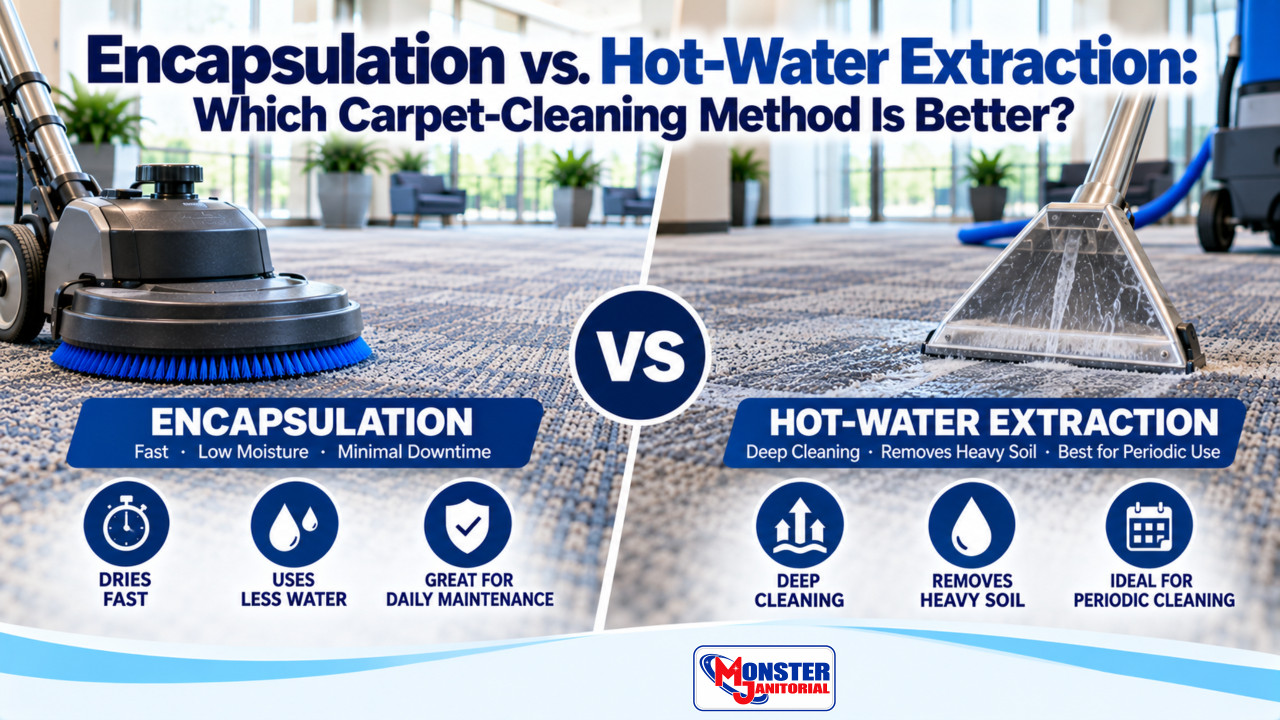
Encapsulation vs. Hot-Water Extraction: Which Carpet-Cleaning Method Is Better?
Encapsulation and hot-water extraction are both valuable commercial carpet-cleaning methods, but they are designed for different maintenance goals.
Encapsulation is commonly used for interim appearance maintenance and faster reopening, while hot-water extraction is commonly used for restorative cleaning, residue removal, and deeper soil recovery.
Which Method Should You Use?
Use encapsulation when the priority is routine interim maintenance, lower moisture, and shorter reopening time. Use hot-water extraction when carpet needs restorative flushing, heavier soil recovery, or detergent-residue removal. Many commercial facilities benefit from using both methods in the same maintenance program.
What Is Encapsulation Carpet Cleaning?
Encapsulation uses specialized low-moisture chemistry and mechanical agitation. The cleaning solution loosens compatible soil and residue while encapsulating polymers dry into brittle crystals.
After drying, the crystals and captured soil are removed through routine commercial vacuuming.
Apply
Apply properly diluted encapsulation chemistry at a controlled rate.
Agitate
Use an approved orbital, CRB, or cylindrical-brush cleaning system.
Dry
Allow the encapsulating polymer to dry according to the product instructions.
Vacuum
Remove dried crystals and captured soil during subsequent vacuuming.
What Is Hot-Water Extraction?
Hot-water extraction applies cleaning solution to the carpet and then uses vacuum recovery to remove suspended soil, dissolved residue, and wastewater.
It is often called steam cleaning, although the cleaning process primarily relies on heated water, cleaning chemistry, agitation when needed, and strong vacuum recovery.
Encapsulation vs. Hot-Water Extraction
| Category | Encapsulation | Hot-Water Extraction |
|---|---|---|
| Primary Role | Interim appearance maintenance | Restorative cleaning |
| Moisture Use | Lower | Higher with wastewater recovery |
| Drying | Usually faster | Usually longer |
| Soil Recovery | Moderate/interim cleaning | Stronger restorative flushing |
| Facility Disruption | Often lower | More drying and area-control time may be needed |
| Typical Use | Cleaning between restorative cycles | Periodic deep/restorative cleaning |

Which Method Removes More Soil?
Hot-water extraction usually provides stronger restorative soil and residue recovery because loosened contamination and wastewater are physically removed from the carpet.
Encapsulation can provide a strong appearance improvement on suitable commercial carpet, but it does not provide the same flushing action. Performance also depends on thorough pre-vacuuming and follow-up vacuuming after the chemistry dries.
Do Not Use Encapsulation to Delay Needed Restorative Cleaning
When heavy soil, sticky residue, contamination, or cleaning chemistry extends below the visible carpet surface, extraction or another specialized cleaning process may be needed.
Drying-Time Differences
Encapsulation
- Lower moisture application
- Often shorter drying time
- Lower overwetting risk when properly applied
- Useful where reopening time matters
Hot-Water Extraction
- More moisture is normally introduced
- Drying depends on recovery performance
- Dry passes can reduce remaining moisture
- Air movement and facility conditions matter
Exact drying times should not be promised. Carpet construction, solution volume, extractor performance, operator technique, temperature, humidity, and airflow all affect drying.
Which Method Is Faster?
Encapsulation Labor May Include
- Pre-vacuuming
- Chemical preparation
- Spot treatment
- Mechanical agitation
- Post-cleaning vacuuming
Extraction Labor May Include
- Preconditioning and agitation
- Wet extraction passes
- Dry recovery passes
- Filling and wastewater dumping
- Hose and air-mover management
Actual productivity depends on machine size, facility layout, carpet condition, available staff, water access, hose management, and operator experience.
When Extraction Has an Advantage
Hot-water extraction may be more appropriate when carpet contains accumulated cleaning residue that needs to be flushed and recovered.
Which Method Fits the Cleaning Goal?
Consider Encapsulation For:
- Routine appearance maintenance
- Moderate traffic-lane soil
- Compatible commercial carpet tile
- Occupied offices and public facilities
- Areas needing quicker reopening
- Maintenance between restorative extractions
Consider Hot-Water Extraction For:
- Heavily soiled carpet
- Detergent or spotter buildup
- Deep traffic-lane contamination
- Greasy or oily soil
- Restorative carpet flushing
- Areas no longer responding to interim cleaning
Some Carpet Should Not Be Cleaned With Either Method Automatically
Sewage, floodwater, bodily fluids, significant mold concerns, hazardous contamination, severe odor sources, and backing or subfloor contamination require proper assessment. Specialized remediation, controlled removal, or carpet replacement may be necessary.
Can You Use Encapsulation and Extraction Together?
Yes. A balanced commercial carpet-care program may combine frequent dry-soil removal, prompt spotting, interim encapsulation, and periodic restorative extraction.
Equipment Used for Each Method
Encapsulation Equipment
- Orbital carpet machines
- Counter-rotating-brush machines
- Cylindrical-brush machines
- Low-moisture applicators
- Commercial upright or backpack vacuums
Extraction Equipment
- Portable carpet extractors
- Self-contained extractors
- Walk-behind extractors
- Truck-mounted systems
- Carpet wands and air movers
Encapsulation & Extraction Chemicals
Match chemistry to the carpet fiber, soil type, cleaning method, equipment, and product instructions.
Encapsulation Products
TASKI Dry Foam Shampoo & Encapsulation Cleaner → Karcher Red Carpet iCapsol OA →Extraction Products
Karcher Red Carpet Super Pre-Spray → Karcher Red Carpet Extraction Cleaner → Karcher Red Carpet Super Conditioning Rinse →Related Carpet-Care Guides
Learn More About Commercial Carpet Care
Explore commercial carpet guides covering extraction, encapsulation, carpet chemistry, fibers, spotting, drying, maintenance, and equipment selection.
Explore Carpet Care Learning →Need Help Choosing a Carpet-Cleaning Method?
Monster Janitorial can help compare encapsulation equipment, CRB machines, orbital systems, carpet extractors, chemicals, vacuums, and air movers based on your carpet type and maintenance goals.
- #carpet cleaning chemicals
- #carpet cleaning methods
- #carpet drying time
- #carpet extraction
- #carpet extractors
- #carpet residue removal
- #carpet soil removal
- #commercial carpet cleaning
- #commercial carpet maintenance
- #counter-rotating-brush machines
- #cylindrical-brush carpet machines
- #Encapsulation carpet cleaning
- #encapsulation vs extraction
- #hot-water extraction
- #interim carpet maintenance
- #low-moisture carpet cleaning
- #MJ University
- #Monster Janitorial
- #orbital carpet machines
- #restorative carpet cleaning