
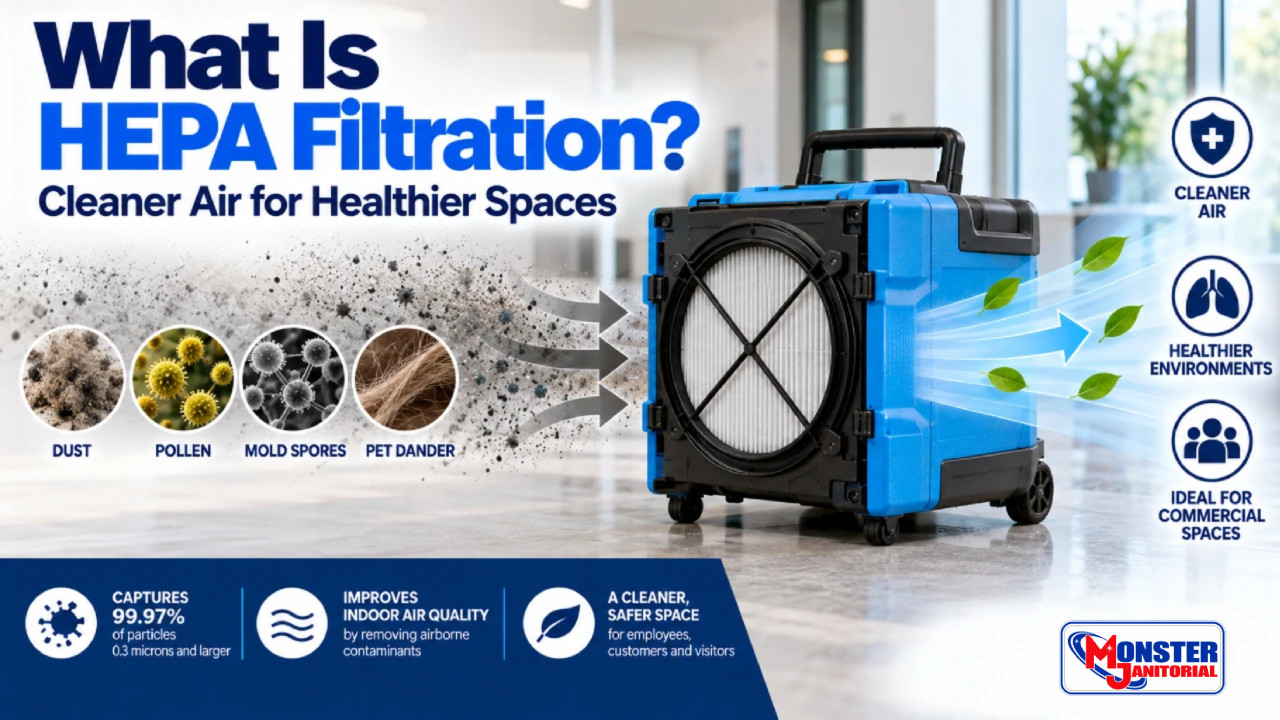
What Is HEPA Filtration?
HEPA filtration is used to capture fine airborne particles in commercial facilities, restoration projects, construction work areas, and other environments where particulate control matters.
This guide explains what HEPA means, how HEPA filters capture particles, how multi-stage filtration works, what HEPA does not remove, and how to maintain filtration performance.
What Does HEPA Mean?
HEPA stands for high-efficiency particulate air. A true HEPA filter is designed to meet a defined particle-capture efficiency standard. In common U.S. applications, HEPA filtration is associated with at least 99.97% efficiency at 0.3 microns under specified test conditions.
The Stages of Multi-Stage Air Filtration
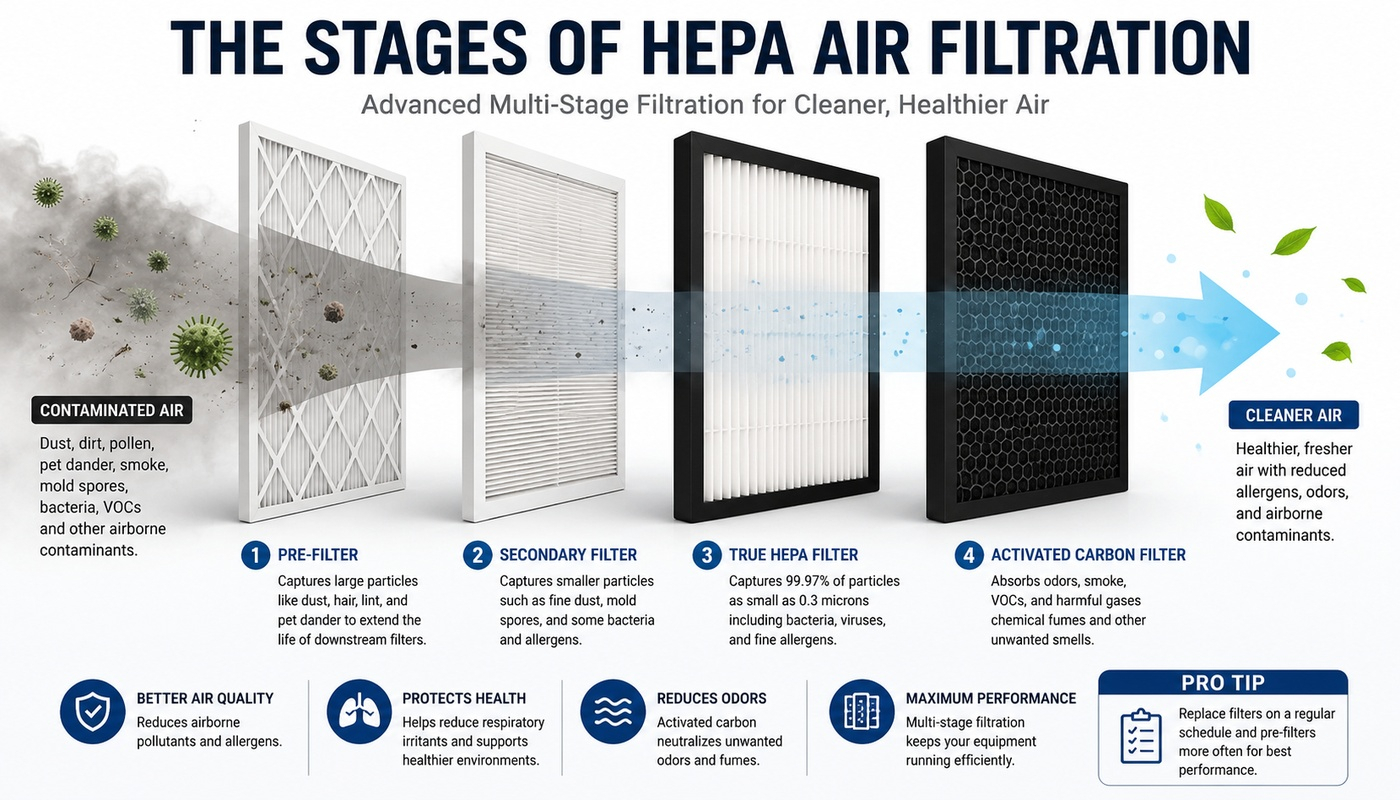
Commercial air scrubbers often use multiple filtration stages so larger debris is captured before air reaches the final HEPA filter.
From Contaminated Air to Filtered Air
Each filtration stage performs a different job before air leaves the machine.
Contaminated Air
Dust, fibers, pollen, spores, smoke particles, and other debris enter the machine.
Prefilter
Captures larger dust, hair, lint, fibers, and visible debris.
Secondary Filter
Captures smaller particles before they reach the final filtration stage.
HEPA Filter
Captures fine airborne particles before filtered air exits the machine.
What Does HEPA Mean?
HEPA stands for high-efficiency particulate air.
Particle-capture efficiency at 0.3 microns under specified test conditions
HEPA Is a Performance Standard
HEPA is more than a general description for a dense filter. The filter must meet a defined particulate-efficiency standard under specified testing conditions.
The filter media uses a dense network of fibers that creates a complex path for airborne particles moving through the filter.
Important: Overall machine performance also depends on proper filter fit, cabinet sealing, airflow, filter condition, and preventing air from bypassing the filter.
Why Is 0.3 Microns Used?
Particles near this size are commonly used as a reference because they can be especially challenging for fibrous filters to capture.
Particles both larger and smaller than 0.3 microns can also be captured through different physical mechanisms inside the filter media.
Common reference point used in HEPA performance testing
How HEPA Filters Capture Particles
Impaction
Larger particles cannot follow airflow around the fibers and collide directly with them.
Interception
Particles following the airflow pass close enough to a fiber to make contact and remain trapped.
Diffusion
Very small particles move irregularly, increasing their chance of contacting filter fibers.
What Can HEPA Filtration Capture?
What HEPA Filtration Does Not Remove
HEPA filtration is designed for particles. It does not automatically solve every air-quality problem.
Activated carbon may help with selected odors or gaseous contaminants. Dehumidifiers are used for moisture removal, while source removal and surface cleaning remain important for contamination control.
HEPA, Prefilter or Activated Carbon?
Prefilter
Captures larger dust, hair, lint, fibers, and visible debris to help protect downstream filters.
HEPA Filter
Captures fine airborne particulate matter that passes through earlier filtration stages.
Activated Carbon
Can adsorb selected odors and gaseous contaminants depending on carbon capacity, contact time, and contaminant type.
How Filter Loading Affects Airflow
As filters collect particles, resistance increases and the amount of air moving through the machine may decrease.
Less air moves through the filtration system.
The machine may filter the room more slowly.
Filter loading increases resistance through the system.
Reduced airflow can affect containment performance.
When Should Filters Be Inspected or Replaced?
Visible Loading
Inspect when dust, fibers, or debris visibly cover the filter surface.
Reduced Airflow
A noticeable drop in discharge airflow can indicate increased filter resistance.
Filter Indicator
Follow the machine's filter indicator, gauge, or maintenance alert when equipped.
Heavy-Dust Jobs
Demolition, smoke cleanup, remediation, and heavy-dust work may require more frequent inspection.
Always follow the equipment manufacturer's instructions for filter inspection, replacement, handling, and disposal.
Common Commercial Applications
Occupied Facilities
Schools, offices, healthcare spaces, public buildings, and other commercial environments.
Construction & Renovation
Dust control during sanding, drywall work, flooring removal, drilling, demolition, and cleanup.
Water & Fire Restoration
Particle control during demolition, material removal, smoke cleanup, cleaning, and structural drying.
Remediation Work
HEPA filtration may be used as part of properly designed containment and contamination-control procedures.
XPOWER HEPA Filtration Equipment
Compare room size, airflow, filtration stages, noise, portability, electrical capacity, and ducting requirements before selecting a machine.
XPOWER AP-1500U
HEPA and activated-carbon filtration with UV-C treatment, variable-speed control, and PM2.5 monitoring.
View AP-1500U →XPOWER X-4700A / X-4700AM
Three-stage HEPA air scrubber series with variable speed, GFCI outlets, and available hour-meter configuration.
View X-4700 Series →XPOWER X-3400A / X-3580
HEPA air scrubber options, with the X-3580 adding activated-carbon filtration for selected odor-control applications.
View X-3400 / X-3580 →XPOWER X-2480A / X-2580
Compact air scrubber series for smaller rooms, localized work zones, apartments, offices, and similar applications.
View Mini Air Scrubbers →Common HEPA Filtration Mistakes
Skipping the Prefilter
Large debris can load the more expensive HEPA filter faster.
Allowing Filter Bypass
Improperly seated filters or damaged seals can allow air to travel around the filter.
Ignoring Reduced Airflow
A heavily loaded filter can reduce effective airflow through the machine.
Using HEPA for Odors Alone
HEPA targets particles. Selected odor problems may require activated carbon or source correction.
Using the Wrong Machine Size
Insufficient airflow may not provide the desired air-change rate for the space.
Treating Filtration as Source Removal
Air filtration does not replace removing contaminated materials or cleaning affected surfaces.
Continue Learning About Air Quality & Drying
Learn More About Air Quality & Filtration
Explore commercial guides covering HEPA filtration, air scrubbers, negative air, construction dust, floor drying, dehumidification, restoration, and filter maintenance.
Explore MJ University →Safety & Compliance Notice
Projects involving asbestos, lead, silica, hazardous materials, healthcare environments, significant mold contamination, or other regulated substances may require specialized containment, monitoring, exposure controls, PPE, procedures, and qualified professionals.
Need Help Choosing a HEPA Air Scrubber?
Monster Janitorial can help compare airflow, filtration stages, carbon-filter options, machine size, electrical requirements, portability, and air-quality equipment for commercial facilities and restoration work.