
Air Scrubbers vs Negative Air Machines
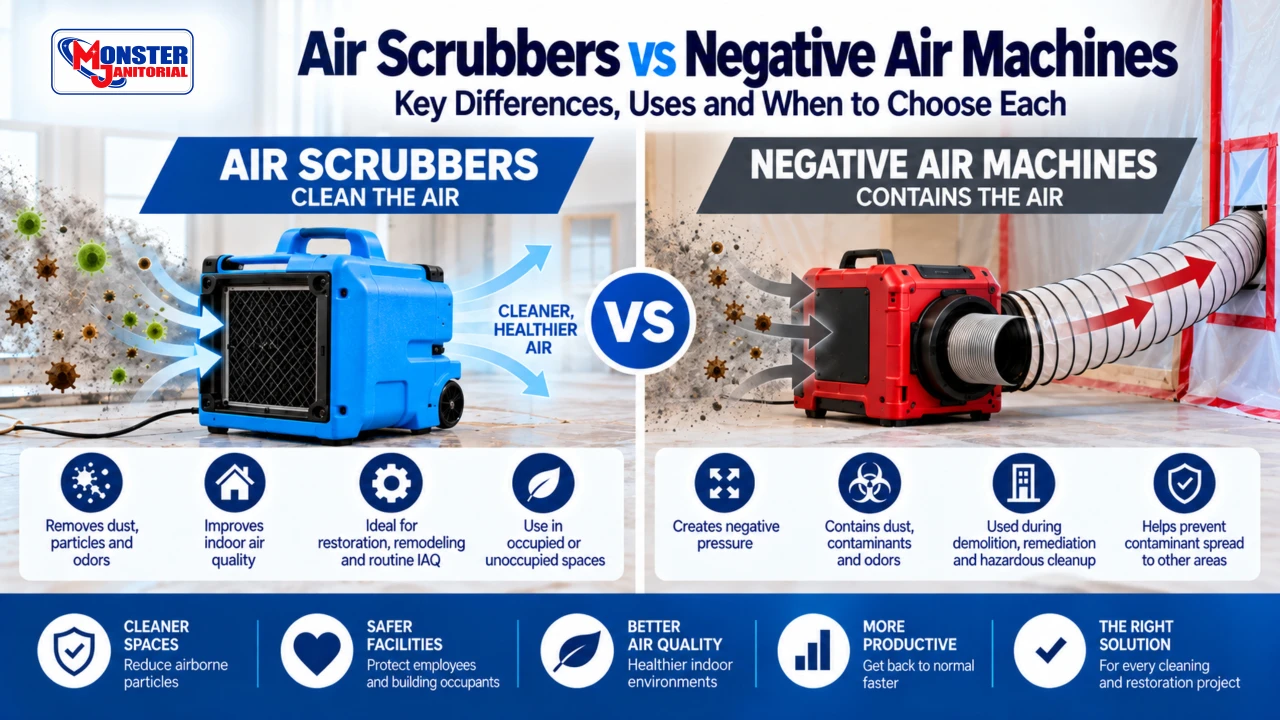
Air scrubbers and negative-air systems may use similar HEPA-filtered equipment, but they perform different jobs depending on how the machine is placed, ducted, and used.
This guide explains when to use air recirculation, when containment and exhaust are needed, how HEPA filtration fits into each system, and what to consider when sizing equipment.
Air Scrubber = Filtration | Negative Air = Containment + Exhaust
An air scrubber usually pulls room air through filters and returns filtered air to the same space. A negative-air setup uses containment and controlled exhaust to remove filtered air from the work zone and encourage surrounding air to flow inward.
Air Filtration or Airflow Containment?
The same general type of HEPA-filtered machine may sometimes be used in either role, but the airflow configuration determines the function.
What Is an Air Scrubber?
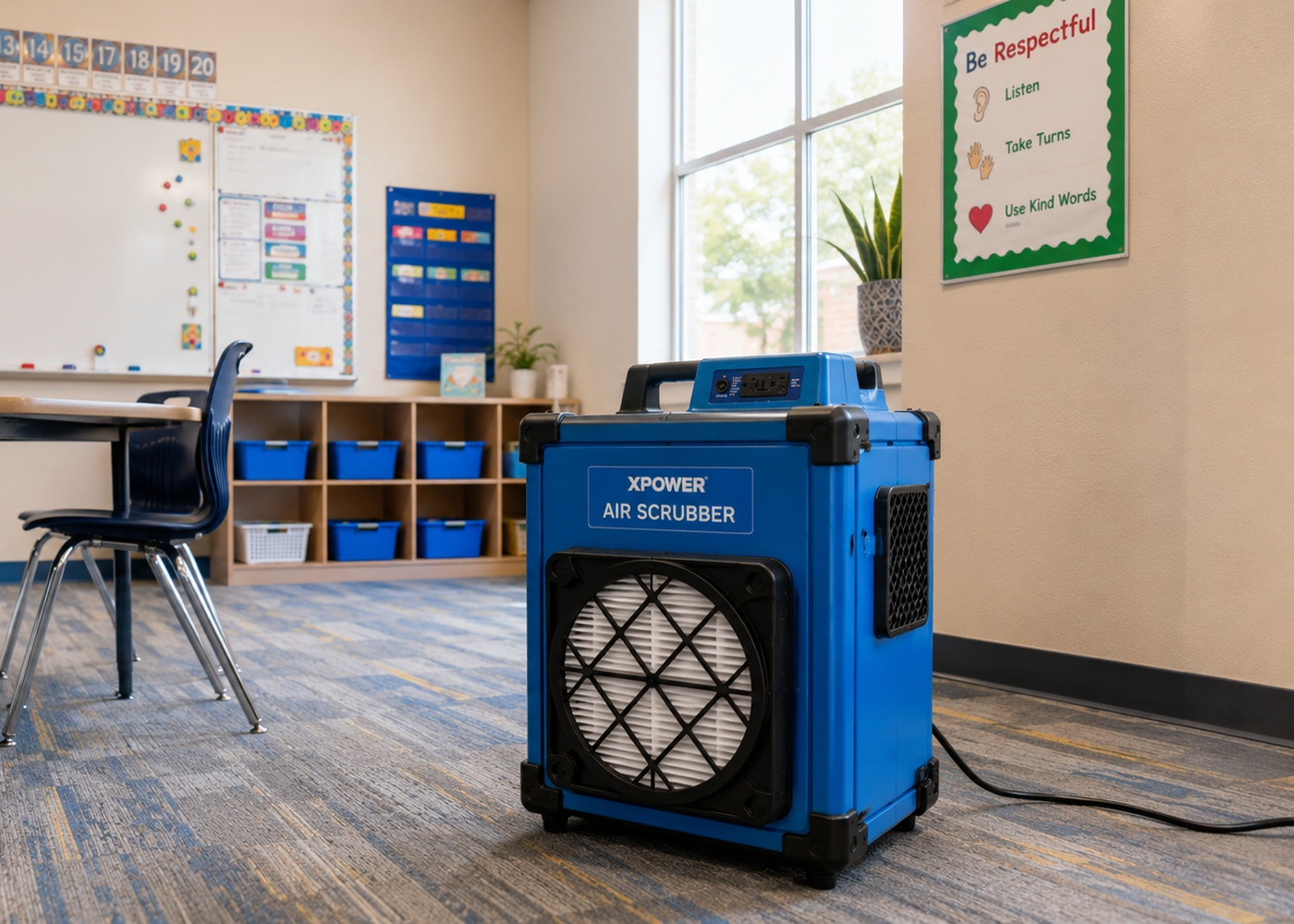
An air scrubber pulls surrounding air through one or more filtration stages and typically returns filtered air to the same space.
Common Applications
- Construction and renovation dust
- Water-damage restoration
- Occupied commercial spaces
- Fine airborne particulate control
- Selected odor-control applications with compatible carbon filtration
What Is a Negative-Air System?
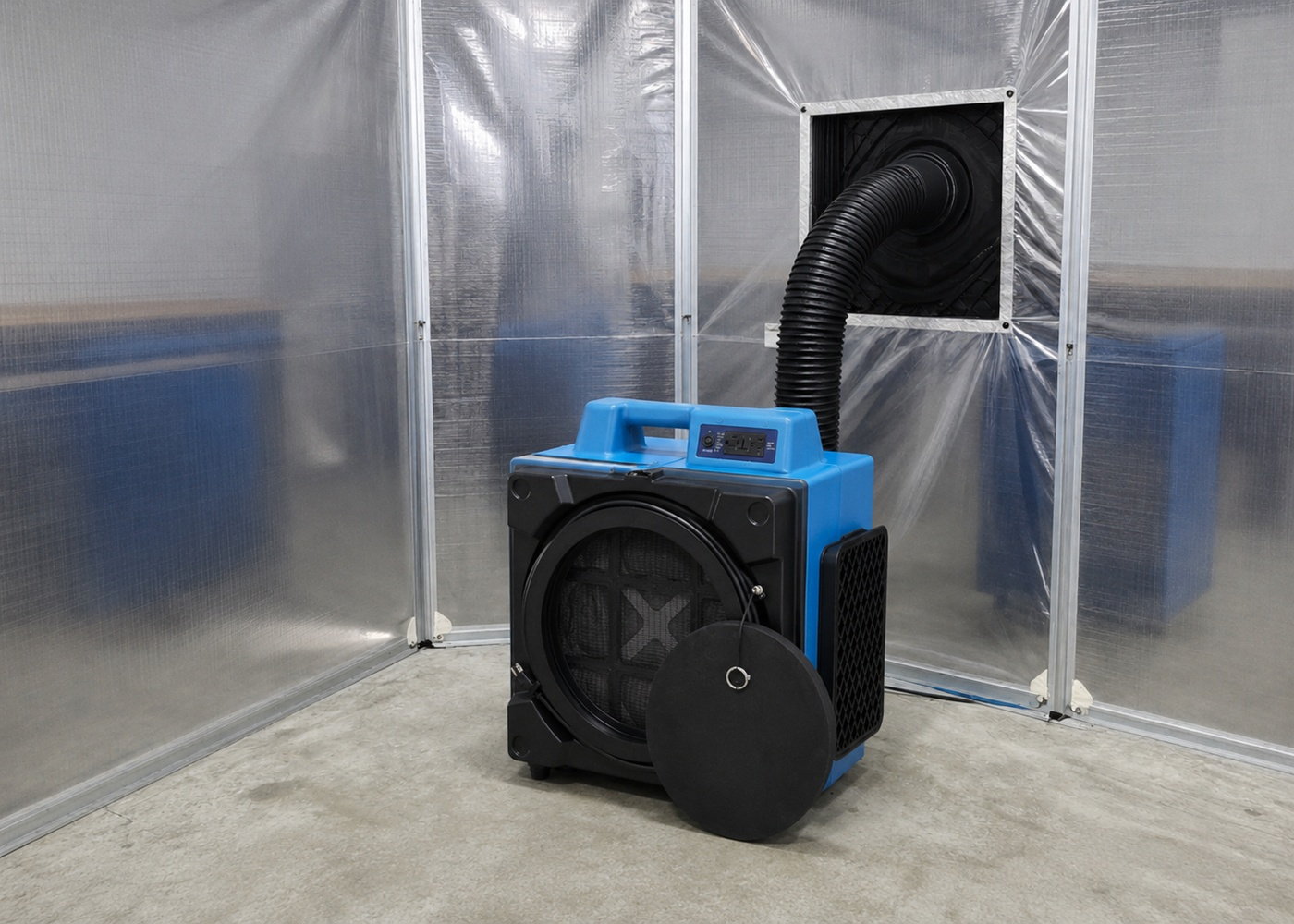
A negative-air setup removes filtered air from a contained work zone so pressure inside the enclosure is lower than the surrounding area. This helps encourage air to move inward rather than allowing contaminated air to move outward.
- Sealed containment
- HEPA-filtered equipment
- Compatible exhaust ducting
- Controlled makeup air
- Approved exhaust location
- Pressure verification or monitoring as required
Common Applications
- Interior demolition
- Renovation containment
- Mold-remediation projects
- Cross-contamination control
- Other controlled work zones where directional airflow is required
The Airflow Setup Changes the Job
Air scrubbing focuses on filtering room air. Negative-air operation adds containment, controlled airflow, and exhaust to help maintain a pressure relationship between the work zone and surrounding spaces.
How Containment, Negative Pressure & HEPA Filtration Work Together
Effective contamination control usually depends on the full system — not just the machine. Barriers, airflow direction, filtration, ducting, makeup air, and equipment capacity all matter.
Build Containment
Separate the work area from clean or occupied portions of the building using the containment method required for the project.
Control Airflow
Exhaust filtered air from the enclosure so air is encouraged to enter the work zone through controlled openings.
Filter the Air
Use properly installed filtration appropriate for the project before air is discharged from the controlled area.
What Can a Containment System Include?
Asbestos, lead, silica, healthcare, hazardous-material, mold-remediation, and other regulated work may require specific containment procedures, pressure targets, monitoring, PPE, environmental controls, and qualified professionals.
How Negative Pressure Helps Control Air Movement
When filtered air is exhausted from containment, pressure inside the enclosure can become lower than the surrounding building. This encourages replacement air to enter through planned openings.
Lower pressure encourages inward airflow.
High CFM Alone Does Not Guarantee Effective Negative Pressure
Published airflow is only one part of the system. Actual performance can change significantly once filters, ducting, bends, pressure resistance, containment leakage, and real jobsite conditions are added.
Length × width × height
Can reduce airflow
Adds resistance
Can reduce performance
Leaks affect pressure relationships
Needs a planned path into containment
What Does HEPA Filtration Do?
HEPA stands for high-efficiency particulate air. HEPA filtration is intended to capture fine airborne particles when the filter is properly installed and the machine is operating as designed.
Efficiency at 0.3 microns under specified test conditions
HEPA filtration is designed for particles. It does not automatically remove every odor, gas, vapor, or chemical. Activated carbon may help with some odors or gaseous contaminants, depending on the contaminant and filter design.
Understanding Air Changes per Hour
ACH estimates how many times the volume of air in a room theoretically passes through the machine each hour.
Actual airflow may be lower because of filter loading, ducting, bends, resistance, voltage conditions, and machine placement.
XPOWER Commercial HEPA Air Scrubbers
Compare airflow, filtration, size, electrical requirements, and ducting compatibility for the specific job.
XPOWER AP-1500U
Four-stage filtration system with HEPA and activated carbon, variable-speed operation, PM2.5 monitoring, and UV-C treatment.
View AP-1500U →XPOWER X-4700A / X-4700AM
Three-stage HEPA filtration, variable speed, GFCI daisy-chain capability, and duct-compatible design for suitable room-air or negative-air setups.
View X-4700 Series →XPOWER X-3400A / X-3580
Compact HEPA air scrubber options, with the X-3580 adding activated-carbon filtration for projects where compatible odor control is desired.
View X-3400 / X-3580 →XPOWER X-2480A / X-2580
Compact portable air scrubber options for smaller rooms, localized work areas, apartments, offices, and restoration spaces.
View X-2480 Series →Are Air Movers Negative-Air Machines?
No. Standard axial, centrifugal, low-profile, downdraft, and whole-room air movers are designed primarily to move air and increase evaporation.
They generally do not include the sealed HEPA filtration system required for air scrubbing or filtered negative-air containment.
An unfiltered fan can spread dust or other particles beyond the work zone.
Do Dehumidifiers Clean the Air?
Commercial dehumidifiers remove moisture from the air and support structural drying. They perform a different job from HEPA air scrubbers and should not be treated as substitutes for particle filtration.
Read the Commercial Dehumidifier Guide →Three Machines, Three Different Jobs
Air Movers
Move air across wet materials to increase evaporation.
Dehumidifiers
Remove moisture from the air to support controlled drying.
Air Scrubbers
Help reduce airborne particles generated during cleaning, demolition, drying, and material removal.
How to Select the Right Air Scrubber
Calculate the room or containment volume.
Use project requirements, applicable guidance, and the environmental plan.
Filters, ducting, bends, and containment resistance can reduce real airflow.
Match HEPA, carbon, and other stages to the actual application.
Verify machine connections, duct route, and approved discharge location.
Check circuits, amp draw, cords, and the combined equipment load.
Inspect and replace filters according to equipment instructions and job conditions.
Basic Negative-Air Setup
- Identify the work zone. Define contaminated and clean areas.
- Construct containment. Seal barriers and unintended air pathways according to the project plan.
- Address HVAC openings. Follow the required procedure for supply and return vents.
- Position the machine. Keep the intake within the controlled work zone.
- Install the correct filters. Confirm filters are seated correctly and bypass gaps are not present.
- Connect exhaust ducting. Route discharge to the approved location.
- Provide makeup air. Establish a controlled route for air entering containment.
- Start the equipment. Inspect airflow and containment behavior.
- Verify pressure. Use the method required for the project.
- Monitor throughout the job. Inspect filters, barriers, ducting, electrical connections, and airflow conditions.
Continue Learning About Air Quality & Drying
Learn More About Air Quality & Filtration
Explore guides covering HEPA filtration, air scrubbers, negative air, construction dust, floor drying, dehumidification, restoration, and filter maintenance.
Explore MJ University →Safety & Compliance Notice
This guide provides general equipment information. Regulated or hazardous-material projects may require project-specific remediation plans, exposure controls, containment standards, pressure monitoring, PPE, environmental assessment, and qualified professionals. Follow applicable regulations and manufacturer instructions.
Need Help Choosing an Air Scrubber?
Monster Janitorial can help compare airflow, filtration stages, machine size, ducting compatibility, electrical requirements, air movers, dehumidifiers, and restoration equipment.
- #Air Quality & Filtration
- #Air Scrubbers
- #Commercial Air Filtration
- #Construction Cleaning
- #Containment Systems
- #Dust Control
- #HEPA Filtration
- #Indoor Air Quality
- #MJ University
- #Mold Remediation
- #Negative Air Machines
- #Negative Pressure
- #Restoration Equipment
- #Water Damage Restoration
- #XPOWER Air Scrubbers