
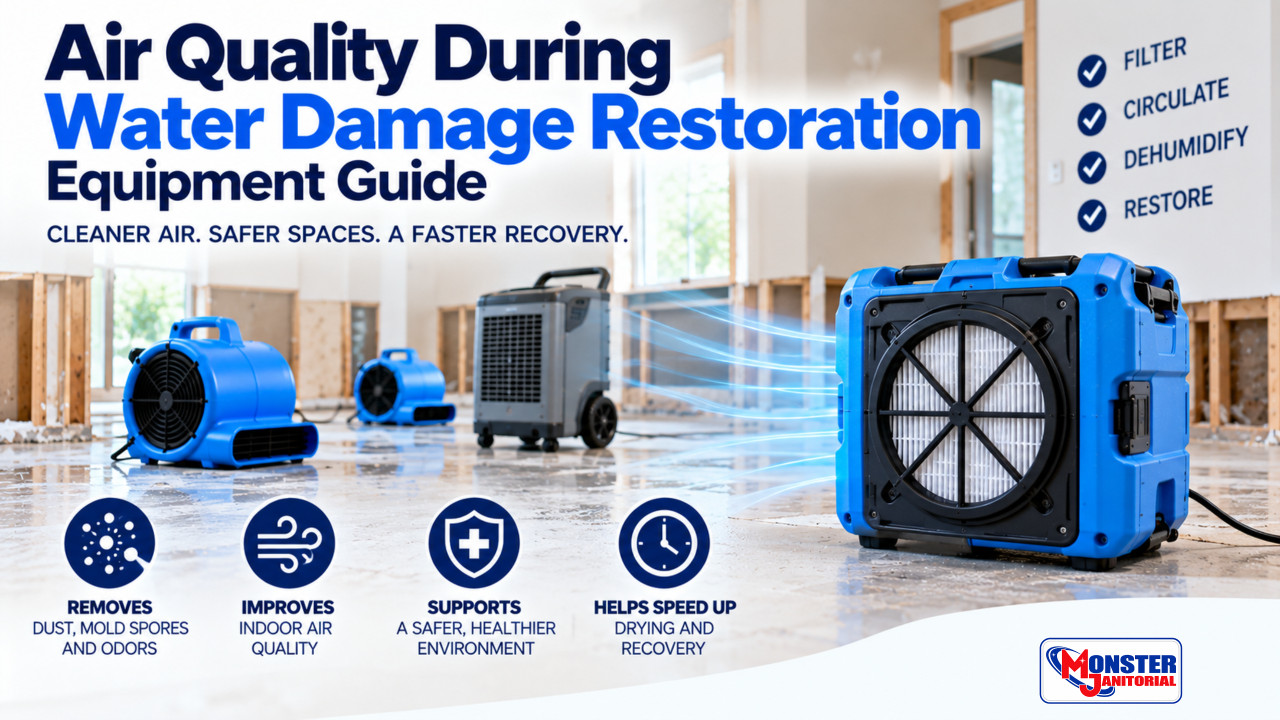
Air Quality During Water Damage Restoration
Water-damage restoration is not only about removing moisture. Demolition, wet materials, high humidity, dust, odors, and aggressive airflow can all affect indoor air quality during the project.
This guide explains how containment, HEPA air filtration, air movers, dehumidifiers, cleanup, and equipment placement work together during commercial restoration.
Dry Wet Materials Without Spreading Contamination
Control the work area first, remove standing water and damaged materials, clean affected surfaces, then use dehumidifiers and air movers for drying while HEPA air scrubbers help reduce airborne particles generated during demolition, cleaning, and restoration work.
Start With the Work Area, Then Dry
Water-damage drying should be coordinated with contamination control and cleanup.
Control the Work Area
Separate affected spaces when demolition, contamination, or nearby occupied rooms make particle migration a concern.
Remove Water & Debris
Extract standing water, remove unsalvageable materials, and clean affected surfaces before introducing aggressive airflow.
Dry & Filter
Use dehumidifiers and air movers for structural drying while HEPA air scrubbers help control airborne particles.

Why Water Damage Changes Indoor Air
Wet materials, demolition, cleaning, and drying equipment can change humidity levels and disturb particles that were previously settled or trapped inside building materials.
Common Air-Quality Concerns
Do Not Start High-Velocity Airflow Too Early
Air movers increase evaporation, but they can also redistribute loose dust, fibers, demolition debris, and other particles. Evaluate the materials, establish containment when needed, remove debris, and begin appropriate filtration before directing aggressive airflow across affected surfaces.
How Air-Quality Needs Change During the Project
Equipment placement and filtration needs may change as the project moves from inspection through demolition, cleaning, drying, and final verification.
Inspection
Identify affected rooms, wet materials, HVAC pathways, occupants, visible debris, and areas that may require isolation.
Material Removal
Use appropriate isolation and filtration when removing damaged drywall, carpet, insulation, flooring, or other materials.
Cleaning
Remove debris, HEPA vacuum surfaces, clean affected materials, and inspect filtration equipment before drying.
Structural Drying
Position air movers and dehumidifiers for drying while maintaining filtration where particles remain a concern.
Three Machines, Three Different Jobs
Air Movers
Increase evaporation by moving air across wet floors, carpet, walls, upholstery, and structural materials.
Dehumidifiers
Remove water vapor from the air to lower humidity and support controlled structural drying.
Air Scrubbers
Help reduce airborne particles produced during demolition, material removal, cleaning, and drying.
Where HEPA Air Scrubbing Fits
HEPA air scrubbers help reduce airborne particles released during demolition, cleaning, material removal, and structural drying.
HEPA filtration controls particles; it does not remove moisture. Dehumidifiers are used for humidity control and structural drying.
Need More Information About Containment?
Learn how air scrubbers, negative-air setups, containment, ducting, and airflow control work together.
Read Air Scrubbers vs Negative Air Machines →Basic Equipment Placement
Air Scrubbers
Place near particle-producing work while keeping intake and discharge clear. Use approved ducting when the project requires negative air.
Dehumidifiers
Position where air can circulate freely and route purge or drain lines to an approved discharge location.
Air Movers
Direct airflow across wet surfaces without blowing loose debris into clean rooms, occupied spaces, or HVAC openings.
Monitor Filters Throughout the Job
Check for visible dust and debris loading.
A noticeable reduction may indicate resistance.
Follow manufacturer and project procedures.
Confirm filters are installed and seated correctly.
How to Choose the Right Commercial Dehumidifier for Water Damage
Compare moisture-removal capacity, AHAM ratings, airflow, operating range, purge pumps, portability, and XPOWER LGR dehumidifier options.
Read the XPOWER LGR Guide →Equipment for Water-Damage Restoration
Choose equipment based on affected area, drying conditions, contamination concerns, electrical capacity, airflow, and filtration needs.
XPOWER X-4700A / X-4700AM
Three-stage HEPA air-scrubber series with variable-speed control for commercial filtration and restoration applications.
View X-4700 Series →XPOWER X-2480A / X-2580
Compact air-scrubber series for smaller work zones and localized restoration filtration.
View Mini Air Scrubbers →XPOWER XD-165L
165-pint-per-day LGR dehumidifier with automatic purge pump for commercial restoration drying.
View XD-165L →XPOWER XD-85L2
85-pint-per-day LGR dehumidifier with automatic purge pump and onboard storage.
View XD-85L2 →XPOWER X-600A
Three-speed centrifugal air mover with multiple operating positions and GFCI daisy-chain capability.
View XPOWER X-600A →XPOWER PL-650A / PL-700A
650–1,050 CFM low-profile air movers for floors, carpet, tight areas, and larger surface sections.
View PL Air Movers →Common Air-Quality Mistakes During Restoration
Water-Damage Air-Quality Checklist
- Inspect the affected area and identify wet, damaged, and potentially contaminated materials.
- Separate the work zone from unaffected or occupied spaces when particle migration is a concern.
- Install appropriate HEPA filtration before demolition or material removal when the restoration plan calls for it.
- Extract standing water and remove unsalvageable materials.
- Clean affected surfaces before introducing high-velocity airflow.
- Position dehumidifiers and air movers to support efficient structural drying.
- Inspect filters and equipment throughout the project.
- Continue filtration during cleanup while airborne restoration debris remains a concern.
Continue Learning About Air Quality & Drying
Learn More About Air Quality & Restoration
Explore guides covering HEPA filtration, air scrubbers, negative air, construction dust, dehumidification, floor drying, restoration, and filter maintenance.
Explore MJ University →Safety & Compliance Notice
This article provides general equipment guidance and is not a substitute for a project-specific restoration plan, environmental assessment, industrial-hygiene protocol, or applicable OSHA, EPA, state, local, healthcare, mold, asbestos, lead, or silica requirements. Regulated or hazardous-material work should be handled by properly trained and qualified professionals.
Need Help Building a Restoration Equipment Package?
Monster Janitorial can help compare air scrubbers, dehumidifiers, air movers, filtration stages, airflow, electrical requirements, and restoration equipment for commercial water-damage projects.