
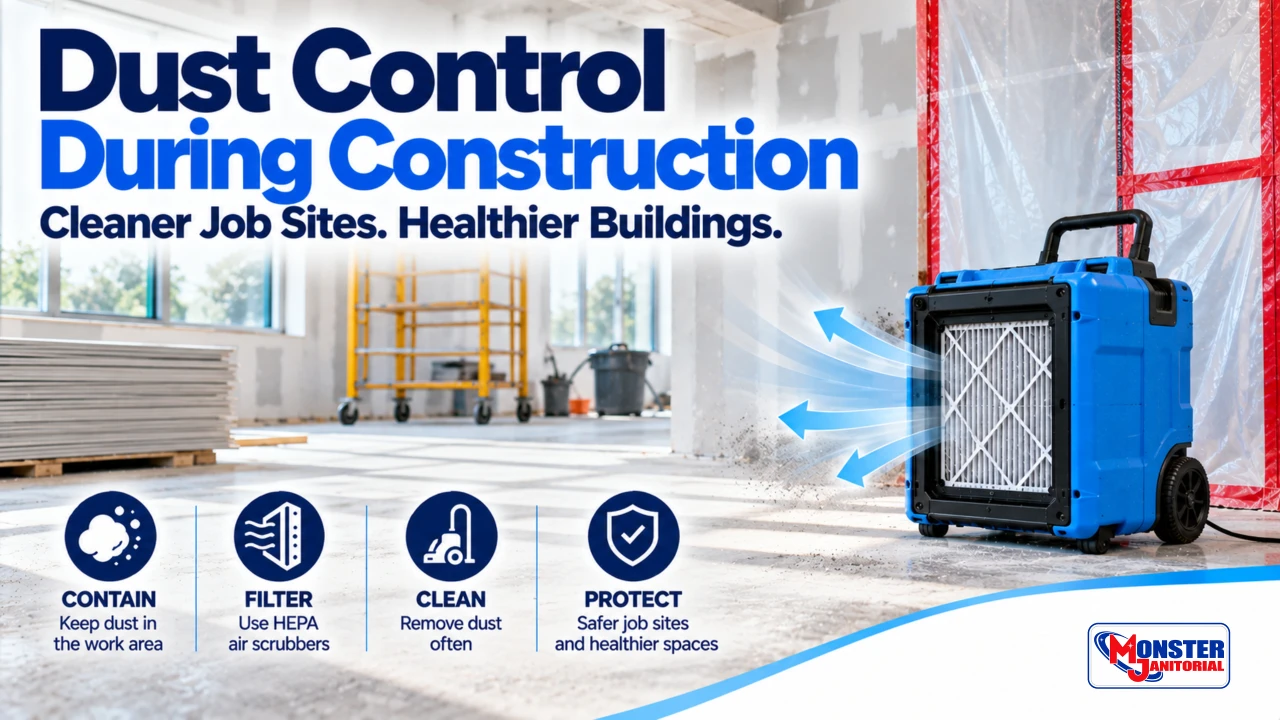
Dust Control During Construction
Construction dust can spread well beyond the immediate work area during demolition, sanding, cutting, drilling, grinding, flooring removal, and renovation.
Effective dust control usually combines source capture, containment, HEPA filtration, airflow management, frequent cleanup, and project-specific safety procedures.
Control Dust Before It Spreads
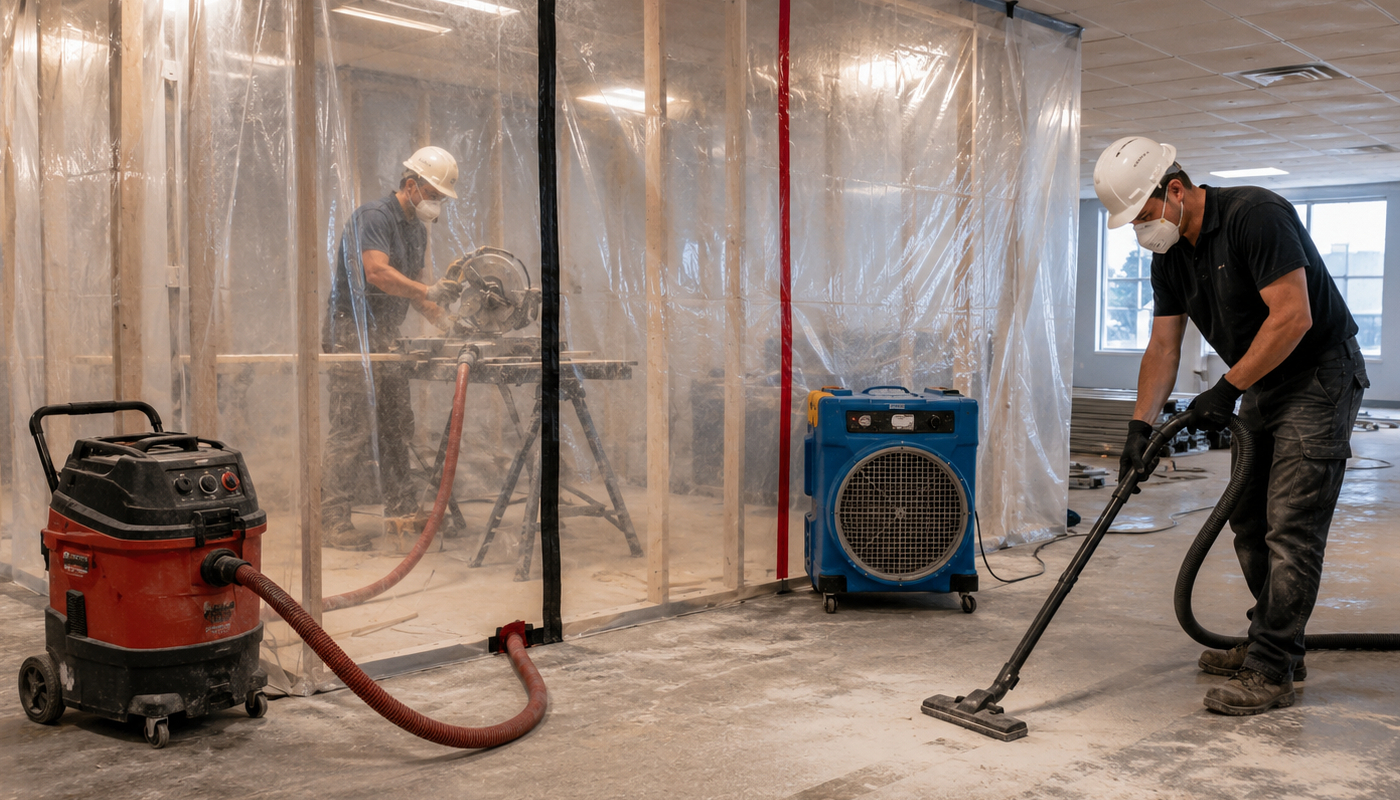
Use source capture at the dust-producing tool when appropriate, isolate the work zone from unaffected spaces, use suitable HEPA filtration, manage airflow carefully, and physically remove settled dust before reopening the area.
A Four-Part Dust-Control Plan
No single machine or barrier handles every part of construction dust control.
Isolate the Work Zone
Separate dusty work from occupied and unaffected portions of the building.
Capture at the Source
Collect dust as close as practical to cutting, drilling, sanding, grinding, or other dust-producing work.
Filter the Air
Use suitable HEPA air filtration to help reduce suspended particles within the controlled work area.
Clean & Verify
Remove settled dust and complete required inspection or verification before containment is removed.
Why Construction Dust Is Difficult to Control
Fine particles can stay suspended in the air, settle on surfaces, and travel beyond the work zone through doors, corridors, HVAC pathways, workers, tools, and building airflow.
Small Particle Size
Fine dust can remain airborne longer than larger visible debris.
Continuous Generation
Cutting, sanding, drilling, grinding, and demolition can create new dust throughout the work period.
Building Air Movement
HVAC systems, fans, open doors, and foot traffic can transport particles.
Repeated Disturbance
Settled dust can become airborne again during debris handling and cleanup.
Common Sources of Construction Dust
Source Capture, Containment & Air Filtration
These controls support one another. They should not automatically be treated as substitutes.
Source Capture
Compatible shrouds, hoses, and dust extractors can collect particles close to where they are generated.
Containment
Temporary barriers, sealed openings, and controlled entry points can help limit dust migration.
HEPA Air Scrubbing
Air scrubbers move room air through filtration stages to help reduce suspended particles.
Negative Pressure
When required and properly configured, compatible ducted HEPA equipment can help maintain airflow toward a contained work zone.
When Is Containment Important?
Containment can be especially important when dust-producing work occurs near occupied rooms, sensitive equipment, finished areas, HVAC pathways, or active building operations.
How to Position HEPA Air Scrubbers
Near Dust-Producing Work
Position the intake where airborne dust can reach it without obstructing workers or equipment.
Keep Airflow Clear
Keep intake and discharge areas clear according to manufacturer instructions.
Control the Discharge
Avoid directing discharge where it may disturb settled dust or push air into unaffected spaces.
Use Compatible Ducting
Use manufacturer-compatible ducting and follow the project's airflow and pressure-control plan when ducted operation is required.
Construction Dust-Control Methods
Protect HVAC Pathways & Unaffected Rooms
Construction dust can travel through return grilles, supply openings, ceiling plenums, corridors, doorways, and other building pathways. Coordinate HVAC controls with the building operator and project plan before work begins.
Daily Cleanup & Final Cleaning
Air filtration addresses airborne particles, but dust that settles on floors, ledges, equipment, and other surfaces must still be physically removed.
HEPA Vacuum
Vacuum compatible floors, ledges, trim, equipment, and horizontal surfaces using equipment appropriate for the task.
Damp Clean
Use an approved damp-cleaning process where appropriate to remove remaining settled residue.
Contain Debris
Follow project procedures for containing and transporting construction waste.
Continue Filtration
Continue air filtration during cleanup when airborne dust remains a concern and the project plan calls for it.
Inspect Filters During Dust-Producing Work
HEPA Air Scrubbers for Construction Dust Control
Compare airflow, filtration stages, dimensions, electrical requirements, portability, ducting capability, and replacement-filter availability.
XPOWER X-4700A / X-4700AM
Three-stage HEPA air-scrubber series with variable-speed airflow for commercial filtration, restoration, and suitable ducted applications.
View X-4700 Series →XPOWER X-2480A
Compact three-stage HEPA air scrubber suited to smaller work zones and localized filtration applications.
View X-2480A →XPOWER X-3580
Commercial HEPA air scrubber with an activated-carbon filtration stage for compatible particulate and odor-control applications.
View X-3580 →XPOWER AP-1500U
Commercial air-filtration unit with HEPA, activated carbon, UV-C treatment, variable speed, and PM2.5 monitoring.
View AP-1500U →Common Construction Dust-Control Mistakes
Construction Dust-Control Checklist
- Identify dust-producing tasks and the materials being disturbed.
- Determine applicable project and regulatory requirements before work begins.
- Separate the work zone from occupied or unaffected areas when appropriate.
- Coordinate HVAC controls with the building operator.
- Use appropriate source capture for cutting, sanding, drilling, grinding, or similar work.
- Set up suitable HEPA filtration when required by the work plan.
- Maintain controlled entry and debris routes.
- Inspect airflow, prefilters, and filter seating.
- Remove settled dust using approved cleanup procedures.
- Complete required inspection or verification before reopening the area or removing containment.
Continue Learning About Air Quality & Drying
Learn More About Air Quality & Filtration
Explore guides covering HEPA filtration, air scrubbers, negative air, construction dust, floor drying, dehumidification, restoration, and filter maintenance.
Explore MJ University →Some Dust Requires Specialized Controls
Projects involving respirable crystalline silica, asbestos, lead, mold, hazardous materials, healthcare environments, or other regulated contaminants may require specific exposure controls, respiratory protection, containment, monitoring, work practices, and qualified personnel. Follow applicable regulations, project requirements, and equipment-manufacturer instructions.
Need Help Choosing Construction Dust-Control Equipment?
Monster Janitorial can help compare HEPA air scrubbers, commercial vacuums, filtration stages, airflow, portability, ducting capability, and replacement filters for renovation and construction-cleanup applications.