
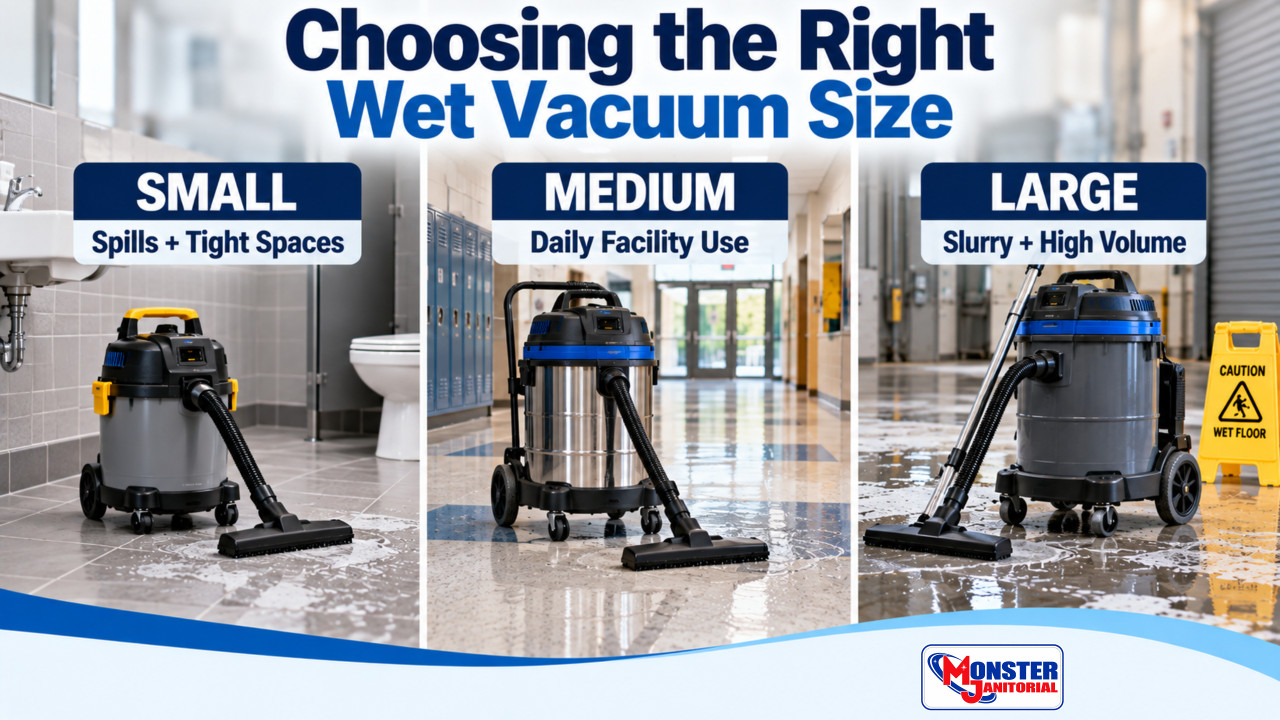
Choosing the Right Wet Vacuum Size
Choosing the right wet vacuum size can reduce unnecessary dumping, improve operator productivity, and make water recovery easier. The best tank capacity depends on your facility, recovery volume, cleaning frequency, storage space, and the type of cleanup work your team performs.
Do Not Choose by Tank Size Alone
A wet vacuum that is too small can force operators to stop and empty the tank repeatedly. A machine that is unnecessarily large can be harder to maneuver, transport, store, and use for everyday spill response.

Why Wet Vacuum Size Matters
The goal is to choose enough recovery capacity for the job without making the machine larger than your staff needs.
- Frequent tank emptying
- More operator trips
- Slower cleanup
- Lower productivity
- More storage space
- Harder maneuverability
- More machine than needed
- Less convenient for small spills
- Fewer unnecessary stops
- Better productivity
- Easier daily use
- Better fit for the facility
Understanding Wet Vacuum Capacity
Recovery-tank capacity is one of the easiest ways to compare wet vacuums, but gallons alone do not tell you which machine will be most productive.
- How much liquid is normally recovered?
- How large are typical spills?
- Will the vacuum recover stripping slurry?
- Is high-volume water recovery common?
- How far is the dumping location?
- How much storage space is available?
- Must operators move between rooms?
- How easy is the machine to transport?
Small vs Medium vs Large Wet Vacuums
These ranges are useful starting points. Actual machine dimensions, usable recovery capacity, dumping method, accessories, and maneuverability can vary by model.
3–6 Gallons
Best when portability, compact storage, and quick spill response matter more than maximum capacity.
Common Uses- Small spills
- Restrooms
- Small offices
- Spot recovery
- Tight spaces
8–15 Gallons
A practical balance of recovery capacity and maneuverability for many commercial facilities.
Common Uses- Schools
- Healthcare facilities
- Retail stores
- Routine spill response
- Floor-maintenance support
20+ Gallons
Designed for jobs where higher recovery volume and fewer dumping stops are more important than compact size.
Common Uses- Warehouses
- Large spills
- Floor stripping
- High-volume recovery
- Heavy facility maintenance
Choosing Wet Vacuum Size by Facility Type
Facility type is a useful starting point, but actual recovery volume and workflow should determine the final machine size.
| Facility Type | Typical Starting Point | Why |
|---|---|---|
| Small Offices | Small | Portable response with limited storage needs |
| Retail Stores | Small to Medium | Balance maneuverability with routine spill recovery |
| Schools | Medium | Useful for hallways, cafeterias, gyms, and floor-care projects |
| Healthcare Facilities | Small to Medium | Mobility can be important in occupied areas |
| Warehouses | Medium to Large | Larger areas may require more recovery capacity |
| Manufacturing Facilities | Large | Higher recovery volume may make capacity more important |
Choosing Wet Vacuum Size by Cleaning Job
Small
Small
Medium
Medium to Large
Large
Medium to Large
Signs Your Wet Vacuum Is the Wrong Size
- Operators constantly empty the tank
- Large spills require repeated recovery trips
- Cleanup takes longer than expected
- The vacuum slows floor-stripping projects
- Capacity is frequently the limiting factor
- The machine is difficult to store
- Operators avoid it for small spills
- The tank rarely approaches capacity
- It is difficult to move through tight spaces
- The extra capacity provides little benefit
Capacity Is Only Part of the Decision
Two wet vacuums with similar tank capacities can perform very differently. Compare the complete machine before choosing.
Compare recovery performance along with capacity.
Can make larger tanks easier to empty.
Useful for recovering liquid across larger hard floors.
Check storage, doors, elevators, and transport routes.
Larger wheels can improve mobility across thresholds.
Make sure the floor tools and hoses match your application.
Compare Wet Vacuum Features & Recovery Performance
Once you know approximately what capacity you need, compare suction, airflow, drain systems, front squeegees, wet/dry capability, and other productivity features.
How to Choose the Right Wet Vacuum for Commercial Use →Recommended Commercial Wet Vacuums
Commercial Wet Vacuums by Capacity & Application
These machines cover several common commercial recovery sizes and configurations. Compare actual capacity, accessories, and recovery features before choosing.
TASKI Vacumat 22T
11.6-gallon commercial wet vacuum with front-squeegee capability for routine water recovery, rinse water, spills, floor stripping slurry, and hard-floor maintenance.
View TASKI Vacumat 22T →NSS Colt 1450 P
14.5-gallon commercial wet/dry vacuum with HEPA and front-mount squeegee options for schools, retail facilities, maintenance crews, spills, and floor-care recovery.
View NSS Colt 1450 P →NSS Alpha Wet Vac Series
Available in 16- and 24-gallon configurations for larger recovery jobs, warehouses, floor-care projects, and facilities that need more capacity between dumping stops.
View NSS Alpha Wet Vac Series →Karcher NT 48/1
13-gallon commercial wet/dry vacuum available in standard or front-squeegee configurations for spill recovery, routine maintenance, water pickup, and commercial floor-care applications.
View Karcher NT 48/1 →Wet Vacuum Size FAQ
Many facilities use medium-capacity machines because they provide a balance of recovery volume and maneuverability, but the correct size depends on the actual application.
No. More capacity can reduce dumping stops, but an oversized machine may be harder to move, transport, and store.
Medium to large recovery capacity is often useful because stripping projects can produce significant amounts of solution and slurry.
Small machines are convenient for occasional minor spills, while facilities with larger or more frequent spills may benefit from medium-capacity equipment.
Yes, when the machine will regularly recover liquid across larger hard-floor areas. A front squeegee can reduce the amount of wand work required.
Not necessarily. Review the manufacturer specifications for the specific model because tank design and usable recovery capacity can vary.
Continue Learning About Wet Recovery
Commercial Wet Recovery Equipment
Compare commercial wet/dry vacuums for small spills, daily facility maintenance, floor stripping, and larger-volume water recovery.
Not Sure What Wet Vacuum Size You Need?
Tell Monster Janitorial your facility type, typical recovery volume, floor-care applications, storage limitations, and how far operators must travel to empty the machine. We can help compare wet vacuum sizes and configurations.
Tax-exempt purchasing and purchase-order support are available for qualifying schools, universities, government agencies, municipalities, healthcare facilities, and other institutional customers.