
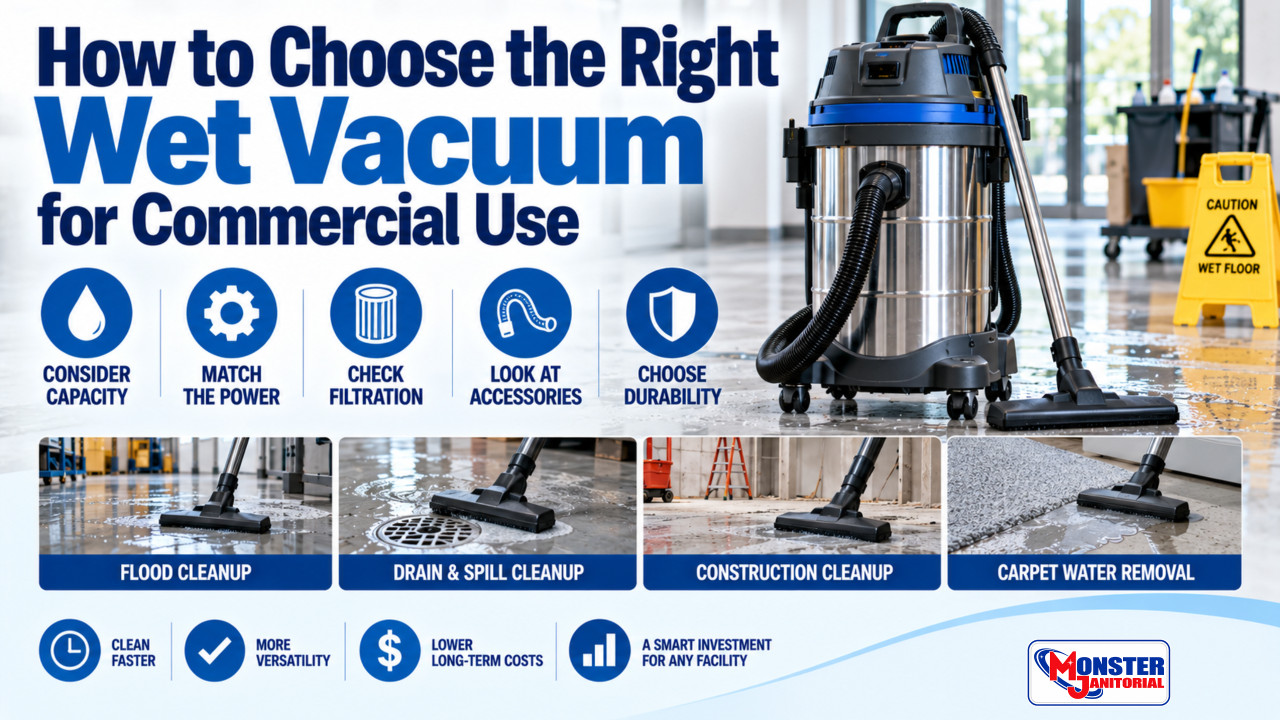
How to Choose the Right Wet Vacuum for Commercial Use
Choosing the right commercial wet vacuum can improve water recovery, spill cleanup, floor stripping, rinse-water pickup, and daily facility maintenance. The best machine depends on tank capacity, suction performance, airflow, mobility, dumping method, and the type of liquid-recovery work your facility performs.
Start With Capacity, Recovery Needs & Workflow
Choose a wet vacuum based on how much liquid you normally recover, how far the machine must travel, how often it will need to be emptied, and whether you need features such as a drain hose, dual motors, pump-out system, or front squeegee.

Choosing the Right Wet Vacuum Size
Tank capacity affects portability, emptying frequency, and how long operators can work before stopping to dump recovered water.
Best for quick spills, tight spaces, restaurants, restrooms, small offices, and portable spot recovery.
A balanced choice for daily commercial use, schools, retail facilities, restaurants, and maintenance crews.
Best for floor stripping slurry, high-volume water recovery, warehouses, large hard floors, and restoration work.
Match the Wet Vacuum to the Cleaning Environment
Facility size, spill frequency, floor area, storage space, and dumping locations all affect which wet vacuum will be easiest and most productive to use.
Useful for cafeterias, hallways, gyms, restrooms, spills, floor-care projects, and rinse-water recovery.
Compact and medium wet vacuums can support frequent spill cleanup and back-of-house floor maintenance.
Fast recovery and easy maneuverability can reduce downtime in occupied commercial spaces.
Higher-capacity recovery, drain hoses, front squeegees, and pump-out options can improve productivity on larger jobs.
Water Lift vs CFM: What Do They Mean?
Wet-vacuum performance depends on more than tank size. Water lift and airflow help describe how the vacuum moves liquid, slurry, air, and debris through the recovery system.
Water lift describes suction strength. Stronger water lift can help pull liquid, slurry, and heavier material through hoses and recovery tools.
CFM measures air movement. Higher airflow can help move air and collected material through the vacuum system efficiently.
Compare water lift, airflow, tank capacity, hose size, floor tools, and dumping method together rather than choosing a vacuum from one specification alone.
Wet Vacuum vs Wet/Dry Vacuum
Some facilities mainly need liquid recovery, while others need one machine that can handle both water and dry debris when configured correctly.
Best for water recovery, spills, floor stripping slurry, rinse water, deep-cleaning projects, and restoration cleanup.
Useful for mixed facility maintenance where operators may need to collect both dry debris and liquids with the proper configuration.
Wet Vacuum Features That Can Improve Productivity
Allows recovered water to be emptied without lifting a heavy tank.
Can speed liquid recovery across larger hard-floor areas.
Some heavy-duty machines use multiple vacuum motors for increased recovery performance.
Useful for larger or continuous recovery jobs where collected water can be pumped to an approved drain location.
Can improve transport across thresholds, hallways, and longer facility routes.
Useful when the same machine will also be configured for dry debris or fine-dust collection.
When Is a Front Squeegee Worth Having?
A front-mounted recovery squeegee can be valuable when operators regularly recover water from larger hard floors. Instead of working only with a hose and wand, the operator can push or pull the machine across the wet area.
Choosing a Wet Vacuum for Floor Stripping Slurry
Floor stripping can create large amounts of solution, dissolved finish, soil, and rinse water. For these jobs, tank capacity, recovery performance, hose size, easy draining, and optional front-squeegee recovery can become especially important.
How to Recover Floor Stripping Slurry Properly →Think About More Than the Tank Size
A larger vacuum is not always the most productive choice. Consider where the machine will be stored, transported, emptied, and used during the cleaning route.
- Responding to small spills
- Moving between rooms
- Working in tight spaces
- Transporting between floors
- Storage space is limited
- Recovering stripping slurry
- Working across large floors
- Handling high-volume water
- Frequent dumping slows productivity
- Using front-squeegee recovery
Pair Wet Recovery With Air Movers When Needed
A wet vacuum removes bulk liquid, but air movers can help accelerate evaporation after the recovery step. This can be useful after floor stripping, spill cleanup, extraction, and other high-moisture cleaning work.
Shop Air Movers & Drying FansRecommended Commercial Wet Vacuums
Wet Vacuums for Spills, Slurry & Commercial Water Recovery
Compare commercial wet and wet/dry vacuums for daily facility cleanup, floor stripping slurry, standing water, rinse-water recovery, and larger commercial recovery jobs.
TASKI Vacumat 22T
11.6-gallon commercial wet vacuum with front-squeegee capability for spill recovery, rinse water, floor stripping slurry, and larger hard-floor cleanup.
View TASKI Vacumat 22T →NSS Colt 1450 P
14.5-gallon commercial wet/dry vacuum with HEPA and front-mount squeegee options for schools, retail, maintenance crews, spills, and floor-care recovery.
View NSS Colt 1450 P →NSS Alpha Wet Vac Series
Available in 16- and 24-gallon configurations for larger water-recovery jobs, floor-care projects, warehouses, and high-volume commercial cleanup.
View NSS Alpha Wet Vac →Karcher NT 48/1
13-gallon commercial wet/dry vacuum available in standard or front-squeegee configurations for water recovery, spills, routine maintenance, and floor-care applications.
View Karcher NT 48/1 →Continue Learning About Wet Recovery
Commercial Wet Recovery Equipment
Browse commercial wet/dry vacuums and drying equipment for spills, floor-care projects, water recovery, and facility maintenance.
Need Help Choosing a Commercial Wet Vacuum?
Tell Monster Janitorial what type of facility you are cleaning, how much liquid you typically recover, and whether the machine will be used for spills, floor stripping slurry, rinse water, or general wet/dry maintenance. We can help compare tank sizes, recovery features, and equipment options.
Tax-exempt purchasing and purchase-order support are available for qualifying schools, universities, government agencies, municipalities, healthcare facilities, and other institutional customers.