
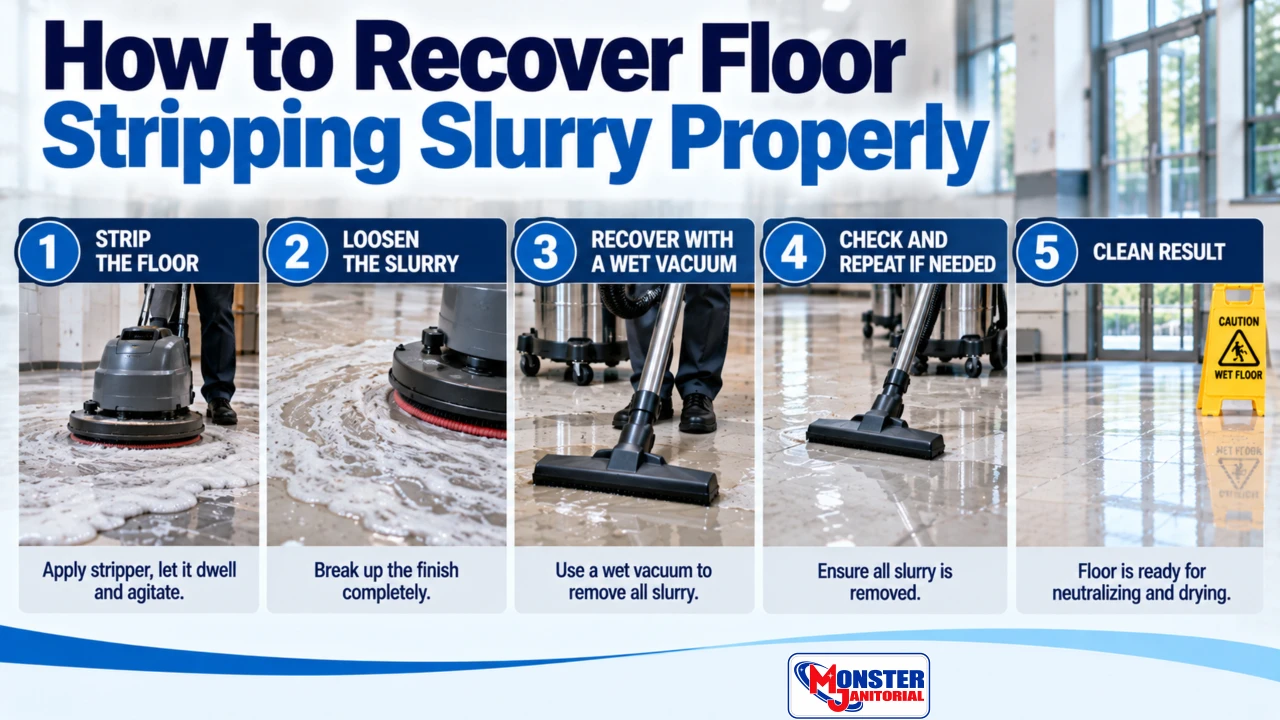
How to Recover Floor Stripping Slurry Properly
Floor stripping slurry is the dirty liquid mixture created when floor stripper, old finish, soil, and water combine during the stripping process. Recovering this slurry correctly is critical for removing residue and preparing the floor for new finish.
Do Not Let Stripping Slurry Dry on the Floor
Work in manageable sections and recover slurry while it is still wet. Dried slurry can leave residue behind, increase labor, and interfere with proper floor preparation before new finish is applied.
What Is Floor Stripping Slurry?
Floor stripping slurry is the liquid mixture created when stripper chemical breaks down old floor finish and mixes with soil, coating residue, and water.
Old floor finish broken down during stripping.
Embedded dirt released during agitation.
Chemical solution used to break down finish.
Liquid carrying the dissolved finish and soil.
Why Proper Slurry Recovery Matters
Helps remove dissolved finish and chemical residue.
Reduces the chance of residue being left behind.
Creates a cleaner surface before new finish is applied.
Efficient recovery keeps the stripping process moving.
Proper Slurry Recovery Workflow
Apply stripper, allow proper dwell time, agitate the floor, recover slurry while wet, rinse thoroughly, and allow the floor to dry before applying new finish.
Apply according to the chemical label and allow the required dwell time.
Use appropriate stripping equipment and pad or brush for the floor.
Use a wet recovery vacuum before the slurry begins to dry.
Remove remaining stripper and residue following the floor-care system instructions.
Remove dirty rinse water and repeat rinsing if required.
Do not apply new finish until the floor is clean, dry, and properly prepared.
Work in Manageable Sections
Do not apply stripper to more floor than your team can agitate, recover, and rinse before the slurry begins to dry.
Section size depends on staffing, equipment, temperature, floor condition, stripper dwell time, and the speed of the recovery process. Smaller controlled sections are generally easier to manage than treating a large hallway or room all at once.
Agitate the Floor Properly
After the stripper has reached the appropriate dwell time, agitate the floor using equipment and stripping media suitable for the flooring and finish system.
Recover Slurry Immediately
Once the old finish has been broken down, use a commercial wet recovery vacuum to remove the slurry before it begins to dry.
- Dirty stripping solution
- Dissolved floor finish
- Suspended soil
- Liquid residue
- Standing slurry
Wet Vacuum Features That Help With Slurry Recovery
Reduces frequent dumping during larger stripping projects.
Makes it easier to empty recovered solution where appropriate.
Can improve recovery speed across larger hard-floor areas.
Helps move dirty solution and slurry through the recovery system.
Rinse the Floor Thoroughly
After the stripping slurry has been recovered, follow the stripper and floor-finish manufacturer's rinsing or neutralization instructions. Some systems may require more than one rinse or additional preparation before finish is applied.
Allow the Floor to Dry Before Applying Finish
Before new finish is applied, the floor should be clean, free of stripping residue, and dry according to the floor-finish manufacturer's instructions. Applying finish over moisture or residue can lead to appearance and performance problems.
Slurry Recovery Problems That Cause Rework
Problems during stripping and recovery can leave residue behind and make final floor preparation more difficult.
Dried slurry becomes harder to recover and may leave residue.
Only use equipment specifically designed and configured for wet recovery.
Large uncontrolled sections increase the chance of slurry drying before recovery.
Remaining stripper or residue can interfere with proper floor preparation.
Recommended Floor Stripping Equipment
Machines for Agitation & Slurry Recovery
A typical stripping setup includes a low-speed floor machine for agitation and a commercial wet recovery vacuum for removing slurry and rinse water.
Low-Speed Rotary Floor Machines
Used with the appropriate stripping pad or brush to agitate stripper solution and remove old floor finish.
TASKI ergodisc 175
Low-speed rotary floor machine for stripping, scrubbing, and hard-floor restoration applications.
View TASKI ergodisc 175 →TASKI ergodisc 200
Commercial rotary floor machine for deep scrubbing, stripping, and general hard-floor maintenance.
View TASKI ergodisc 200 →Commercial Wet Recovery Vacuums
Used to recover stripping slurry, dirty solution, and rinse water before residue dries on the floor.
TASKI Vacumat 22T
11.6-gallon commercial wet vacuum with front-squeegee capability for slurry recovery, rinse water, spills, and hard-floor maintenance.
View TASKI Vacumat 22T →NSS Colt 1450 P
14.5-gallon commercial wet/dry vacuum with HEPA and front-mount squeegee options for slurry, spill, and general facility recovery.
View NSS Colt 1450 P →NSS Alpha Wet Vac Series
Higher-capacity commercial wet/dry recovery options for larger stripping projects, warehouses, and high-volume water recovery.
View NSS Alpha Wet Vac Series →Karcher NT 48/1
13-gallon commercial wet/dry vacuum available in standard or front-squeegee configurations for slurry recovery, water pickup, and floor-care work.
View Karcher NT 48/1 →Floor Stripping Slurry FAQ
It is the liquid mixture of stripper, dissolved floor finish, soil, contaminants, and water created during the stripping process.
No. Recover it while wet to reduce residue and unnecessary rework.
Use a commercial wet or wet/dry vacuum specifically designed and properly configured for liquid recovery.
It can be very useful on larger hard-floor areas because it allows the operator to recover solution without relying only on a wand.
Follow the stripper and floor-finish manufacturer's preparation instructions. Many stripping systems require thorough rinsing or other residue-removal steps.
Apply finish only after the floor has been properly prepared and is dry according to the finish manufacturer's instructions.
Continue Learning About Wet Recovery & Floor Care
Floor Stripping & Wet Recovery Equipment
Browse commercial floor machines, stripping equipment, wet recovery vacuums, and other floor-care equipment.
Need Help Choosing Floor Stripping Equipment?
Tell Monster Janitorial what flooring you are stripping, the approximate area, your current floor machine, and the amount of slurry you need to recover. We can help compare floor machines, wet vacuums, pads, and recovery equipment.
Tax-exempt purchasing and purchase-order support are available for qualifying schools, universities, government agencies, municipalities, healthcare facilities, and other institutional customers.