
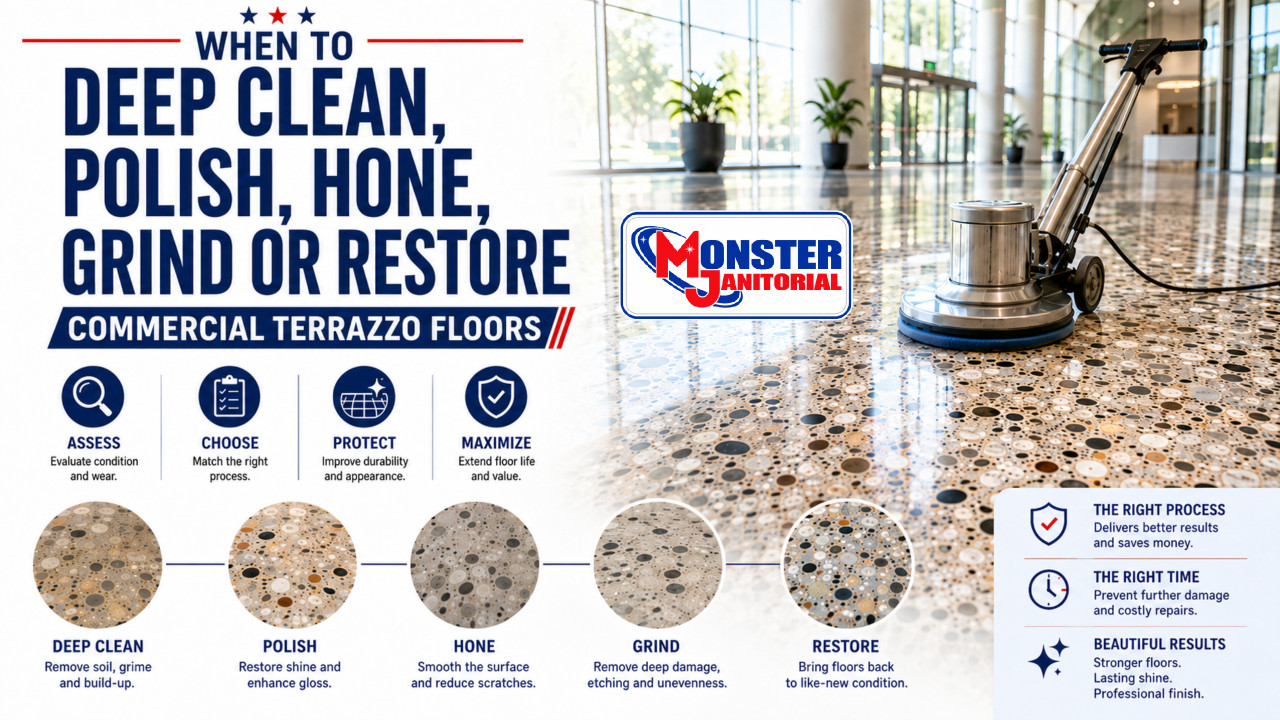
When to Deep Clean, Polish, Hone, Grind or Restore Commercial Terrazzo Floors
A dull or damaged terrazzo floor does not automatically need grinding. Many appearance problems can be corrected with proper cleaning, diamond maintenance, or polishing before more aggressive restoration is considered.
The goal is to identify the condition of the floor and use the least aggressive process that produces the required result.
Start with cleaning. Move to polishing, honing, or grinding only when the condition of the terrazzo requires it.
Deep cleaning removes soil and residue. Diamond maintenance can provide controlled surface refinement. Polishing improves clarity and gloss. Honing mechanically corrects a worn or lightly damaged surface. Grinding removes more material and belongs to a restoration process.
Start With the Least Aggressive Process
Each step below changes the floor more than the one before it.
When Does Terrazzo Only Need a Deep Cleaning?
Deep cleaning should normally be the first corrective step when the terrazzo is structurally sound but looks dirty, dull, cloudy, or uneven.
What a Terrazzo Deep Cleaning Process Should Accomplish
When to Use Diamond Maintenance Pads
Diamond-impregnated maintenance pads can bridge the gap between ordinary cleaning and more intensive restoration when the terrazzo needs controlled mechanical refinement.
When Should Commercial Terrazzo Be Polished?
Polishing is appropriate when the terrazzo is clean and generally sound but needs improved clarity, refinement, or gloss.
"Polishing" Can Mean Different Things
On terrazzo, polishing may refer to progressive mechanical refinement with diamond abrasives or to a specific maintenance system designed to increase gloss. Do not assume a high-speed burnisher, polishing chemical, or one-step pad produces the same result as a complete mechanical polishing sequence.
When Should Terrazzo Be Honed?
Honing mechanically cuts and refines the surface. It is more corrective than routine polishing and should be considered when cleaning and light refinement cannot correct the condition.
Honing Changes the Surface
Honing is not simply a stronger cleaning step. Abrasive tooling removes a controlled amount of the terrazzo surface. The resulting finish is then progressively refined through finer abrasive stages according to the restoration system.
When Does Terrazzo Need Grinding?
Grinding is a restoration process used when substantial correction is required. It removes more material than polishing or light honing and normally uses specialized diamond tooling.
A Scrubber or Stripping Machine Is Not a Terrazzo Grinder
Auto scrubbers and conventional floor machines are excellent maintenance tools, but full grinding requires equipment, diamond tooling, slurry or dust control, and operating procedures intended for surface restoration. Do not substitute an aggressive floor pad or coating-stripping machine for proper terrazzo grinding equipment.
Cracks, Chips, Spalls & Divider-Strip Problems
Some terrazzo defects cannot be corrected by polishing or grinding alone. Repair may need to occur before final surface refinement.
When Should Terrazzo Be Resealed or Recoated?
Not every terrazzo floor uses the same sealer or coating system. Identify the binder and existing treatment before adding or removing any protective product.
Cementitious vs. Epoxy Terrazzo Restoration
Cementitious Terrazzo
Cementitious terrazzo can include marble or other mineral aggregate in a cement-based matrix. Porosity, acid sensitivity, previous sealers, aggregate condition, and existing repairs should be considered before restoration.
Epoxy Terrazzo
Epoxy terrazzo uses a resin matrix. Restoration methods must account for resin compatibility, aggregate type, tooling, heat generation, existing coatings, and the specific floor system.
What Level of Terrazzo Work Does the Floor Need?
Deep clean first.
Consider diamond maintenance.
Evaluate polishing.
Evaluate honing and progressive refinement.
Evaluate grinding and restoration.
Repair before final refinement.
Understanding Diamond Grit Progression
Restoration typically progresses from more aggressive abrasive stages toward progressively finer stages. The starting point should be based on the amount of correction actually required.
When Is a Scrubber or Floor Machine Enough?
Read: Best Cleaning Chemicals, Machines & Pads for Commercial Terrazzo Floors →
Typical Commercial Terrazzo Restoration Sequence
Plan for Dust or Slurry Control
Grinding and honing can produce dust or wet slurry depending on the process. Use equipment, containment, recovery methods, PPE, and jobsite procedures appropriate for the terrazzo system, abrasive process, facility, and manufacturer instructions.
Common Terrazzo Restoration Mistakes
Commercial Terrazzo Restoration Checklist
Terrazzo Floor Care Learning Library
Explore commercial terrazzo guides covering identification, cleaning chemicals, equipment, floor pads, troubleshooting, polishing, honing, grinding, and restoration.
Complete Commercial Terrazzo Floor Cleaning & Maintenance Guide
The complete overview covering terrazzo identification, routine cleaning, chemistry, machines, pads, diamond maintenance, floor problems, polishing, and restoration.
Read Complete Guide →How to Identify Terrazzo Floors Before Cleaning: Cementitious vs. Epoxy Terrazzo
Identify the binder, aggregate, finish, coatings, sealers, and condition before selecting a cleaning or restoration process.
Read Guide →Best Cleaning Chemicals, Machines & Pads for Commercial Terrazzo Floors
Compare terrazzo cleaners, auto scrubbers, floor machines, burnishers, standard pads, and diamond maintenance systems.
Read Guide →Terrazzo Floor Problems: Dullness, Haze, Streaks, Scratches, Stains & Etching
Diagnose soil, cleaner residue, coating wear, scratching, staining, etching, and other terrazzo appearance problems.
Read Guide →When to Deep Clean, Polish, Hone, Grind or Restore Commercial Terrazzo Floors
Determine when cleaning is enough and when polishing, honing, grinding, repair, or full restoration is required.
Current GuideHelpful Equipment, Pad & Maintenance Guides
Terrazzo Restoration FAQs
How do I know whether terrazzo needs cleaning or polishing?
Deep clean the floor first. If proper cleaning removes the haze or dullness, polishing may not be necessary. If the clean surface still lacks clarity or refinement, evaluate diamond maintenance or polishing.
What is the difference between polishing and honing terrazzo?
Polishing generally focuses on increasing surface refinement and gloss. Honing is more corrective and mechanically removes a controlled amount of material to address wear, fine scratching, etching, or uneven refinement.
When does terrazzo need grinding?
Grinding may be appropriate for deeper scratches, severe wear, substantial surface irregularities, major restoration, or conditions that lighter honing and polishing cannot correct.
Can an auto scrubber restore terrazzo?
An auto scrubber can perform routine cleaning, deep cleaning, and compatible diamond maintenance. It is not a substitute for specialized grinding equipment when substantial surface removal or restoration is required.
Can diamond pads restore dull terrazzo?
Diamond maintenance pads can improve some dull terrazzo surfaces through controlled refinement, but deeper scratching, etching, or severe wear may require a more intensive honing or grinding sequence.
Can etched terrazzo be cleaned back to a shine?
True etching is physical or chemical alteration of the surface. Cleaning can remove contamination around the damaged area, but restoring the finish usually requires mechanical refinement.
Should terrazzo be sealed after restoration?
That depends on the terrazzo system and restoration program. Cementitious and epoxy terrazzo can have different protection requirements, and any sealer or coating should be compatible with the floor and intended maintenance system.
Need Help Deciding How Far to Restore a Terrazzo Floor?
Monster Janitorial can help you determine whether the job calls for routine cleaning equipment, diamond maintenance, floor machines, polishing equipment, or a more specialized restoration process.