
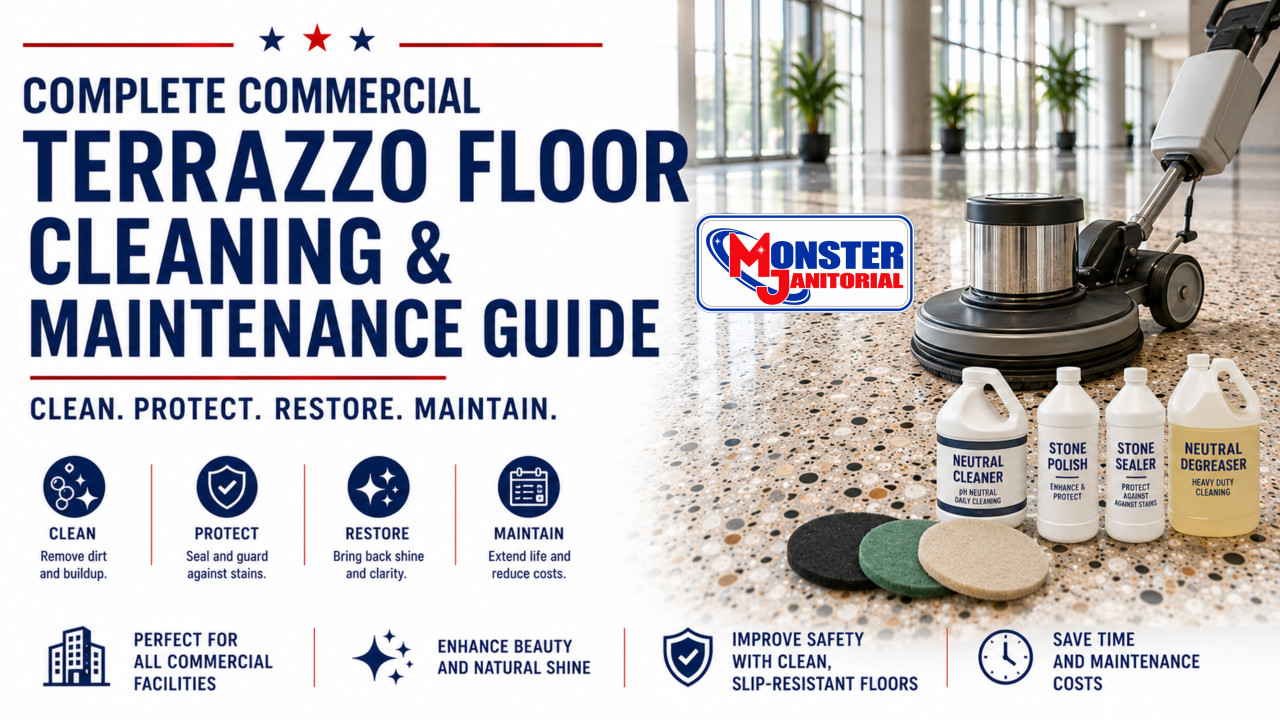
Complete Commercial Terrazzo Floor Cleaning & Maintenance Guide
Commercial terrazzo is durable and highly maintainable, but the correct cleaning process depends on whether the floor is cementitious or epoxy, the type of aggregate, the surface finish, existing sealers or coatings, and the current condition.
This guide explains routine cleaning, chemicals, auto scrubbers, floor machines, standard pads, diamond maintenance, troubleshooting, polishing, and when restoration may be necessary.
Identify the terrazzo first, remove abrasive soil, use compatible low-residue chemistry, clean with controlled agitation, and recover dirty solution completely.
Start with the least aggressive process that achieves the desired result. Routine cleaning should remove soil without unnecessarily altering the surface. Diamond maintenance, polishing, honing, and grinding belong progressively deeper into the maintenance and restoration process.
What Is Commercial Terrazzo?
Terrazzo is a composite flooring system made by embedding decorative aggregate into a binder and mechanically finishing the surface. Aggregate may include marble, granite, quartz, glass, or other decorative materials.
Cementitious vs. Epoxy Terrazzo
The binder is one of the most important things to identify before changing chemistry, pads, or restoration methods.
Cementitious Terrazzo
Uses a cement-based matrix. It may be more absorbent than epoxy terrazzo and often includes marble or other mineral aggregate. Acid sensitivity, porosity, sealers, and previous treatments should be considered before cleaning.
Epoxy Terrazzo
Uses a resin-based matrix and is generally less porous. Chemical compatibility still matters because the resin, aggregate, surface treatment, and previous coatings may react differently to cleaners or restoration methods.
Inspect More Than Just the Terrazzo Type
Commercial Terrazzo Cleaning Process
Routine cleaning should remove abrasive soil and contamination without unnecessarily altering the terrazzo surface.
Vacuum, dust mop, or sweep abrasive grit before wet cleaning.
Use a cleaner appropriate for the binder, aggregate, coating, and soil load.
More chemical does not automatically provide better cleaning.
Use the least aggressive effective pad or brush.
Do not allow contaminated cleaning solution to dry back onto the floor.
Evaluate the surface after residue and moisture are gone.
Best Cleaning Chemistry for Terrazzo
A low-residue neutral cleaner is often a strong starting point for routine commercial terrazzo maintenance. Heavier soil may require stronger compatible chemistry, but always verify the floor system before increasing chemical aggression.
Avoid Unverified Acidic or Aggressive Chemistry
Cementitious terrazzo and marble-containing terrazzo can be damaged by acidic chemistry. Epoxy terrazzo should not automatically be treated as acid-proof because aggregate and surface treatments may still be sensitive. Test unfamiliar chemicals before expanding the process.
Auto Scrubbers & Floor Machines for Terrazzo
Terrazzo can be maintained with several types of commercial equipment. Match the machine to the cleaning or refinement objective rather than selecting equipment by machine type alone.
Read: Best Cleaning Chemicals, Machines & Pads for Terrazzo →
Standard Pads vs. Diamond Pads
Standard Floor Pads
Used primarily for cleaning, scrubbing, polishing, or burnishing according to the specific pad design and machine speed. Use the least aggressive pad that accomplishes the job.
Diamond Maintenance Pads
Diamond-impregnated pads can combine cleaning with controlled mechanical refinement and may be used in progressive maintenance systems designed to improve surface clarity and gloss.
Diamond Pad Maintenance for Terrazzo
Diamond maintenance systems can help facilities maintain or progressively improve compatible terrazzo surfaces without immediately moving into a full restoration process.
Commercial Terrazzo Maintenance Schedule
When Does Terrazzo Need a Deep Cleaning?
Deep cleaning is appropriate when routine maintenance no longer removes accumulated soil or residue but the terrazzo itself is still structurally sound.
Common Commercial Terrazzo Floor Problems
Cleaning vs. Diamond Maintenance vs. Polishing vs. Restoration
Removes removable soil, residue, spills, and traffic contamination.
Combines cleaning with controlled mechanical refinement.
Improves surface refinement, clarity, and gloss.
Mechanically corrects deeper wear, fine scratching, or etching.
Removes more material and is used for substantial surface correction.
Read: When to Deep Clean, Polish, Hone, Grind or Restore Terrazzo →
Not Every Terrazzo Floor Uses the Same Protection System
Cementitious terrazzo may use a penetrating treatment, sealer, topical finish, or other protective system. Epoxy terrazzo is generally less porous but may still have a coating or maintenance treatment.
Identify the existing treatment before stripping, resealing, recoating, burnishing, or using aggressive diamond processes.
Common Commercial Terrazzo Cleaning Mistakes
Before Cleaning a Commercial Terrazzo Floor
Terrazzo Floor Care Learning Library
Explore our commercial terrazzo guides covering identification, cleaning chemicals, equipment, pads, troubleshooting, polishing, honing, grinding, and restoration.
Complete Commercial Terrazzo Floor Cleaning & Maintenance Guide
The complete overview covering terrazzo identification, routine cleaning, chemistry, machines, pads, diamond maintenance, common problems, polishing, and restoration.
Complete Terrazzo GuideHow to Identify Terrazzo Floors Before Cleaning: Cementitious vs. Epoxy Terrazzo
Identify the binder, aggregate, finish, coatings, sealers, and condition before choosing a maintenance process.
Read Guide →Best Cleaning Chemicals, Machines & Pads for Commercial Terrazzo Floors
Compare recommended cleaners, auto scrubbers, floor machines, burnishers, standard pads, and diamond systems.
Read Guide →Terrazzo Floor Problems: Dullness, Haze, Streaks, Scratches, Stains & Etching
Diagnose soil, residue, coating wear, scratches, stains, etching, and other common terrazzo problems.
Read Guide →When to Deep Clean, Polish, Hone, Grind or Restore Commercial Terrazzo Floors
Determine when cleaning is enough and when polishing, honing, grinding, repair, or restoration is needed.
Read Guide →Helpful Equipment, Pad & Maintenance Guides
Commercial Terrazzo Floor Care FAQs
What is the best way to clean commercial terrazzo?
Remove abrasive dry soil first, use compatible low-residue chemistry at the correct dilution, agitate with an appropriate pad or brush, recover dirty solution completely, and inspect the floor after drying.
Can an auto scrubber be used on terrazzo?
Yes. Auto scrubbers can be very effective on compatible commercial terrazzo when the correct pad or brush, chemistry, pressure, and solution recovery are used.
Should terrazzo be cleaned with acidic chemicals?
Acidic chemistry should not be used unless compatibility is specifically confirmed. Cementitious terrazzo and marble-containing aggregate can be particularly vulnerable to acid damage.
Are diamond pads good for terrazzo?
Compatible diamond maintenance pads can be very useful for cleaning and progressive surface refinement. Follow the specific pad system rather than selecting by color alone.
Why does terrazzo look dull after cleaning?
Dullness may come from residue, embedded soil, fine abrasion, worn coatings, or loss of surface refinement. Determine the cause before increasing pad or chemical aggression.
When should terrazzo be polished or restored?
Consider polishing, honing, or restoration when proper cleaning and compatible maintenance cannot correct loss of clarity, scratching, etching, uneven wear, or other physical surface damage.
Is epoxy terrazzo maintained the same as cementitious terrazzo?
Not always. Binder type, aggregate, porosity, coatings, chemical sensitivity, and restoration methods can differ. Identify the floor system before changing the maintenance process.
Need Help With Commercial Terrazzo Floor Care?
Monster Janitorial can help you compare terrazzo cleaning chemicals, auto scrubbers, floor machines, burnishers, standard pads, diamond-pad systems, and maintenance equipment.