
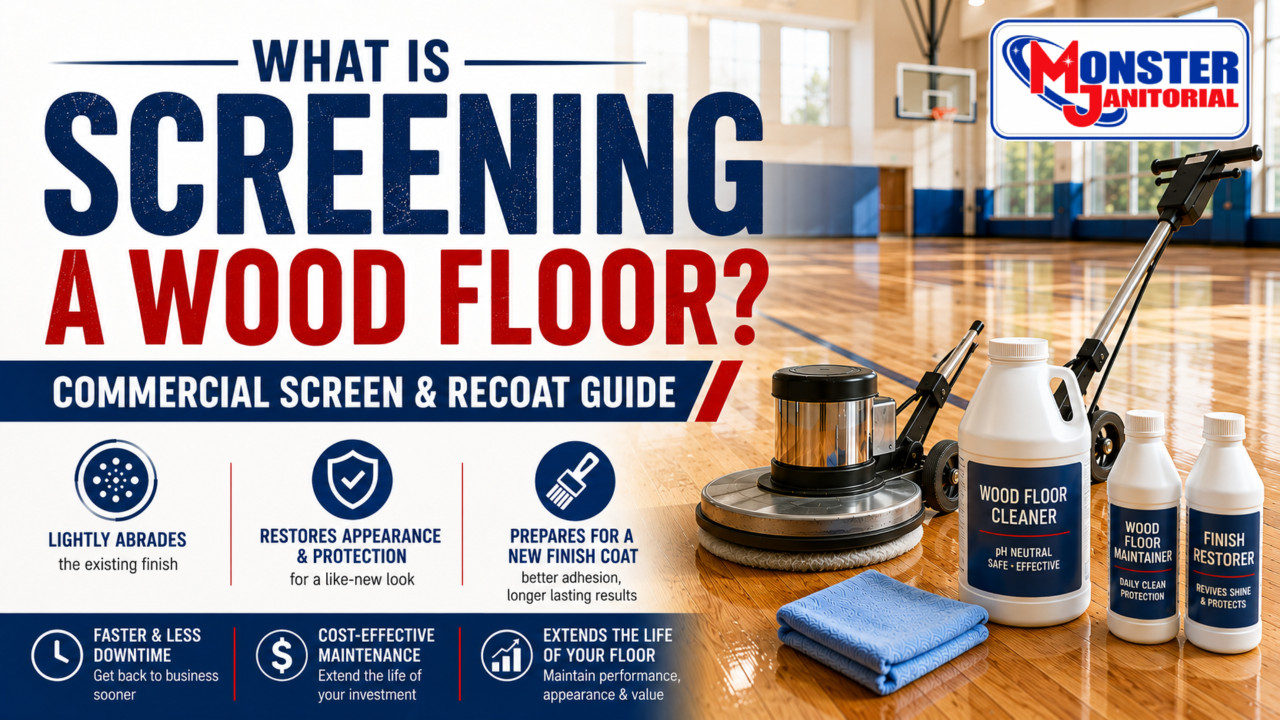
What Is Screening a Wood Floor?
Commercial Screen & Recoat Guide
Screening is a wood-floor maintenance process used to prepare an existing finish for a compatible new coat without sanding the entire floor down to bare wood.
For commercial hardwood, gym, athletic, stage, and other finished wood floors, screening can help renew protection when the coating is worn or lightly scratched but the underlying wood remains in serviceable condition.
Screening lightly abrades or prepares the existing wood-floor coating so a new compatible coat can bond properly.
It is less aggressive than full sanding because the goal is normally to prepare the existing finish rather than remove the entire coating system and expose bare wood.
Screening vs. Sanding a Wood Floor
These processes are often confused, but they solve different levels of wear and damage.
Prepares the Existing Finish
- Lightly abrades or prepares the coating.
- Creates a surface suitable for compatible recoating.
- Does not normally remove all finish to bare wood.
- Used when the underlying wood is still protected.
- Often part of preventive wood-floor maintenance.
Removes Much More Material
- Removes existing finish more aggressively.
- Can expose and level the wood surface.
- Used for deeper scratches and severe wear.
- May be necessary when coating has failed.
- Requires more extensive restoration work.
Signs a Commercial Wood Floor May Need a Screen & Recoat
Screening is most useful when the coating shows wear but the finish has not deteriorated to the point that full sanding is required.
Signs the Floor May Need More Than a Screen & Recoat
Commercial Wood Floor Screen & Recoat Process
Exact preparation procedures depend on the existing finish and coating system, but the overall process usually follows this sequence.
Why the Floor Must Be Properly Cleaned Before Screening
Screening over contamination can grind soil, grease, cleaner residue, or other materials into the existing finish and interfere with the preparation process.
What Equipment Is Used to Screen a Wood Floor?
Screening may use a compatible low-speed or orbital floor machine with the abrasive or preparation system specified for the coating being renewed.
Read: Auto Scrubbers, Floor Machines & Pads for Commercial Wood Floors →
Remove Screening Dust Before Applying Finish
Mechanical preparation creates fine dust that must be removed before bonding agents, sealers, or coatings are applied. Dust left on the floor can interfere with surface preparation and final appearance.
Screening Is Not Routine Floor Cleaning
Screening intentionally abrades or prepares the existing finish. That makes it fundamentally different from normal scrubbing or damp cleaning.
Screening Does Not Guarantee a New Coating Will Bond
The existing finish, previous maintenance products, contaminants, preparation method, bonding treatment, and new coating all affect adhesion. Confirm coating compatibility and follow the complete preparation system rather than assuming mechanical abrasion alone is sufficient.
Commercial Wood-Floor Preparation & Coating Products
Use products as part of their compatible wood-floor system and according to manufacturer preparation requirements.
Pioneer Eclipse TimberBond 717
Bonding agent used as part of compatible commercial wood-floor preparation and recoating systems.
View TimberBond 717 →Pioneer Eclipse TimberGuard Varsity 719
Commercial sport-floor coating for compatible gym and athletic wood-floor systems.
View TimberGuard Varsity 719 →Pioneer Eclipse WoodStar 702
High-gloss wood-floor coating for compatible prepared commercial wood-floor systems.
View WoodStar 702 →Screening Commercial Gym Floors
Gym floors often have game lines, logos, multiple finish coats, and years of maintenance history. Screening must preserve the underlying floor design while preparing the clear coating for compatible recoating.
How Often Should a Commercial Wood Floor Be Screened & Recoated?
There is no single schedule that applies to every facility. Recoat timing should be based on actual finish condition, traffic, maintenance practices, floor use, coating system, and manufacturer guidance.
Do Not Wait Until Bare Wood Is Exposed
Screening and recoating while the existing protective finish is still serviceable can help extend the life of the floor. Once heavy wear reaches bare wood, restoration usually becomes more involved.
Common Screen & Recoat Mistakes
Does the Floor Need Cleaning, Screening, or Sanding?
- Soil or residue is visible.
- Haze improves after proper cleaning.
- Scuffs are removable.
- Finish remains healthy.
- Finish is dull after cleaning.
- Light scratches are in the coating.
- Traffic lanes show finish wear.
- Wood is still protected.
- Bare wood is exposed.
- Deep scratches reach the wood.
- Coating has significantly failed.
- Major surface correction is required.
Commercial Wood Floor Care Learning Library
Follow the complete commercial wood-floor care path from identification and routine cleaning through chemistry, equipment, troubleshooting, screening, recoating, sanding, and restoration.
Complete Commercial Wood Floor Cleaning & Maintenance Guide
Start with the complete overview of commercial wood-floor identification, cleaning, chemistry, moisture control, machines, pads, troubleshooting, recoating, sanding, and restoration.
Read Complete Wood Floor Guide →How to Identify Commercial Wood Floors Before Cleaning
Compare sealed vs. unsealed, solid vs. engineered wood, finish types, wear, seams, and moisture risk.
Read Identification Guide →Best Cleaning Chemicals for Commercial Wood & Gym Floors
Compare daily, routine, deep-cleaning, preparation, bonding, sealing, and coating products.
Read Chemical Guide →Commercial Gym & Sealed Wood Floor Cleaning Guide
Learn the routine process for soil removal, damp cleaning, scuff control, moisture management, and compatible machine cleaning.
Read Cleaning Guide →Auto Scrubbers, Floor Machines & Pads for Commercial Wood Floors
Compare machines, pads, pressure, solution flow, recovery, orbital equipment, and screening applications.
Read Equipment Guide →Commercial Wood & Gym Floor Problems
Diagnose dullness, haze, streaks, scuffs, black marks, scratches, finish wear, and moisture damage.
Read Troubleshooting Guide →What Is Screening a Wood Floor? Commercial Screen & Recoat Guide
Learn how screening prepares an existing finish and when preventive recoating may extend the life of the wood floor.
Current GuideWhen to Clean, Screen & Recoat, or Sand & Refinish
Decide whether the floor needs routine cleaning, finish renewal, or complete sanding and refinishing.
Read Decision Guide →Commercial Wood Floor Restoration & Sanding Guide
Learn when to sand, refinish, repair, or replace floors with deep scratches, exposed wood, failed coatings, or moisture damage.
Read Restoration Guide →From Routine Cleaning to Full Restoration
Wood Floor Screening FAQs
What does screening a wood floor mean?
Screening prepares or lightly abrades the existing finish so a compatible new coating can bond. It generally does not remove the entire finish down to bare wood.
Is screening the same as sanding?
No. Screening is primarily finish preparation. Sanding removes significantly more finish and may remove wood material as part of a full refinishing process.
Can screening remove scratches?
Screening may help address very light finish-level wear as part of a recoat process, but it does not repair deep scratches extending into the wood.
Can a gym floor be screened and recoated?
Yes, many commercial gym floors use periodic screen-and-recoat maintenance when the existing coating and new coating system are compatible and the underlying wood remains protected.
Do you need to clean before screening?
Yes. Soil, grease, residue, and contaminants should be removed according to the coating system before mechanical preparation begins.
How do you know when screening is not enough?
Exposed wood, deep scratches, severe coating failure, significant moisture damage, or major surface defects may require more extensive repair or sanding and refinishing.
Should you wait until the floor is badly worn before screening?
No. A screen-and-recoat process is often most useful while the existing finish is still protecting the wood and can be properly prepared for another compatible coat.
Need Help With a Commercial Wood Floor Screen & Recoat System?
Monster Janitorial can help you compare wood-floor cleaners, deep-scrub products, preparation equipment, bonding agents, coatings, pads, and maintenance products for commercial hardwood and gym-floor projects.