
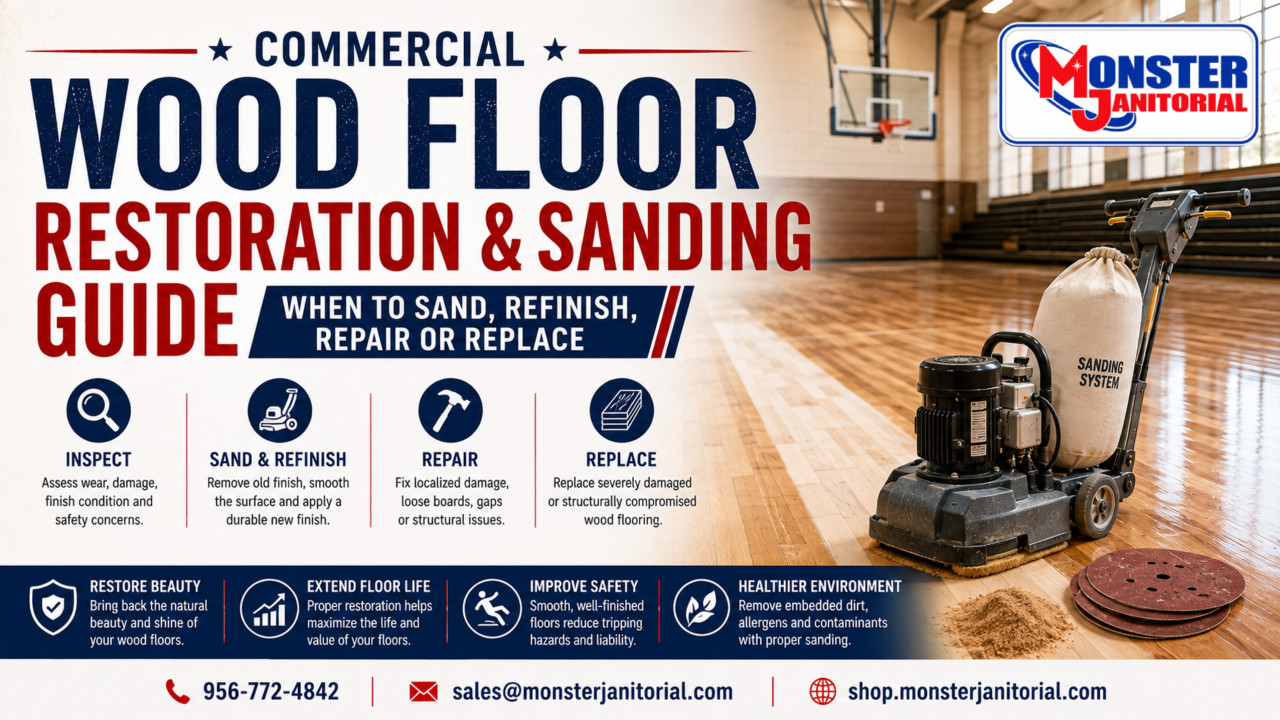
Commercial Wood Floor Restoration & Sanding Guide
When to Sand, Refinish, Repair or Replace
Commercial hardwood and gym floors can often be preserved through cleaning and periodic recoating, but deeper scratches, exposed wood, failed coatings, severe wear, and physical damage can require more extensive restoration.
This guide explains how full sanding differs from screening, what equipment is used, how to manage dust and abrasives, and when repair or replacement should be considered instead of simply sanding the floor again.
Sand and refinish when damage extends beyond the existing coating or when the finish system can no longer be successfully cleaned and recoated.
Full sanding removes significantly more material than screening. It may be appropriate for deep scratches, exposed wood, failed coatings, severe wear, or major surface correction, but moisture damage and structural problems should be investigated before sanding begins.
Clean, Recoat, Sand or Replace?
Screening Is Not the Same as Full Sanding
Lightly abrades or prepares the existing finish so a compatible new coating can bond. It normally does not remove the complete coating system or expose the entire wood surface.
Removes substantially more finish and may remove wood material so deeper wear, scratches, previous coatings, and surface irregularities can be corrected before the floor is rebuilt with a new finishing system.
Read: What Is Screening a Wood Floor? Commercial Screen & Recoat Guide →
Signs a Commercial Wood Floor May Need Sanding
Do Not Sand Away the Evidence of an Active Moisture Problem
Cupping, swelling, raised edges, darkened boards, open seams, or movement can indicate moisture imbalance or intrusion. The underlying moisture source should be identified and the floor stabilized before aggressive sanding or refinishing.
Solid Hardwood vs. Engineered Wood Refinishing
Solid wood generally provides more material above the tongue-and-groove structure than a thin engineered wear layer, but previous sanding, board thickness, damage, and floor construction still need to be evaluated before additional material is removed.
Engineered flooring has a real wood wear layer above its core. Wear-layer thickness varies, so sanding limits differ by product. Confirm the manufacturer specification and remaining wear layer before planning full sanding.
Read: How to Identify Commercial Wood Floors Before Cleaning →
How Many Times Can a Commercial Wood Floor Be Sanded?
There is no universal number. The answer depends on floor construction, original thickness, previous sanding depth, wear layer, fastener location, current damage, and how much wood must be removed during the next restoration. Inspect the actual floor rather than assuming it can be sanded again.
Equipment Used for Commercial Wood-Floor Restoration
Full wood-floor restoration normally requires equipment designed for different parts of the job. A floor machine used for screening should not be confused with a dedicated drum sander or edger used for full sanding.
Wood-Floor Sanding Equipment Supported by Monster Janitorial
Monster Janitorial provides parts-manual support for Pacific Floorcare wood-floor sanding equipment, including the Rhino PFS 8 drum sander and Wolverine PF7 edger.
Pacific Rhino PFS 8 8" Drum Sander
Monster Janitorial's Pacific Floorcare support library includes parts manuals for both clamp-bar and expandable-drum versions of the Rhino PFS 8, along with a multi-speed conversion kit manual.
View Pacific Floorcare Parts Manuals →Pacific Wolverine PF7 Edger Sander
Monster Janitorial also provides parts-manual support for the Pacific Wolverine PF7 edger, used for perimeter and edge sanding where a larger field sander cannot reach.
View Pacific Floorcare Parts Manuals →Orbital & Low-Speed Machines for Recoat Preparation
Screening and recoat preparation are lighter processes than full drum sanding. Orbital or low-speed machines can be used with compatible pads, screens, or abrasives when specified by the wood-floor coating system.
ORBOT Vibe 17"
A commercial orbital floor machine for hard-floor scrubbing, stripping, polishing, grinding, and other surface-maintenance applications when paired with the correct accessory.
View ORBOT Vibe →EDIC Saturn SV 17"
A 175 RPM low-speed machine that can be used for compatible screening and surface-preparation work when paired with the correct pad driver and abrasive system.
View EDIC Saturn SV →Karcher BDS 43/Orbital C
An orbital floor machine that can support compatible screening and finish-preparation applications with the appropriate abrasive and coating system.
View Karcher BDS 43/Orbital C →Important: These machines are not substitutes for a dedicated drum or belt sander when full removal and leveling of a wood floor is required.
Read: Auto Scrubbers, Floor Machines & Pads for Commercial Wood Floors →
Choosing Sandpaper, Screens & Preparation Abrasives
Abrasive selection determines how much material is removed and how the floor is prepared for the next sanding step or finishing system.
Sanding & Surface-Preparation Abrasives Sold by Monster Janitorial
Monster Janitorial carries machine-specific sanding and surface-preparation abrasives. Compatibility should be confirmed with the exact machine and restoration process before ordering.
Tomcat EDGE-4035 13" × 19" 100-Grit Sand Paper
OEM 100-grit sandpaper sold for compatible Tomcat, Factory Cat, and Timberline orbital floor-machine applications. Confirm machine and wood-floor process compatibility before use.
View Tomcat EDGE-4035 100-Grit Sand Paper →Control Sanding Dust at the Source
Full sanding can create large amounts of fine wood and finish dust. Where compatible equipment allows it, source-capture dust control should collect material close to the sanding point, followed by thorough vacuum cleanup before sealing or coating.
Monster Janitorial's Pacific Floorcare manual library also includes a Vacuum - Dust Control for Orbital Floor Machine parts manual for compatible Pacific equipment.
XPOWER X-4700A / X-4700AM 750 CFM HEPA Air Scrubber
For larger commercial wood-floor sanding and restoration projects, the XPOWER X-4700A Series provides up to 750 CFM of airflow with three-stage HEPA filtration and variable-speed operation.
Use the air scrubber as supplemental airborne-dust control after source capture at the sanding equipment. It can help filter fine particles that escape the primary dust-collection system or become airborne during sanding and cleanup.
Basic Commercial Wood-Floor Sanding Sequence
Exact grit progression and preparation procedures depend on the floor and finishing system.
Commercial Wood-Floor Sealer, Bonding & Coating Products
Pioneer Eclipse WoodPrime 701
Sanding sealer for compatible commercial wood-floor finishing systems after the wood has been properly prepared.
View WoodPrime 701 →Pioneer Eclipse TimberBond 717
Bonding agent used within compatible commercial wood-floor recoating and preparation systems.
View TimberBond 717 →Pioneer Eclipse WoodStar 702
High-gloss wood-floor coating for compatible commercial wood-floor systems.
View WoodStar 702 →Pioneer Eclipse TimberGuard Varsity 719
Sport-floor coating for compatible commercial gym and athletic wood-floor systems.
View TimberGuard Varsity 719 →Commercial Gym Floor Sanding & Refinishing
Gym-floor restoration requires additional planning because court markings, logos, game lines, bleacher areas, stages, entrances, and high-traffic zones may all have different levels of wear.
Read the Commercial Gym & Sealed Wood Floor Cleaning Guide →
When Repair or Replacement Makes More Sense Than Sanding
Common Wood-Floor Restoration Mistakes
Before Starting a Commercial Wood-Floor Restoration
Commercial Wood Floor Care Learning Library
Explore commercial wood and gym-floor guides covering identification, routine cleaning, chemistry, machines, pads, troubleshooting, screening, recoating, sanding, refinishing, repair, and restoration.
Complete Commercial Wood Floor Cleaning & Maintenance Guide
Start with the complete guide for an overview of floor identification, cleaning, moisture control, chemicals, machines, pads, gym-floor maintenance, troubleshooting, recoating, and refinishing.
Read Complete Wood Floor Guide →How to Identify Commercial Wood Floors Before Cleaning
Compare sealed vs. unsealed, solid vs. engineered wood, finish types, coating condition, exposed wood, and moisture risk.
Read Identification Guide →Best Cleaning Chemicals for Commercial Wood & Gym Floors
Compare neutral, low-residue, and gym-floor cleaners based on the existing coating and maintenance objective.
Read Chemical Guide →Commercial Gym & Sealed Wood Floor Cleaning Guide
Learn how to remove dust, soil, shoe marks, body oils, spills, and residue while protecting the coating and controlling moisture.
Read Cleaning Guide →Auto Scrubbers, Floor Machines & Pads for Commercial Wood Floors
Compare auto scrubbers, low-speed machines, orbital equipment, pads, moisture recovery, pressure, and screening equipment.
Read Equipment Guide →Commercial Wood & Gym Floor Problems
Diagnose dullness, haze, streaks, scuffs, black marks, scratches, slipperiness, coating wear, and moisture damage.
Read Troubleshooting Guide →What Is Screening a Wood Floor? Commercial Screen & Recoat Guide
Learn what screening does, how preparation abrasives differ from cleaning pads, and when recoating may extend floor life.
Read Screening Guide →When to Clean, Screen & Recoat or Sand & Refinish
Determine whether the floor needs cleaning, screening and recoating, or complete sanding and refinishing.
Read Decision Guide →Commercial Wood Floor Restoration & Sanding Guide
Learn when to sand, refinish, repair, or replace wood flooring based on coating failure, scratches, exposed wood, moisture damage, and structural condition.
Current GuideFrom Routine Cleaning to Full Restoration
Commercial Wood-Floor Sanding FAQs
What is the difference between screening and sanding?
Screening lightly prepares the existing coating for recoating. Full sanding removes substantially more coating and may remove wood material to correct deeper wear and damage.
When does a commercial wood floor need full sanding?
Full sanding may be appropriate when bare wood is exposed, scratches extend into the wood, the coating has substantially failed, or major surface correction is necessary.
Can engineered wood floors be sanded?
Some engineered wood can be refinished, but sanding depth is limited by the thickness and condition of the real wood wear layer. Verify manufacturer specifications before sanding.
What equipment is used to sand commercial wood floors?
Full restoration commonly uses a drum or belt sander for the field, an edger for perimeter work, detail or orbital equipment where needed, abrasives in a planned progression, and dust-control equipment.
Can an orbital floor machine replace a drum sander?
Not for every job. Orbital machines are useful for many screening, preparation, and detail applications, but a dedicated drum or belt sander is designed for heavier field sanding and material removal.
Should cupped wood floors be sanded flat immediately?
Not automatically. Cupping can indicate moisture imbalance. The source and condition should be investigated and stabilized before aggressive surface correction.
When should damaged boards be replaced instead of refinished?
Replacement may be appropriate when boards are structurally damaged, severely moisture affected, too thin to sand safely, badly split, or otherwise beyond practical surface restoration.
Need Help With Commercial Wood-Floor Restoration Equipment?
Monster Janitorial can help you identify compatible floor machines, orbital equipment, sanding and preparation abrasives, dust-control equipment, wood-floor cleaners, sealers, bonding products, coatings, replacement parts, and equipment support for your restoration project.