
MJ University Carpet Chemistry Guide
Commercial Carpet Pre-Sprays Explained: How to Choose the Right Formula
Learn how carpet fiber, soil type, pH, dilution, dwell time, agitation, extraction, and rinsing requirements affect commercial carpet pre-spray selection.
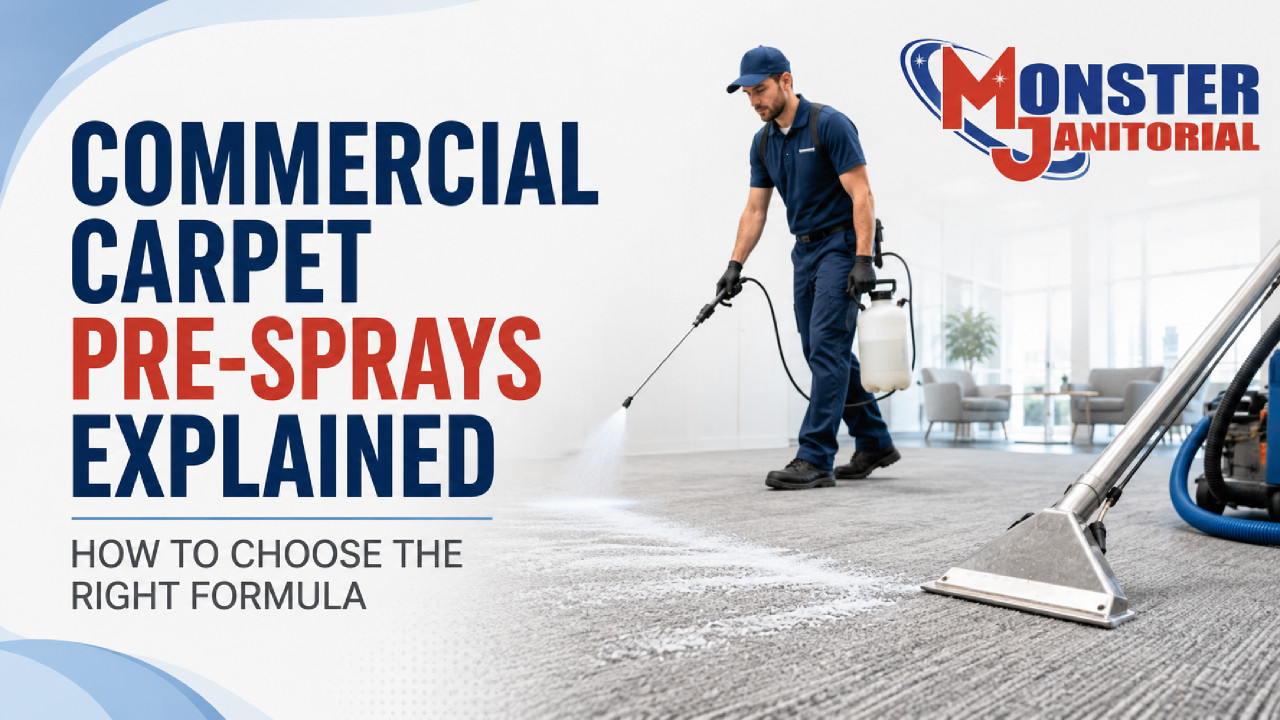
A commercial carpet pre-spray is applied before extraction to loosen bonded soil, oily residue, food contamination, and traffic-lane buildup. It gives the cleaning chemistry time to work before the loosened soil and solution are removed from the carpet.
The strongest formula is not automatically the best choice. Effective preconditioning depends on matching the product to the carpet fiber, soil conditions, cleaning method, and available rinsing and recovery equipment.
The Most Important Pre-Spray Rule
Choose the mildest formula that can effectively loosen the soil without harming the carpet fiber, dye system, backing, adhesive, stain treatment, or surrounding materials. Apply it at the labeled dilution, allow the correct dwell time, prevent it from drying, and recover it thoroughly.
What Is a Commercial Carpet Pre-Spray?
Pre-spray, sometimes called carpet preconditioner or traffic-lane cleaner, is applied to the carpet before extraction. It helps break the bond between soil and carpet fibers so the extractor can remove contamination more efficiently.
What Determines the Correct Formula?
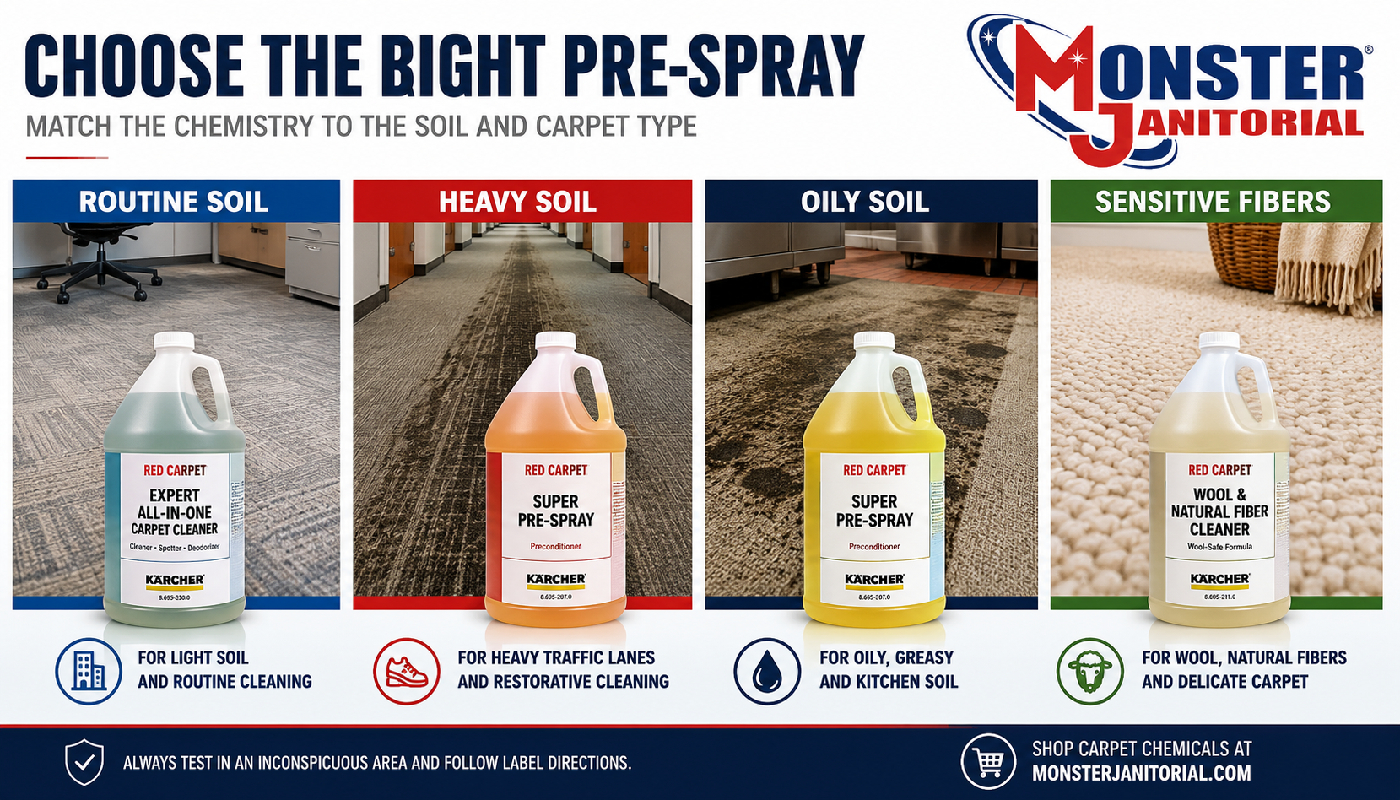
Light-Duty and Routine-Maintenance Pre-Sprays
Mild or moderate pre-sprays are often suitable for frequently maintained carpet, light office soil, and areas where residue control is a priority.
Common Applications
- Routine office maintenance
- Light traffic lanes
- Frequently cleaned carpet
- Low-to-moderate soil conditions
Selection Priorities
- Low residue
- Easy rinsing
- Fiber compatibility
- Controlled application
Heavy-Duty Traffic-Lane Pre-Sprays
Heavy-duty pre-sprays are designed for neglected carpet, greasy traffic lanes, entryways, restaurants, cafeterias, and other areas where routine chemistry may not provide enough soil suspension.
Pre-Sprays for Oily and Greasy Soil
Polyester and olefin carpet can hold oily soil strongly. Entryways, restaurants, automotive facilities, breakrooms, and industrial environments may require chemistry designed to loosen grease and oily residue.
Enzyme and Bio-Enzymatic Preconditioning
Enzyme products may be appropriate for certain food residues, protein-based contamination, organic spills, and odor sources. They must contact the contamination and remain under the required conditions long enough to work.
- Follow the labeled dilution and temperature range.
- Provide the required dwell time.
- Prevent premature drying during treatment.
- Remove loosened contamination as directed.
- Do not assume an enzyme product is safe for every fiber or dye system.
Wool-Safe and Specialty-Fiber Pre-Sprays
Wool, natural fibers, blends, and specialty carpet systems require conservative chemistry and careful testing. A heavy-duty alkaline traffic-lane cleaner should not automatically be used on these installations.
Understanding Pre-Spray pH
Product pH is one part of chemical selection. Alkaline formulas may help loosen heavy oily soil, while controlled-pH products may be more appropriate for sensitive fibers or dye systems.
Why Correct Dilution Matters
When the Mixture Is Too Weak
- Poor soil loosening
- Inconsistent cleaning
- More agitation
- Repeated wet passes
When the Mixture Is Too Strong
- Excess residue
- Rapid resoiling
- Increased foam
- Difficult rinsing
- Possible fiber or dye damage
Dwell Time: Give the Chemistry Time to Work
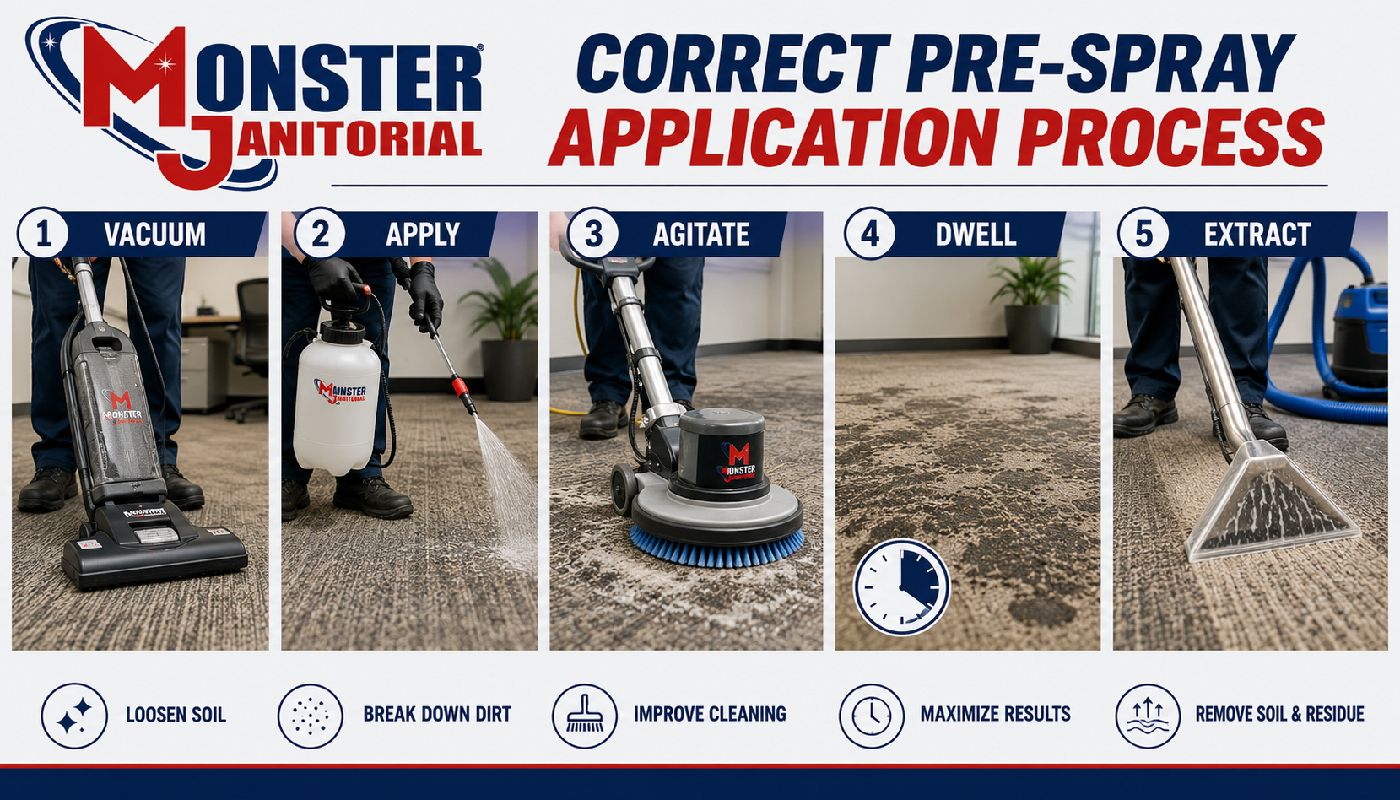
Dwell time is the period between application and extraction. It allows the pre-spray to penetrate and loosen soil before recovery.
- Follow the product label.
- Work in manageable sections.
- Do not allow conventional pre-spray to dry on the carpet.
- Adjust work areas in warm, dry, or high-airflow conditions.
- Do not begin extraction so quickly that the chemistry has no time to work.
When Is Agitation Needed?
Agitation helps distribute the pre-spray and improves contact between the chemistry, carpet fibers, and embedded soil.
Does Carpet Pre-Spray Need to Be Rinsed?
Most conventional carpet pre-sprays are designed to loosen soil before extraction. The loosened soil and remaining chemistry should then be removed through extraction and the rinsing procedure directed by the product manufacturer.
Rinsing is especially important when:
- A heavy-duty alkaline pre-spray was used.
- The carpet has old detergent residue.
- Large amounts of chemistry were applied.
- The carpet feels sticky after cleaning.
- Rapid resoiling has been a recurring problem.
- The product label directs rinsing or neutralization.
Match Pre-Spray to Carpet Fiber
Recommended Monster Janitorial Chemicals
Commercial Carpet Pre-Sprays and Companion Products
These products cover heavy-duty preconditioning, multipurpose cleaning, specialty-fiber care, and post-pre-spray rinsing. Always review the product label and verify compatibility before use.
Dedicated Pre-Spray
Red Carpet Super Pre-Spray
A dedicated commercial carpet pre-spray option for restorative cleaning, traffic lanes, and heavily soiled carpet.
View Karcher 8.695-207.0Multipurpose Formula
Red Carpet Expert All-In-One Cleaner
A versatile carpet-care option for facilities seeking one product for multiple cleaning and spot-treatment applications.
View Karcher 8.695-230.0Specialty Fiber
Red Carpet Wool & Natural Fiber Cleaner
A specialty option for compatible wool and natural-fiber carpet where conservative chemistry is required.
View Karcher 8.695-211.0Companion Rinse
Red Carpet Super Conditioning Rinse
A companion rinse for removing loosened soil and remaining pre-spray residue after extraction cleaning.
View Karcher 8.695-209.0Common Carpet Pre-Spray Mistakes
Carpet Pre-Spray Selection Checklist
- Confirm the carpet fiber and manufacturer.
- Inspect the construction, backing, seams, and installation.
- Identify the dominant soil type.
- Review the product label and safety information.
- Verify fiber, dye, and stain-treatment compatibility.
- Measure the correct dilution.
- Test in an inconspicuous area.
- Apply evenly without overwetting.
- Allow the proper dwell time.
- Do not let conventional pre-spray dry.
- Agitate only as needed.
- Extract and rinse thoroughly.
- Use dry passes and air movement.
- Document the successful cleaning procedure.
Continue Learning
Need Help Choosing a Commercial Carpet Pre-Spray?
Monster Janitorial can help match carpet chemistry to your fiber type, soil conditions, cleaning method, extractor, rinsing procedure, and facility requirements.
Phone: 956-772-4842
Email: sales@monsterjanitorial.com