null
What PSI Do I Need in a Commercial Carpet Extractor?

What PSI Do I Need in a Commercial Carpet Extractor?

Posted by Monster Janitorial Tech Team on Jul 31, 2026

MJ University Carpet-Equipment Guide

What PSI Do I Need in a Commercial Carpet Extractor?

Learn how pump pressure affects solution delivery, when higher pressure may help, and why the correct PSI must be matched to the carpet, cleaning tool, jet size, soil level, and vacuum-recovery system.

Quick Answer

Higher PSI does not automatically mean better carpet cleaning.

The correct setting is the lowest pressure that produces acceptable cleaning while allowing the wand and vacuum system to recover the applied solution efficiently.

Most Important Principle

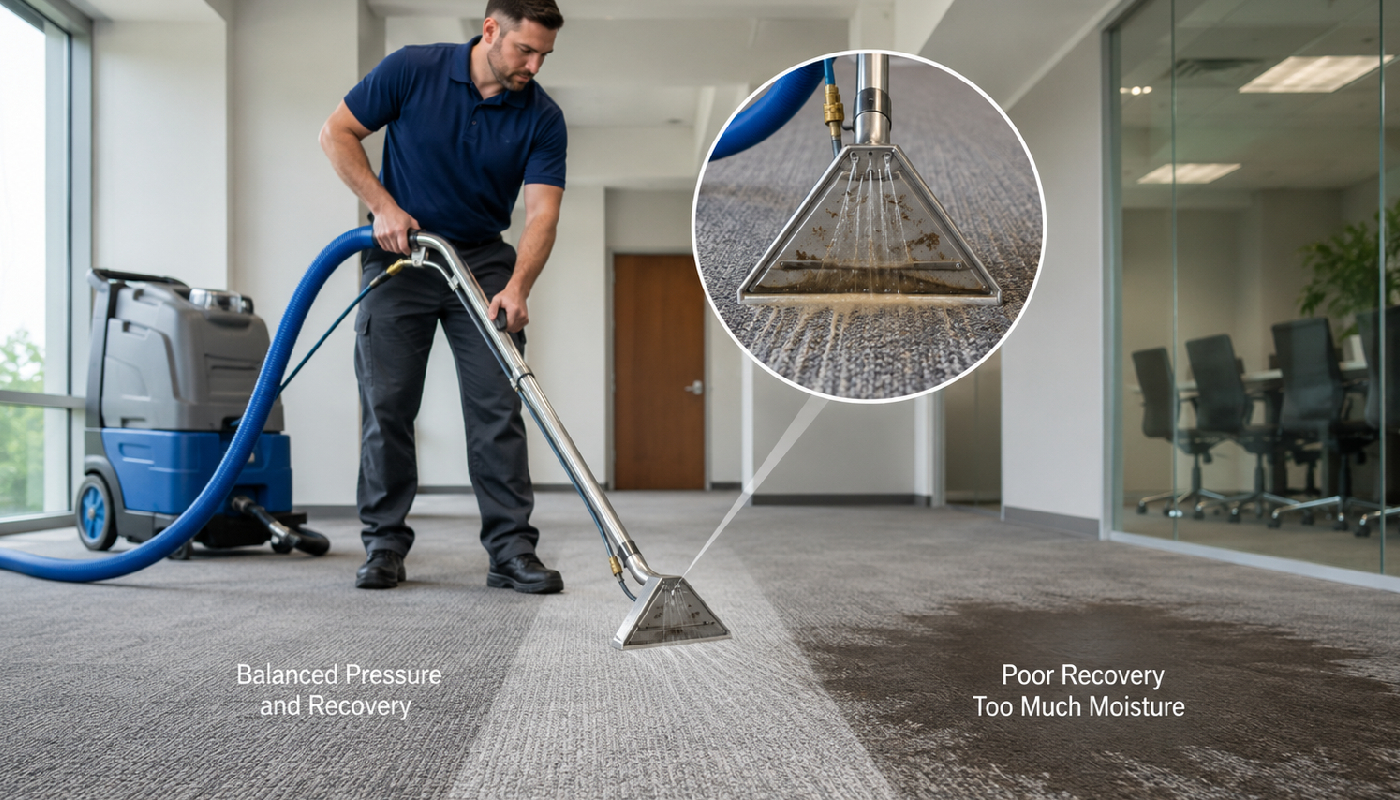
Pressure and recovery must remain balanced.

Increasing solution pressure without adequate vacuum recovery can leave excess moisture in the carpet and increase drying time, wicking, residue movement, and overwetting risk.

PSI

What Does PSI Mean on a Carpet Extractor?

PSI means pounds per square inch. On a carpet extractor, it describes the pressure used to deliver cleaning solution through the pump, hose, wand, and spray jets.

PSI does not measure vacuum recovery, airflow, water lift, cleaning heat, brush agitation, chemistry, or operator technique. A high-pressure pump alone does not guarantee better cleaning or faster drying.

General Equipment Guide

Practical Carpet-Extractor PSI Ranges

These are general working ranges—not universal settings. Always follow the carpet, extractor, wand, jet, upholstery tool, and chemical manufacturers’ instructions.

Low Pressure
Upholstery and Detail Work Use a conservative, manufacturer-approved setting based on fabric, tool, jet size, and dye stability.
50–100 PSI
Light Commercial Cleaning Often sufficient for low-pile carpet, carpet tile, routine maintenance, and compact self-contained machines.
100–200 PSI
Routine Commercial Extraction A common range for portable wand systems used in offices, schools, hotels, and institutional facilities.
200–500 PSI
Restorative Cleaning May be useful for compatible carpet, heavy soil, rotary tools, or restorative work when recovery is adequate.

These Ranges Are Not Universal Settings

Carpet construction, installation method, pile density, tool design, jet size, solution flow, vacuum recovery, operator speed, and drying conditions can all change the correct working pressure. Start conservatively and increase pressure only when the cleaning result requires it.

Application Selection

Matching PSI to the Cleaning Job

LIGHT CLEANING

Light Commercial Carpet Cleaning

Lower or moderate pressure may be enough when the carpet receives regular vacuuming and extraction before heavy soil develops.

Small offices and meeting rooms
Low-pile commercial carpet
Compatible carpet tile
Light soil conditions
Frequent maintenance programs
ROUTINE EXTRACTION

Routine Commercial Extraction

Moderate pressure is often appropriate for normal commercial cleaning when paired with proper chemistry, agitation, recovery, and wand technique.

Schools and universities
Hotels and hospitality areas
Office buildings
Healthcare common areas
Institutional facilities
RESTORATIVE CLEANING

Heavy and Restorative Carpet Cleaning

Higher adjustable pressure may help when compatible carpet contains heavy, oily, or deeply embedded soil that has not responded to routine cleaning.

Heavy traffic-lane buildup
Oily contamination
Thicker carpet pile
Rotary extraction tools
Corrective or restorative cleaning
UPHOLSTERY

Upholstery Tools Need More Control

Upholstery should not be assigned one universal PSI. Use a conservative pressure approved for the fabric, tool, jet, cushion material, and dye stability.

Fabric type and construction
Dye stability
Cushion material
Tool vacuum-slot design
Manufacturer recommendations
Important Tool Rating Note

Maximum tool pressure is not the same as the correct cleaning pressure.

A tool may be capable of handling high pressure without being appropriate for every carpet or upholstery fabric at that setting. Always choose the pressure according to the material being cleaned and the amount of solution the recovery system can remove.

Moisture-Control Risks

Why Excessive PSI Can Cause Problems

Excessive pressure may apply solution faster or deeper than the vacuum system can recover it.

Excess Solution Application More cleaning solution may enter the carpet than is necessary to release the soil.
Carpet Overwetting Moisture may reach the backing, adhesive, cushion, or subfloor.
Longer Drying Times Excess moisture requires more recovery passes, airflow, and drying time.
Carpet Wicking Dissolved soil may migrate back toward the surface while the carpet dries.
Backing or Adhesive Problems Excess moisture can affect seams, adhesive, dimensional stability, and backing materials.
Unnecessary Fiber Stress Excessive solution force may be inappropriate for delicate or poorly secured materials.
Solution-Delivery System

PSI Must Match the Wand, Jets, and Flow Rate

Pump pressure is only one part of solution delivery. Two extractors operating at the same PSI may apply very different amounts of water because of differences in jet size, number of jets, hose restrictions, tool design, and operator speed.

Jet Size A larger jet opening can deliver more solution at the same pump pressure.
Number of Jets A dual-jet wand may have a different total flow rate than a single-jet wand.
Spray Pattern Jet angle and alignment affect coverage, penetration, and solution distribution.
Wand Speed Moving too slowly may apply excessive solution even when the PSI is moderate.
Hose Length Long hose runs and restrictions can affect pressure, flow, airflow, and recovery.
Jet Condition Worn, clogged, or misaligned jets can produce poor coverage and uneven cleaning.
Machine Performance

Pump Pressure and Vacuum Recovery Are Different

One system puts cleaning solution into the carpet. The other system removes the dirty solution.

Pump Pressure

Delivers cleaning solution
Measured in PSI
Works with jet size and flow rate
More pressure is not always better

Vacuum Recovery

Removes dirty solution
Associated with airflow and water lift
Controls residual moisture
Must match the solution flow
Recommended Setup Process

How to Select the Correct PSI Setting

01
Identify the Carpet Confirm the carpet fiber, pile, construction, and overall condition.
02
Inspect the Installation Check the backing, adhesive, seams, cushion, and installation method.
03
Confirm Tool Ratings Review the wand, hose, jet, connector, and upholstery-tool specifications.
04
Start Conservatively Begin with a moderate pressure instead of immediately using the maximum setting.
05
Test the Material Test the cleaning method in an inconspicuous area when appropriate.
06
Observe the Spray Pattern Confirm that the jets provide even coverage without streaking or overspray.
07
Check Solution Recovery Make sure the vacuum system is recovering the applied solution efficiently.
08
Increase Only as Needed Raise pressure only when the current setting does not provide acceptable cleaning.
09
Control Wet Passes Use consistent, controlled passes without applying unnecessary solution.
10
Make Dry Passes Recover additional moisture after the solution trigger is released.
11
Improve Airflow Use air movers when appropriate to support prompt, controlled drying.
12
Reinspect After Drying Check for recurring spots, residue, uneven appearance, odor, or excess moisture.

When Is an Adjustable-PSI Extractor the Better Choice?

Adjustable pressure gives the operator more control when one machine must handle different carpet types, soil conditions, cleaning tools, and upholstery applications.

Routine and restorative carpet cleaning
Multiple wand or rotary-tool options
Carpet and upholstery applications
Facilities with varying soil levels
Longer solution-hose setups
Professional cleaning contractors
Final Recommendation

Choose balanced cleaning performance—not only the highest PSI.

For most routine commercial carpet extraction, moderate pressure combined with proper preconditioning, agitation, jet selection, wand technique, vacuum recovery, dry passes, and airflow is more valuable than maximum pump pressure. Choose an adjustable extractor when the facility must clean both delicate materials and heavily soiled carpet.

Need Help Choosing a Commercial Carpet Extractor?

Monster Janitorial can help compare pump pressure, vacuum motors, airflow, water lift, heat, tank capacity, hose length, wand compatibility, upholstery tools, and drying requirements.

Commercial Cleaning Education

MJ University Learning Center

Explore carpet-care guidance, extractor comparisons, maintenance procedures, chemical-selection resources, and commercial cleaning education from Monster Janitorial.