
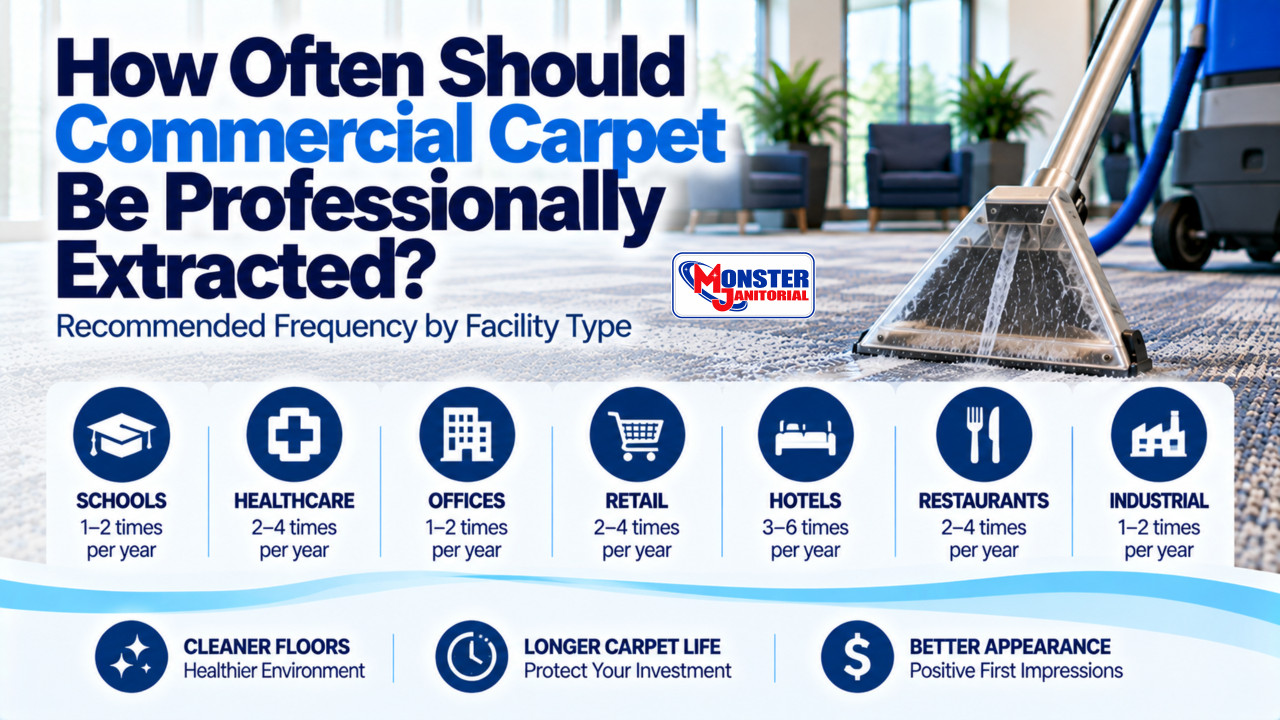
How Often Should Commercial Carpet Be Professionally Extracted?
Commercial carpet extraction frequency depends on foot traffic, soil load, carpet construction, facility type, appearance standards, spot-cleaning practices, interim maintenance, and manufacturer recommendations.
Most Facilities Need a Planned Extraction Schedule
As a general planning range, many commercial carpet programs schedule extraction somewhere between every 3 and 12 months. High-traffic entrances, corridors, hospitality areas, and heavily soiled spaces may need attention more often, while lightly used areas may go longer between restorative cleanings.
There Is No One Extraction Schedule for Every Building
The correct frequency depends on traffic patterns, outdoor soil, weather, matting, vacuuming frequency, spot removal, carpet fiber and backing, low-moisture maintenance, cleaning chemistry, drying conditions, and the carpet manufacturer's care requirements.
Why Commercial Carpet Extraction Matters
Daily vacuuming removes loose dry soil, and interim methods such as encapsulation can help maintain appearance between restorative cleanings. Over time, however, oily soil, spills, residues, and embedded contamination can remain in the carpet pile.
Properly performed extraction can help remove this deeper soil and support the carpet's appearance and maintenance program.
Recover soil and residue that routine vacuuming may not remove.
Help restore the appearance of traffic lanes and heavily used areas.
Proper rinsing and recovery can help remove accumulated cleaning residues.
Removing abrasive soil is one part of a complete carpet-maintenance program.
Typical Commercial Carpet Extraction Planning Ranges
| Area / Facility | Possible Planning Range | Why It May Need More Attention |
|---|---|---|
| Entryways & Transition Areas | 1–3 months | High tracked-in soil and moisture |
| Hallways & Corridors | 3–6 months | Concentrated traffic lanes |
| Hotels & Hospitality | 3–6 months | Guest traffic, spills, corridors, public spaces |
| Healthcare & Assisted Living | 3–6 months | High traffic and facility-specific cleaning protocols |
| Schools & Universities | 6–12 months | Hallways, classrooms, cafeterias, seasonal soil |
| Office Buildings | 6–12 months | Traffic level varies greatly by area |
These are general planning ranges, not fixed requirements. Always consider carpet-manufacturer instructions, warranty requirements, facility conditions, cleaning history, and observed soil levels.
High-Traffic Areas Usually Need Attention First
A building does not have to be extracted on one universal schedule. Entryways and main corridors may need restorative cleaning several times before private offices or low-traffic rooms need it once.
Tracked-in grit, water, salt, mud, and outdoor soil.
Repeated foot traffic concentrates soil into lanes.
Food, beverages, traffic, furniture, and recurring spots.
Hard-floor-to-carpet transitions often collect concentrated soil.
Signs Commercial Carpet May Need Extraction
- Dark traffic lanes
- Visible soil buildup
- Dull or gray appearance
- Recurring spots
- Uneven appearance between traffic and nontraffic areas
- Spots repeatedly return after cleaning
- Carpet feels sticky or holds soil quickly
- Odors remain after routine maintenance
- Interim cleaning no longer restores appearance
- Dry soil removal alone is no longer enough
Low-Moisture Cleaning vs Carpet Extraction
The two methods serve different roles. Low-moisture methods such as encapsulation are commonly used for interim appearance maintenance, while extraction is often used when deeper soil and residues need to be removed.
Encapsulation / Low Moisture
- Appearance maintenance
- Lower moisture use
- Often faster drying
- Useful between restorative cleanings
- Frequency depends on traffic and facility needs
Hot-Water / Water Extraction
- Deeper soil removal
- Recovery of cleaning solution and residue
- Useful for restorative cleaning
- Requires controlled moisture and recovery
- Drying conditions must be managed
Drying Time Matters
Drying time varies with carpet construction, extraction technique, solution volume, recovery performance, temperature, humidity, ventilation, and airflow. Avoid relying on a single universal drying-time estimate.
Air movers can increase airflow across the carpet and may help reduce downtime after extraction.
Shop Commercial Air Movers & Drying Fans →Watch for Carpet Wicking
Wicking can occur when soil or staining moves upward as moisture evaporates and the carpet dries. Good extraction technique, controlled moisture, thorough recovery, spot-treatment procedures, and airflow can help reduce the chance of recurring spots.
How to Prevent Carpet Wicking After Extraction →Extraction Works Best as Part of a Maintenance System
Rather than waiting until carpet is visibly dirty, build a maintenance program around soil prevention, dry-soil removal, spot treatment, interim cleaning, and scheduled restorative cleaning.
Reduce soil before it reaches the carpet.
Remove abrasive dry soil before it becomes embedded.
Address spills and spots promptly using the correct chemistry.
Use low-moisture methods when appropriate for appearance maintenance.
Schedule restorative cleaning based on soil and traffic conditions.
Manage airflow, humidity, and downtime after cleaning.
Recommended Commercial Carpet Extraction Equipment
Commercial Extraction & Carpet Maintenance Machines
Choose equipment based on carpet area, soil level, solution pressure, heat, recovery performance, portability, drying requirements, and cleaning method.
NSS Rally 220 / 220H
Portable commercial carpet extractors for spot cleaning, routine extraction, guestrooms, offices, classrooms, and other commercial carpet applications.
View NSS Rally 220 / 220H →NSS Rally 500H
Heated portable extractor for commercial carpet programs that require deeper restorative cleaning and adjustable solution pressure.
View NSS Rally 500H →TASKI Procarpet 45
Commercial carpet-care machine for larger carpeted areas and facilities using scheduled interim and restorative cleaning programs.
View TASKI Procarpet 45 →Commercial Air Movers
Air movers increase airflow across carpet after extraction and can help reduce drying time and facility downtime.
Shop Air Movers →Commercial Carpet Extraction FAQ
Many offices use a 6–12 month planning range, but entrances, main corridors, break areas, and heavily traveled spaces may require more frequent cleaning.
High-traffic hotel corridors and public areas may require more frequent extraction than guestrooms or lightly used carpeted spaces.
Not necessarily. Encapsulation is commonly used for interim maintenance, while extraction can be used when deeper soil, residues, or restorative cleaning are required.
No. High-traffic entrances and corridors often need cleaning sooner than offices, guestrooms, or other lightly used areas.
Drying time varies with carpet construction, moisture level, extraction performance, temperature, humidity, ventilation, and airflow.
Cleaning frequency should match actual soil conditions and manufacturer guidance. Poor technique, excess moisture, incorrect chemistry, or inadequate drying can create problems regardless of schedule.
Commercial Carpet Cleaning Equipment
Compare commercial carpet extractors, low-moisture cleaning machines, vacuums, spot-cleaning equipment, and drying systems for professional carpet maintenance.
Commercial Carpet Care Learning Center
Learn about carpet identification, vacuuming, spotting, extraction, low-moisture cleaning, chemistry, drying, equipment selection, and maintenance.
Explore the Carpet Care Learning Center →Need Help Building a Commercial Carpet Cleaning Program?
Tell Monster Janitorial about your carpet type, facility size, traffic levels, current maintenance schedule, spots, extraction equipment, and drying requirements. We can help compare carpet-care equipment and cleaning approaches.
Tax-exempt purchasing, quotes, and purchase-order support are available for qualifying schools, universities, government agencies, municipalities, healthcare facilities, and other institutional customers.
- #carpet cleaning frequency
- #carpet drying time
- #carpet extraction schedule
- #carpet maintenance program
- #commercial carpet cleaning
- #commercial carpet extraction
- #commercial carpet extractor
- #commercial carpet maintenance
- #encapsulation carpet cleaning
- #entryway carpet cleaning
- #hallway carpet cleaning
- #healthcare carpet cleaning
- #hot water extraction
- #hotel carpet cleaning
- #how often should carpet be extracted
- #low moisture carpet cleaning
- #NSS Rally extractor
- #office carpet maintenance
- #school carpet cleaning
- #TASKI Procarpet