
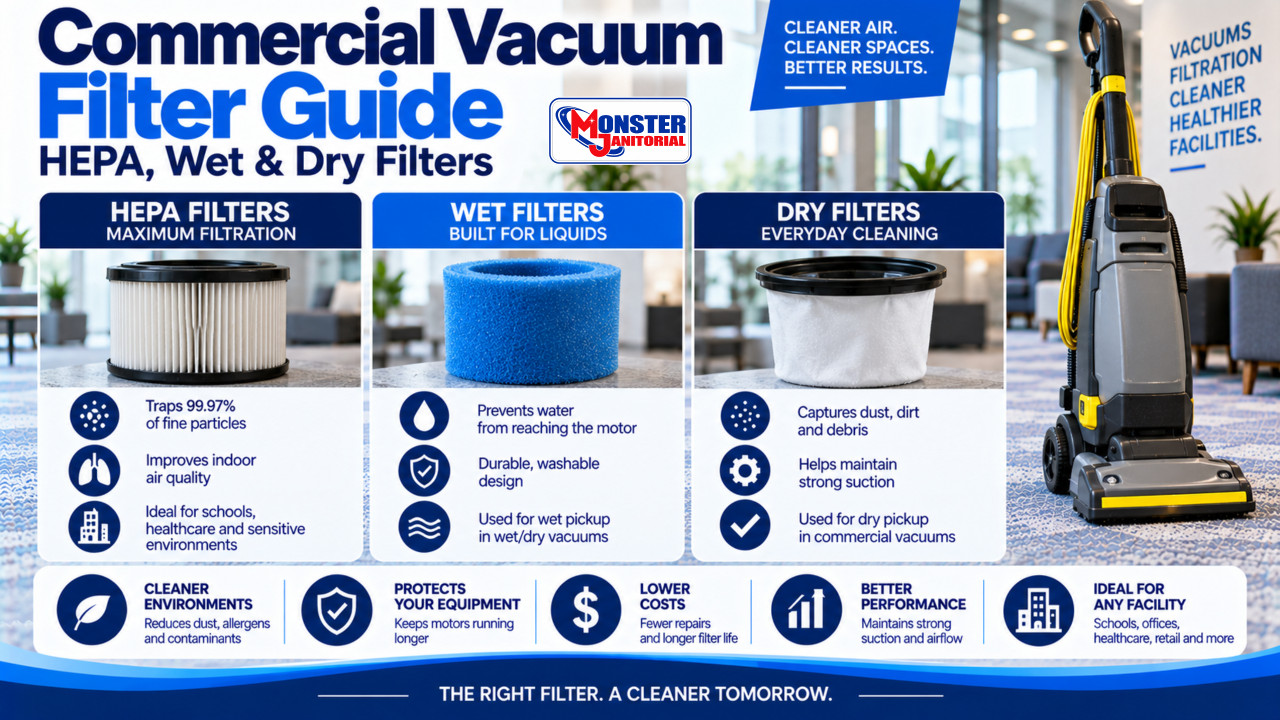
Commercial Vacuum Filter Guide: HEPA, Wet & Dry Filters
Compare commercial vacuum bags, cloth filters, cartridge filters, foam filters, exhaust filters and HEPA filtration for dry soil, fine dust, liquid recovery and occupied commercial facilities.
Match the Filter to the Vacuum and the Material
Use the manufacturer-approved filtration setup for the exact vacuum and application. Dry soil, fine dust, wet pickup and hazardous or regulated materials may require very different bags, cartridges, filters and containment systems.
4 Steps to Choosing the Correct Vacuum Filter
Identify the Material
Dry soil, fine dust, fibers, liquids, allergens or restoration debris.
Choose the Vacuum
Dry, wet/dry, upright, backpack, canister or specialty dust-control vacuum.
Install the Right Filter
Use the approved bag, cartridge, foam filter or HEPA assembly.
Maintain Airflow
Inspect bags, filters, hoses, seals and exhaust airflow regularly.
Why Commercial Vacuum Filters Matter
Filters separate collected material from the airflow moving through the vacuum. The correct filtration system supports pickup performance, protects internal components and helps control particles discharged through the exhaust.
Reduce dust and debris reaching internal components.
Loaded or blocked filters can restrict airflow and reduce pickup performance.
Final filtration can reduce particles discharged back into the room.
Collection bags can make debris handling and disposal cleaner.
How Vacuum Filtration Stages Work Together
Many commercial vacuums use several filtration stages. The exact design varies by model.
Bag or Tank
Collects visible soil, fibers and debris.
Pre-Motor Filter
Provides additional protection before air reaches the motor.
Motor + Airflow
The vacuum motor moves air through the machine.
Exhaust Filter
Captures remaining particles before exhaust air leaves the machine.
Dry Pickup vs Wet Pickup Filtration
A filtration setup intended for dry dust may not be suitable for liquid recovery. Always follow the vacuum manufacturer's wet-pickup instructions.
Dust, Soil & Dry Debris
- Paper or fleece collection bags
- Reusable cloth bags
- Dry cartridge filters
- Fine-dust filters
- HEPA or high-efficiency exhaust filters
Water, Solution & Slurry
- Manufacturer-approved wet filter
- Foam filter on applicable models
- Wet-pickup cage or screen
- Float shutoff system
- Tank setup without incompatible dry bags

Dry debris and liquid recovery often require different vacuum-filter setups.
Do Not Assume a Dry Filter Can Be Used for Liquids
Liquid can damage some dry filters, restrict airflow or compromise filtration. Remove, replace or reconfigure dry filtration only as directed by the vacuum manufacturer before wet pickup.
Common Commercial Vacuum Filters
Disposable collection bags for dry debris. Multilayer fleece bags may provide improved strength and fine-dust retention.
Reusable dry-debris collection bags that require regular emptying and inspection.
Pleated filters used in many commercial canister and wet/dry vacuums. Media and ratings vary by application.
Used on selected wet-pickup machines to help protect the vacuum system during liquid recovery.
High-efficiency filters used where fine-particle capture is important. Overall containment depends on the complete vacuum system.
Final-stage filters positioned near the exhaust to capture remaining particles before air returns to the room.
Common Filter Types

HEPA Filter vs Sealed HEPA Vacuum
Installing a HEPA-rated filter does not automatically make the entire vacuum a sealed HEPA system.
The machine contains a HEPA-rated filter, but air may still bypass filtration through poorly sealed connections or damaged components.
The airflow path is designed so collected air passes through the intended filtration system before leaving the machine.
Check the complete machine specification, not only the filter label, when high-efficiency containment is required.
Bagged vs Bagless Commercial Vacuums
Bagged Vacuums
- Debris stays contained in a disposable or reusable bag
- Can reduce direct contact with collected dust during disposal
- Bag may provide an additional filtration stage
- Requires replacement bags or reusable-bag maintenance
Bagless Vacuums
- Debris collects in a tank, cup or reusable container
- No disposable collection bag required
- Useful for many wet/dry applications
- Emptying dry debris may release more dust if handled poorly
Match the Filter Setup to the Debris
Manufacturer-approved bag, cloth filter or standard dry filtration.
Fine-dust bag and filter setup approved for the machine.
Consider a sealed vacuum with suitable high-efficiency or HEPA filtration.
Use the manufacturer's approved liquid-recovery configuration.
Use a compatible wet/dry recovery system and clean the tank, hose and tools afterward.
Use filtration and equipment specifically approved for the dust being collected.
How Clogged Filters Affect Vacuum Performance
As filters load with debris, resistance can increase and airflow may decrease.
The vacuum may leave soil behind or require more passes.
Less air can move through the filtration system.
Some machines may operate hotter when airflow is restricted.
Damaged or incorrectly seated filters may allow dust to bypass filtration.
When Should Commercial Vacuum Filters Be Replaced?
Replacement timing depends on filter type, operating hours, debris, visible loading, airflow, damage, contamination and manufacturer instructions.
Replace when full according to the manufacturer's guidance, torn, wet, contaminated or restricting airflow.
Replace if fabric, seams, collars or closures become damaged or no longer seal properly.
Replace when damaged or when airflow remains restricted after manufacturer-approved cleaning.
Follow the manufacturer's replacement interval, filter indicator and inspection requirements.
Replace if foam becomes torn, cracked, compressed or no longer fits securely.
Replace when damaged, heavily loaded or due according to manufacturer instructions.
Do not wash a filter unless the manufacturer specifically identifies it as washable.
Filter Selection by Commercial Application
Bagged vacuums with high-efficiency or HEPA options can support routine cleaning in occupied facilities.
Use equipment and filtration appropriate for the facility's cleaning and infection-control protocols.
Fine or regulated dust may require specialized filtration, containment and approved procedures.
Use a wet/dry vacuum configured for liquid recovery and compatible with the material being collected.
Common Commercial Vacuum Filter Mistakes
Regulated Dust Requires More Than a Generic HEPA Filter
Projects involving asbestos, lead, silica, mold, healthcare environments or other regulated materials may require specialized vacuums, containment procedures, disposal methods, regulatory compliance and qualified professionals. Follow applicable requirements for the specific material and job.
Commercial Vacuum Filter FAQ
A dry vacuum should normally use the filtration required by the manufacturer. Wet/dry vacuums may use a different configuration for liquid pickup.
Only if the manufacturer specifically identifies that exact filter as washable.
Only when the manufacturer specifically approves that filter and configuration for liquid recovery.
Check filter compatibility and installation, then inspect the bag, hose, wand, intake, floor tool and brush roll where applicable.
No. The complete airflow path, housing and seals determine whether air can bypass the filter.
Follow the manufacturer's maintenance schedule and replace filters when required because of loading, damage, contamination, airflow restriction or service indicators.
Continue Learning About Commercial Vacuums
Shop Commercial Vacuum Filters & Bags
Find replacement vacuum bags, cartridge filters, foam filters, HEPA filters and other filtration parts for commercial cleaning equipment.
Need Help Finding the Correct Vacuum Filter?
Send Monster Janitorial the vacuum brand, model number and type of debris or liquid being collected. We can help identify compatible bags, cartridges, cloth filters, foam filters, HEPA filters and replacement parts.