
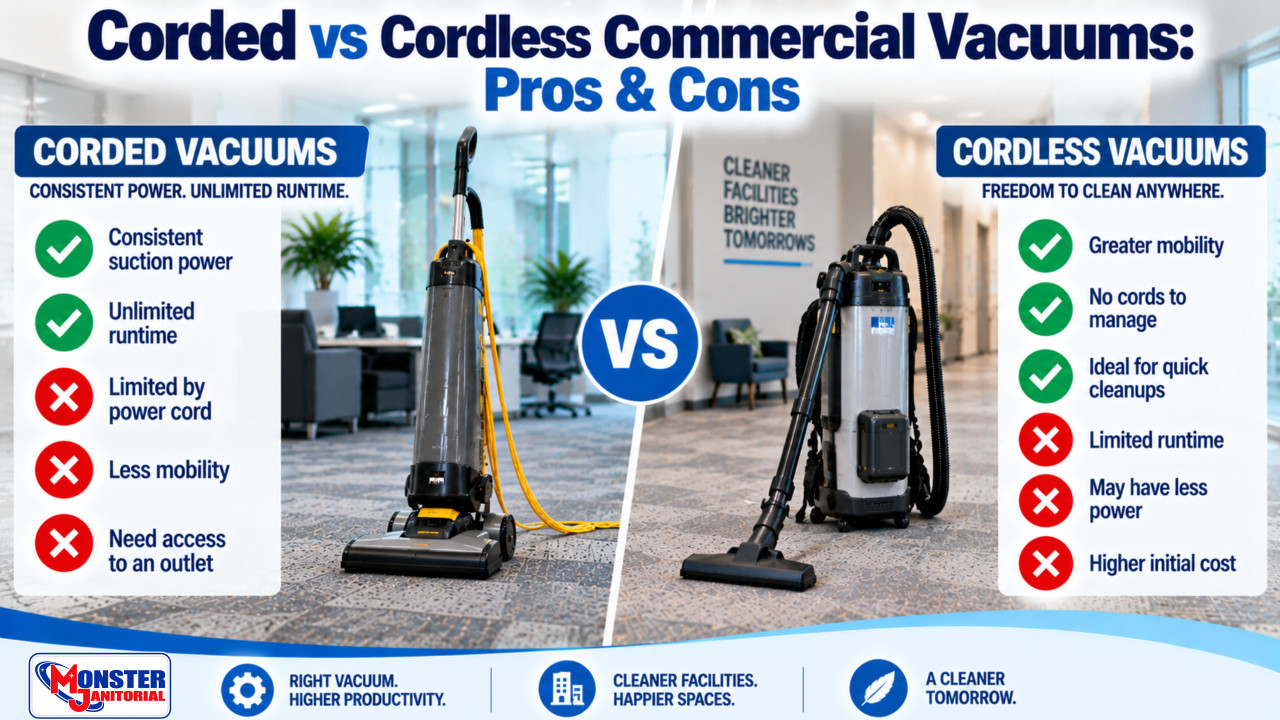
Corded vs Cordless Commercial Vacuums: Pros & Cons
Choosing between a corded and cordless commercial vacuum depends on cleaning-route length, outlet access, battery runtime, facility layout, flooring, and how frequently operators move between rooms or occupied areas.
Corded for Continuous Runtime — Cordless for Mobility
Choose a corded commercial vacuum when you need continuous operation and reliable access to electrical outlets. Choose a cordless vacuum when eliminating cords, moving quickly between spaces, and cleaning stairs or occupied areas are higher priorities.
Corded vs Cordless at a Glance
Continuous Runtime
Mobility + Flexibility
What Is a Corded Commercial Vacuum?
A corded vacuum operates from building electrical power. As long as the operator has access to a suitable outlet, the vacuum can continue running without waiting for batteries to charge.
Useful for long cleaning routes and extended shifts.
No charging cycle or spare-battery rotation is required.
Available across backpack, canister, upright, and other commercial vacuum designs.
Operators must manage cord length, outlets, doorways, furniture, and pedestrian traffic.
What Is a Cordless Commercial Vacuum?
A cordless commercial vacuum uses a rechargeable battery rather than a power cord. This allows operators to move between rooms, stairs, entrances, hallways, and other areas without repeatedly unplugging and reconnecting the vacuum.
Useful where operators move frequently between spaces.
Eliminates the trailing electrical cord from the cleaning route.
Operators do not need to locate and change outlets as frequently.
Runtime, recharge time, battery life, and spare-battery availability matter.
Corded vs Cordless Commercial Vacuum
| Category | Corded | Cordless |
|---|---|---|
| Runtime | Continuous with outlet access | Limited by battery capacity |
| Mobility | Cord and outlet dependent | Excellent |
| Outlet Changes | Required as route progresses | Not required during battery runtime |
| Charging | Not required | Required |
| Power | Model dependent | Model and battery-system dependent |
| Cord-Related Trip Hazard | Requires proper cord management | Eliminated |
| Upfront Cost | Often lower | Often higher due to battery and charger |
| Long-Term Consumables | Bags, filters, brushes and wear parts | Same items plus eventual battery replacement |
Vacuum performance should be compared by the actual machine specifications, floor tool, filtration, airflow, suction, battery system, and application—not power source alone.
Compare Runtime and Recharge Time Together
Battery runtime tells you how long the vacuum can operate before charging, but it is only half of the equation. Recharge time determines how quickly the machine can return to service.
For longer routes, compare whether the vacuum accepts removable batteries, whether additional batteries are available, and whether your cleaning program can rotate charged batteries during the shift.
TASKI AERO BP E vs TASKI AERO BP+
The TASKI AERO BP platform is a useful example because Monster Janitorial carries both corded and battery-powered versions.
Corded backpack configuration with continuous runtime while plugged in.
Lithium battery backpack configuration with up to 60 minutes of runtime and a listed 90-minute recharge time.
Which Power Source Fits Your Facility?
Cordless can be useful for classrooms, stairs, entrances, and daytime response cleaning. Corded equipment remains useful for longer evening routes.
Cordless equipment can move efficiently between guestrooms and stairs, while corded vacuums work well for extended room and corridor cleaning.
Cordless vacuums simplify movement around cubicles and occupied areas. Corded models suit longer after-hours routes.
Cordless designs remove the trailing cord, while noise level, filtration, tools, and facility cleaning protocols should also be considered.
Cordless Can Simplify Daytime Cleaning
When operators clean while people are present, removing the power cord can make it easier to move through hallways, classrooms, entrances, offices, and other high-traffic spaces.
However, cordless does not automatically mean quieter. Compare the actual manufacturer dB(A) rating when noise is important.
Cord Management Matters
A corded vacuum can work efficiently in commercial facilities when operators plan the route and manage the cord properly.
Battery Care Is Part of Vacuum Maintenance
Cordless vacuum programs should include battery and charger management in addition to normal bag, filter, hose, and floor-tool maintenance.
- Use the manufacturer-approved charger.
- Follow recommended charging and storage procedures.
- Inspect batteries and chargers for damage.
- Track battery age and declining runtime.
- Plan spare-battery capacity for longer routes when needed.
Compare More Than the Purchase Price
Cordless vacuums often have a higher initial cost because the battery and charger are part of the system. Over time, batteries are also wear items that may eventually need replacement.
The better value depends on labor savings, route efficiency, battery replacement cost, machine life, maintenance, and how often cord-free mobility actually improves the cleaning workflow.
Many Facilities Benefit From Both
Large facilities do not necessarily need to standardize on only one power source. Corded vacuums can handle long scheduled routes, while cordless machines can support stairs, entrances, quick-response cleaning, occupied spaces, and locations where changing outlets slows the operator down.
Which One Should You Choose?
- You clean for long uninterrupted periods
- Outlets are readily available
- You do not want to manage batteries
- Your routes are predictable
- Initial equipment cost is a major consideration
- You frequently move between rooms
- You clean stairs or entrances
- You work around occupied areas
- You want to eliminate cord management
- Your battery runtime supports the route
Recommended Corded & Cordless Commercial Vacuums
Compare Corded Power With Battery Mobility
These commercial vacuum options cover quiet canister cleaning, corded backpack routes, and cordless backpack mobility.
TASKI AERO 8 PLUS
Compact corded commercial canister vacuum designed for quiet cleaning in offices, guestrooms, classrooms, healthcare, and other occupied facilities.
View TASKI AERO 8 PLUS →TASKI AERO 15 PLUS
Larger-capacity corded commercial canister vacuum for longer cleaning routes in offices, schools, hospitality, conference areas, and occupied buildings.
View TASKI AERO 15 PLUS →TASKI AERO BP E
Corded commercial backpack vacuum for continuous-runtime cleaning on stairs, hallways, offices, schools, and high-mobility routes.
View TASKI AERO BP E →TASKI AERO BP+
Lithium battery backpack vacuum designed for cordless mobility in stairs, entrances, circulation areas, schools, offices, hospitality, and occupied facilities.
View TASKI AERO BP+ →Corded vs Cordless Vacuum FAQ
It depends on the machines being compared. Power source alone does not determine suction, airflow, floor-tool performance, or cleaning effectiveness.
Runtime varies by model, battery capacity, operating mode, and battery condition. Check the manufacturer specification for the exact machine.
Some commercial cordless vacuums support removable or additional batteries. Check the specific machine and charger system before planning battery rotation.
They can be convenient because there is no trailing cord, but also compare machine noise, filtration, route length, and battery runtime.
Often, but not always. Compare the total machine price along with batteries, chargers, replacement batteries, filters, bags, and expected service life.
Often yes. Corded vacuums can cover long scheduled routes while cordless models handle stairs, quick response, occupied spaces, and areas where cords slow the workflow.
Continue Learning About Commercial Vacuums
Commercial Corded & Battery Vacuums
Compare commercial vacuum options for long cleaning routes, schools, offices, hospitality, healthcare, stairs, occupied areas, and quick-response cleaning.
Commercial Vacuum Learning Center
Learn how to compare commercial vacuum styles, filtration systems, wet-recovery equipment, battery options, and facility applications.
Explore the Vacuum Learning Center →Need Help Choosing a Corded or Cordless Vacuum?
Tell Monster Janitorial about your facility size, flooring, cleaning-route length, stairs, outlet availability, filtration needs, and desired battery runtime. We can help compare commercial vacuum options.
Tax-exempt purchasing, quotes, and purchase-order support are available for qualifying schools, universities, government agencies, municipalities, healthcare facilities, and other institutional customers.