
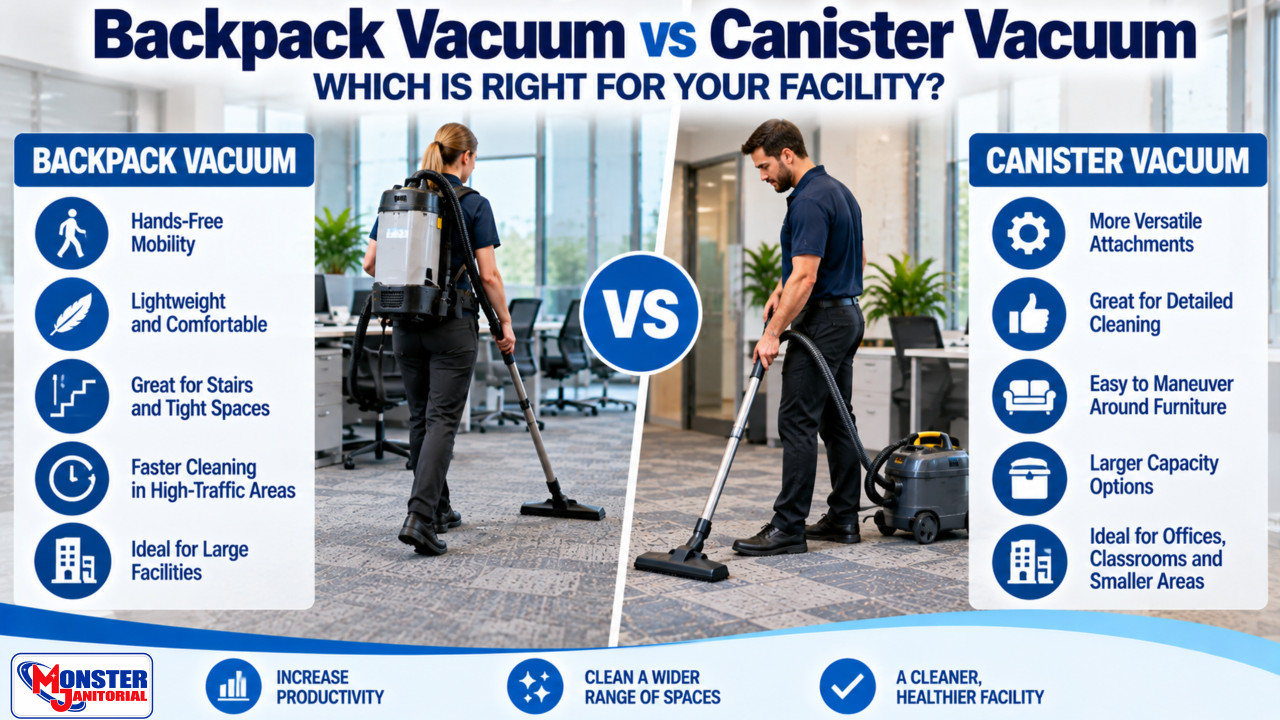
Backpack Vacuum vs Canister Vacuum
Backpack and canister vacuums are both widely used in hotels, schools, offices, healthcare facilities, convention centers, and other commercial buildings. The better choice depends on cleaning route, floor plan, operator preference, noise requirements, filtration needs, power source, and the amount of detail cleaning required.
Choose Backpack for Mobility — Canister for Controlled Detail Cleaning
Backpack vacuums are usually strongest where operators need to move quickly through hallways, stairs, offices, classrooms, and obstacle-heavy spaces. Canister vacuums are often preferred when quiet operation, detail cleaning, compact storage, and keeping the vacuum weight off the operator are priorities.
Backpack vs Canister at a Glance
Both styles can work well in commercial facilities. The difference is how the operator moves the machine and how the cleaning route is organized.
Mobility + Productivity
Quiet + Detail Cleaning
What Is a Backpack Vacuum?
A backpack vacuum is worn on the operator using a shoulder-and-waist harness. The hose and wand remain in the operator's hands while the vacuum body moves with them instead of rolling behind them.
This design can be especially useful when cleaning stairs, long corridors, rows of desks, offices, auditoriums, aircraft interiors, hospitality spaces, and areas with frequent obstacles.
Moves with the operator instead of being pulled behind.
Useful where rolling equipment is awkward to move.
The operator can work around desks, chairs, beds, and fixtures without dragging a canister.
Often useful for hallway and circulation-area cleaning.
Backpack Vacuum Comfort Depends on Proper Harness Adjustment
Backpack vacuums eliminate the need to repeatedly pull a canister behind the operator, but they place the vacuum's weight on the operator. Comfort therefore depends on machine weight, harness design, body size, adjustment, cleaning duration, and operator preference.
Fit shoulder and waist straps according to the manufacturer instructions.
Compare actual operating weight before choosing a backpack model.
A short detail route and an all-day cleaning route may require different equipment.
What Is a Canister Vacuum?
A commercial canister vacuum uses a wheeled body connected to a hose, wand, and cleaning tool. The machine remains on the floor while the operator moves the wand through the cleaning area.
Canister vacuums are commonly used in hotel rooms, offices, classrooms, healthcare facilities, libraries, hospitality properties, and other occupied spaces where detail cleaning and low noise are important.
The vacuum body rolls on the floor instead of being carried.
Useful around furniture, beds, offices, and smaller rooms.
Many commercial canister models are designed for occupied-building cleaning.
Compact tub-style machines can fit into janitorial closets and carts more easily than some larger vacuum types.
Backpack Vacuum vs Canister Vacuum
| Feature | Backpack Vacuum | Canister Vacuum |
|---|---|---|
| Mobility | Excellent around obstacles, stairs, and long routes | Good in rooms and detailed cleaning areas |
| Large-Area Productivity | Often very strong | Better suited to controlled routes and detail work |
| Stairs | Excellent | Less convenient to carry between levels |
| Operator Load | Machine weight is carried on the body | Machine weight remains on wheels |
| Noise | Model dependent | Many commercial models are extremely quiet |
| Filtration | HEPA options available on many models | HEPA commonly available on commercial models |
| Cordless Options | Common and useful for mobility | Less common than backpack battery options |
| Best Fit | Hallways, stairs, offices, schools, open routes | Guest rooms, offices, healthcare, occupied areas |
Actual performance, sound level, filtration, weight, runtime, capacity, and tool compatibility vary by model.
Corded vs Battery Backpack Vacuums
- Continuous runtime
- No charging downtime
- Good for extended cleaning routes
- Requires cord management
- Outlet location affects workflow
- No power cord during cleaning
- Fast movement between rooms
- Useful on stairs and occupied routes
- Runtime is limited by battery capacity
- Charging strategy matters on long shifts
HEPA Filtration: Look at the Entire Vacuum System
HEPA filtration can be useful where fine-dust control and indoor-air-quality goals are important, but the filter is only one part of vacuum performance.
Also consider the vacuum's filtration stages, bag design, seals, filter maintenance, airflow, and whether the HEPA filter is standard or optional on the specific model.
Confirm the exact filtration rating for the model.
Bag quality and installation affect dust containment.
Loaded filters and bags can reduce airflow and cleaning performance.
Compare Actual Noise Ratings
The words “quiet” or “ultra-quiet” are useful descriptions, but facilities should compare the manufacturer's actual sound-pressure rating when noise matters.
This is especially important in hotels, healthcare facilities, schools, libraries, offices, conference centers, and other areas where cleaning may happen while occupants are present.
Vacuum Type Is Only Part of Cleaning Performance
The hose, wand, floor tool, brush, turbo tool, and carpet nozzle can affect how well either vacuum style performs on a particular surface.
Confirm the supplied or optional carpet tool is appropriate.
Use a tool designed to recover dry soil without scratching the floor.
Crevice and dusting tools are important around edges, furniture, and fixtures.
Which Vacuum Is Better by Facility Type?
Backpacks work well in long corridors, conference areas, stairs, and open routes. Canisters are excellent for guest rooms, detailed cleaning, and quiet occupied areas.
Backpacks can improve mobility through classrooms and hallways, while quiet canisters work well in libraries, offices, and occupied classrooms.
Noise, filtration, cord management, infection-control procedures, and room layout should all be considered before choosing a vacuum style.
Backpacks are useful for cubicles and long routes; canisters are useful for offices, conference rooms, and quieter daytime cleaning.
Recommended TASKI Backpack & Canister Vacuums
TASKI Backpack & Canister Options
Compare corded and battery backpack vacuums with compact and larger-capacity HEPA canister options.
TASKI AERO BP E
Lightweight corded commercial backpack vacuum for hallways, stairs, hospitality, schools, offices, and extended cleaning routes.
TASKI AERO BP+
Battery-powered backpack vacuum for stairs, occupied buildings, hospitality, schools, offices, and routes where cord-free mobility is valuable.
TASKI AERO 8 PLUS
Compact commercial canister vacuum for hotels, offices, classrooms, healthcare facilities, and daytime cleaning in occupied buildings.
TASKI AERO 15 PLUS
Larger-capacity commercial canister vacuum for extended routes, convention centers, hospitality facilities, offices, and occupied-building cleaning.
Which Vacuum Should You Choose?
- Your routes include many stairs or obstacles
- You clean long hallways or large circulation areas
- Fast room-to-room mobility matters
- The operator is comfortable wearing the machine
- You want corded or cordless backpack options
- You clean guest rooms, offices, or detailed spaces
- Very low noise is a priority
- You do not want the machine carried on the operator
- You need compact janitorial-closet storage
- HEPA filtration and quiet daytime cleaning are priorities
You Do Not Necessarily Have to Choose Only One Style
Hotels, schools, healthcare facilities, convention centers, and large office buildings may benefit from using backpack vacuums for high-mobility routes and canister vacuums for quiet, detailed, occupied-area cleaning.
Backpack vs Canister Vacuum FAQ
They can be more productive on routes with stairs, hallways, furniture, cubicles, or frequent obstacles because the operator does not have to pull a machine behind them.
Many commercial canister vacuums are designed for very quiet operation, but compare the actual dB(A) rating of the specific models rather than assuming all canisters are quieter.
Comfort depends on vacuum weight, harness design, adjustment, operator size, route length, and personal preference. A properly fitted lightweight backpack can work very well for many operators.
Battery models improve mobility and eliminate cord management, while corded models provide continuous runtime without waiting for battery charging.
HEPA filtration is available on many models, but it may be standard on one vacuum and optional on another. Always confirm the exact filtration configuration.
Many hotels benefit from both: backpack vacuums for corridors, stairs, conference areas, and larger routes, and canister vacuums for guest rooms and quiet occupied spaces.
Continue Learning About Commercial Vacuums
Commercial Backpack & Canister Vacuums
Compare corded backpacks, battery backpacks, HEPA canister vacuums, and other commercial vacuum options for hotels, schools, offices, healthcare facilities, and large cleaning routes.
Need Help Choosing Between a Backpack & Canister Vacuum?
Tell Monster Janitorial your facility type, flooring, cleaning route, occupied-cleaning needs, filtration requirements, and whether corded or cordless operation is preferred. We can help compare the best commercial vacuum setup.
Tax-exempt purchasing and purchase-order support are available for qualifying schools, universities, government agencies, municipalities, healthcare facilities, and other institutional customers.
- #backpack vacuum cleaner
- #backpack vacuum vs canister vacuum
- #commercial backpack vacuum
- #commercial canister vacuum
- #commercial carpet vacuum
- #commercial cleaning equipment
- #commercial vacuum comparison
- #hallway vacuum cleaner
- #HEPA backpack vacuum
- #HEPA canister vacuum
- #hotel vacuum cleaner
- #indoor air quality vacuum
- #large area vacuuming
- #office building vacuum
- #quiet commercial vacuum
- #school vacuum cleaner
- #TASKI AERO 15 Plus
- #TASKI AERO 8 Plus
- #TASKI AERO BP
- #tub vacuum cleaner