
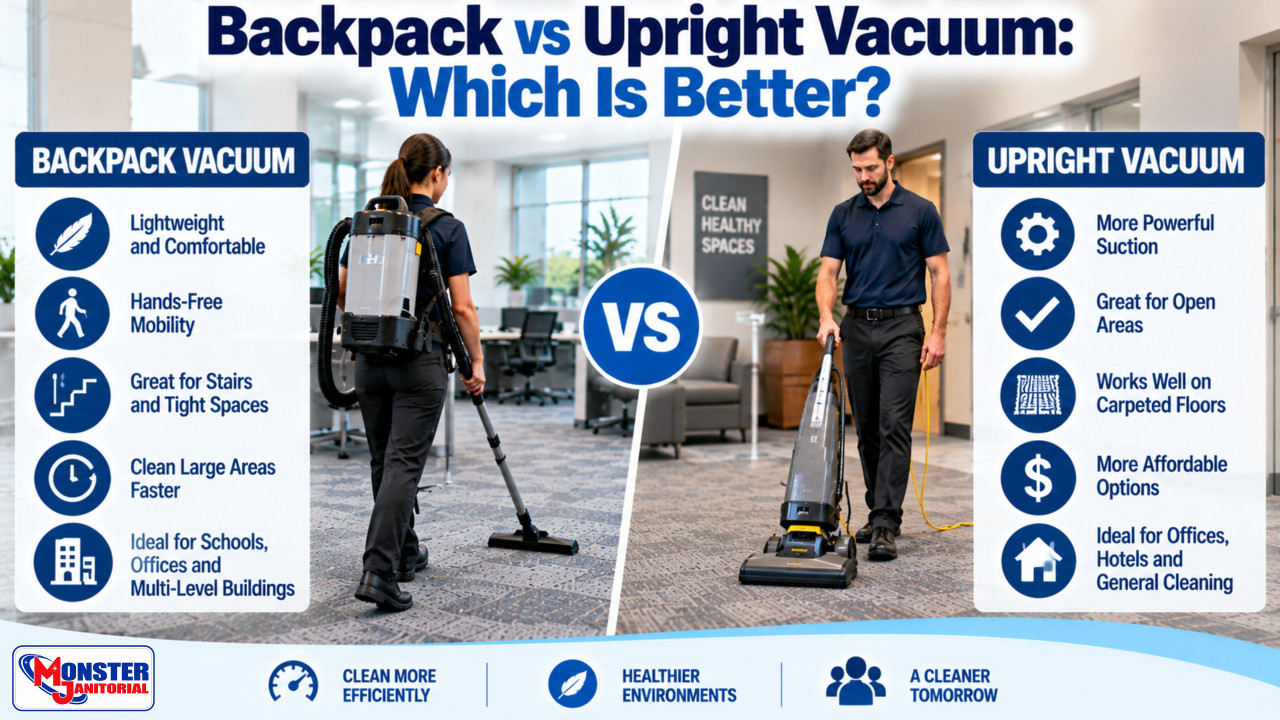
Backpack Vacuum vs Upright Vacuum: Which Is Better?
Backpack and upright vacuums can both be effective in commercial facilities, but they solve different cleaning problems. Backpack vacuums emphasize mobility and access around obstacles, while upright vacuums are typically strongest on carpeted areas where powered brush agitation is important.
Choose Backpack for Mobility — Upright for Carpet Agitation
Choose a backpack vacuum when your route includes stairs, hallways, classrooms, offices, cubicles, furniture, and frequent obstacles. Choose an upright vacuum when the priority is routine carpet maintenance with a powered brush roll that agitates carpet fibers while vacuuming.
Backpack vs Upright at a Glance
The better style depends on flooring, route layout, cleaning tools, operator preference, and the type of soil being removed.
Mobility + Access
Carpet + Agitation
What Is a Backpack Vacuum?
A backpack vacuum is worn using a harness system while the operator cleans with a hose, wand, and floor tool. Because the vacuum body moves with the operator, it can be easier to navigate stairs, rows of desks, cubicles, furniture, and other obstacles.
The operator does not need to push or pull the vacuum body around obstacles.
Backpack designs are particularly useful where rolling equipment is difficult to use.
Useful when operators move between hallways, classrooms, offices, and hard floors.
Crevice, dusting, upholstery, and floor tools can support multiple cleaning tasks.
What Is an Upright Vacuum?
A commercial upright vacuum combines the vacuum body, floor head, and handle into a push-style machine. Many commercial uprights include a powered brush roll that agitates carpet while suction removes loosened soil.
Helps loosen dry soil from carpet fibers.
Familiar push-style design is easy for many operators to learn.
Strong fit for offices, guestrooms, retail carpet, and other carpet-heavy spaces.
Floor head and vacuum body move together as one machine.
Brush Agitation Can Matter on Carpet
Many backpack vacuums use straight-suction floor tools. These can work very well for routine surface soil, low-pile commercial carpet, hard floors, and detail cleaning.
A commercial upright with a powered brush roll adds mechanical agitation, which can help loosen embedded dry soil from carpet fibers. Tool design varies, so compare the actual floor head supplied with each machine.
Backpack Vacuum vs Upright Vacuum
| Category | Backpack Vacuum | Upright Vacuum |
|---|---|---|
| Mobility | Excellent around furniture, stairs, desks, and obstacles | Best on accessible carpeted areas |
| Large Cleaning Routes | Often very efficient | Efficient when the route is primarily carpet |
| Stairs | Excellent | Less convenient |
| Carpet Agitation | Depends on floor tool or powered accessory | Powered brush roll common |
| Hard Floors | Very useful with appropriate hard-floor tool | Model and brush-roll setting dependent |
| Operator Load | Vacuum is carried using a harness | Machine weight stays on the floor |
| Training | Proper harness fit and wand technique are important | Straightforward push-style operation |
| Best Fit | Schools, offices, hallways, stairs, cubicles, mixed routes | Hotels, offices, retail, and carpet-heavy facilities |
Actual performance depends on machine design, floor tool, brush roll, filtration, flooring, operator technique, and maintenance.
Operator Comfort Depends on Harness Fit
A backpack vacuum eliminates the need to push or pull the vacuum body, but the operator carries the machine. Comfort depends on operating weight, harness design, adjustment, cleaning duration, body size, and operator preference.
Follow manufacturer instructions for shoulder and waist straps.
Compare the actual weight the operator will carry during use.
Long shifts and short detail routes may favor different equipment.
Corded vs Battery Backpack Vacuums
- Continuous runtime
- No battery charging downtime
- Useful for long cleaning routes
- Requires cord management
- Outlet locations affect workflow
- Cordless movement
- Useful on stairs and between rooms
- No extension cord to reposition
- Runtime is battery dependent
- Charging strategy matters
Brush Roll Condition Affects Carpet Performance
An upright vacuum relies heavily on its floor head. A worn, jammed, or improperly adjusted brush roll can reduce carpet agitation and cleaning performance.
HEPA Filtration Is Available in Both Styles
Many commercial backpack and upright vacuums are available with high-efficiency or HEPA filtration. Filtration should be evaluated separately from vacuum style.
Compare the bag, prefilters, HEPA filter, seals, airflow path, and manufacturer filtration specifications—not simply whether the vacuum is a backpack or upright.
HEPA Vacuums vs Standard Commercial Vacuums →Match the Vacuum to the Floor Surface
Both styles can work well. Powered agitation may help where embedded dry soil is common.
Backpacks are highly flexible when paired with the correct hard-floor tool.
Commercial uprights are a strong option where brush agitation is needed throughout the route.
A backpack with interchangeable tools can be convenient when operators move frequently between surfaces.
Which Vacuum Is Better by Facility Type?
Backpacks are excellent for classrooms, stairs, hallways, libraries, and areas filled with desks. Uprights can complement them in large carpeted rooms.
Uprights are useful in carpeted guestrooms and corridors. Backpacks work well on stairs, around furniture, and in larger circulation areas.
Backpacks work well around cubicles and desks. Uprights can be used efficiently in open carpeted offices and conference rooms.
Uprights can be a strong choice for open carpeted areas, while backpacks provide mobility around fixtures and displays.
Compare Actual Noise Ratings
Either vacuum style may be suitable for daytime cleaning, depending on the model. If operators will clean around students, guests, patients, customers, or office workers, compare the manufacturer's actual dB(A) rating rather than assuming one vacuum style is always quieter.
Many Facilities Benefit From Both
A backpack vacuum can handle stairs, obstacles, offices, and high-mobility routes, while an upright can focus on carpeted spaces where powered brush agitation is valuable. Large facilities do not necessarily need to choose only one vacuum style.
Which One Should You Choose?
- Your route includes stairs
- You clean around desks or furniture
- Mobility is a major priority
- You move between multiple floor types
- You need corded or battery backpack options
- Your facility is heavily carpeted
- Powered brush agitation is important
- You want simple push-style operation
- Your routes contain fewer stairs or obstacles
- You routinely clean open carpeted rooms
Recommended Backpack & Upright Vacuums
Backpack & Upright Options for Commercial Facilities
Compare backpack vacuums for mobility with upright vacuums designed for carpet maintenance and powered agitation.
TASKI AERO BP E
Commercial backpack vacuum for hallways, stairs, classrooms, offices, hospitality, and high-mobility cleaning routes.
View TASKI AERO BP E →TASKI AERO BP Lithium
Battery-powered backpack vacuum for routes where cord-free mobility is valuable, including stairs, classrooms, hospitality, and occupied facilities.
View TASKI AERO BP Lithium →NSS Pacer 12UE / 15UE
Commercial upright vacuum series for daily carpet maintenance in schools, offices, hospitality, retail, healthcare, and other carpeted facilities.
View NSS Pacer 12UE / 15UE →Pacific V12ES Upright Vacuum
Commercial upright option for routine carpet cleaning in offices, hospitality, education, retail, and other commercial facilities.
Read About the Pacific V12ES →Backpack vs Upright Vacuum FAQ
They can be more productive on routes with stairs, desks, furniture, cubicles, and frequent obstacles because the machine moves with the operator.
Commercial uprights are often a strong choice for carpet because powered brush rolls provide agitation. Actual cleaning performance depends on the specific machine and carpet.
Yes. Backpack vacuums are widely used on commercial carpet, but the floor tool determines whether the machine provides straight suction or powered agitation.
A backpack vacuum is usually more convenient because the vacuum body stays on the operator instead of being moved from step to step.
Comfort depends on machine weight, harness design, adjustment, route length, operator size, and personal preference.
Often yes. Backpacks can handle high-mobility routes while uprights focus on carpeted areas that benefit from powered brush agitation.
Continue Learning About Commercial Vacuums
Commercial Backpack & Upright Vacuums
Compare commercial vacuum options for stairs, hallways, classrooms, offices, hospitality, retail, and carpeted commercial facilities.
Need Help Choosing a Backpack or Upright Vacuum?
Tell Monster Janitorial your facility type, flooring, cleaning route, stairs, carpet type, filtration requirements, and operator preferences. We can help compare backpack and upright commercial vacuum options.
Tax-exempt purchasing and purchase-order support are available for qualifying schools, universities, government agencies, municipalities, healthcare facilities, and other institutional customers.