
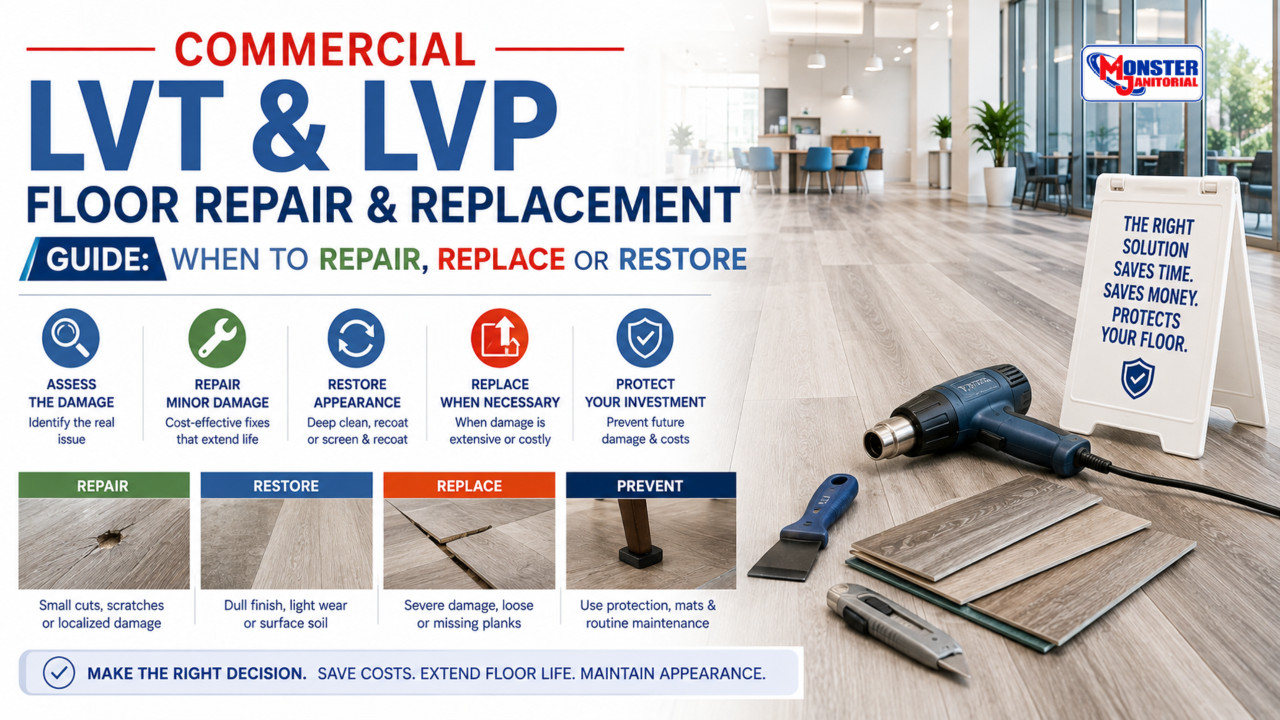
Commercial LVT & LVP Floor Repair & Replacement Guide: When to Repair, Replace or Restore
Commercial LVT and LVP floors can often be repaired or restored without replacing the entire floor, but the correct solution depends on the type, location, and extent of the damage.
This guide explains when cleaning is enough, when individual tiles or planks can be repaired or replaced, when a compatible restorative coating may help, and when larger-scale replacement is the better long-term option.
Repair isolated damage, restore compatible worn surfaces, and replace flooring when damage is widespread, structural, unstable, or beyond the wear layer.
Do not use stronger chemistry to solve physical damage. First determine whether the problem is removable soil, cosmetic wear, a damaged coating, a scratched wear layer, a loose tile or plank, a gouge, water-related failure, or widespread flooring deterioration.
Is the Problem Cleaning, Surface Wear, or Physical Damage?
A dull or marked floor does not automatically need repair or replacement. Some problems are maintenance-related, while others indicate permanent damage.
Repair, Restore or Replace?
Choose the least disruptive option that returns the floor to a safe, maintainable condition.
Localized Damage
Best when damage is limited to one or a small number of tiles or planks and the surrounding flooring remains stable and serviceable.
Worn but Structurally Sound
May be appropriate when the floor is still secure and intact but has lost appearance due to compatible surface wear or a worn maintenance layer.
Widespread or Severe Damage
Usually the better option when damage affects large areas, the substrate or installation has failed, or the flooring can no longer be safely maintained.
When Can LVT or LVP Be Repaired?
Localized repair can be cost-effective when the surrounding flooring remains in good condition.
Can Individual LVT Tiles or LVP Planks Be Replaced?
One advantage of modular luxury vinyl is that localized replacement may be possible without replacing the entire room.
Do Scratched LVT or LVP Floors Need Replacement?
Not always. The depth and extent of the scratch matter.
Gouges, Tears & Deep Cuts
Deep physical damage cannot normally be solved through cleaning or aggressive scrubbing.
Loose Tiles, Lifting Planks & Open Seams
Loose flooring should not simply be cleaned more aggressively. First identify why the flooring is moving.
Does Water-Damaged LVT or LVP Need Replacement?
The visible flooring may survive some water exposure, but the installation system, adhesive, seams, substrate, and conditions beneath the floor also matter.
When Can LVT Be Restored Instead of Replaced?
Restoration may be worth considering when the floor is still securely installed and structurally sound but has lost appearance because of compatible surface wear or an existing maintenance coating.
Products for Compatible LVT Restoration Programs
These products are for compatible maintenance or restoration systems and should not be used to hide structural damage or replace necessary flooring repairs.
Pioneer Eclipse Helios H216 Floor Maintainer
A specialty floor maintainer available in matte and high-gloss options for compatible low-maintenance floor-care systems.
View Helios H216 →Pioneer Eclipse Helios H106 Floor Coating
A matte or high-gloss coating option for compatible floors where a protective coating and appearance renewal are part of the maintenance program.
View Helios H106 →Pioneer Eclipse Helios H522 Floor Stripper
Specialized restorative chemistry for compatible resilient-floor systems when an approved coating must be removed before restoration or recoating.
View Helios H522 →When Is Replacement the Better Option?
Repair Cost vs. Replacement Cost
The lowest-cost repair today is not always the lowest-cost solution over the life of the floor.
Do Not Keep Increasing Chemical or Pad Aggressiveness
If proper cleaning removes the soil but scratches, gouges, lifting, wear-layer damage, or installation failures remain, more aggressive cleaning is unlikely to solve the problem and can make the floor worse.
Common LVT & LVP Repair Mistakes
Before Repairing, Restoring or Replacing LVT & LVP
LVT & LVP Floor Care Learning Library
Explore focused commercial LVT and LVP guides covering identification, equipment, chemicals, deep cleaning, troubleshooting, coatings, repair, restoration, and replacement.
How to Identify LVT & LVP Floors Before Cleaning
Learn how construction, wear layers, factory finishes, coatings, textures, and floor condition affect cleaning and maintenance.
Read Identification Guide →Auto Scrubbers, Floor Machines & Pads for Commercial LVT & LVP Floors
Compare auto scrubbers, low-speed machines, disc and cylindrical systems, floor pads, brushes, and cleaning methods.
Read Equipment & Pad Guide →How to Deep Clean Commercial LVT & LVP Floors
Learn how to improve chemistry, dwell time, agitation, pads or brushes, fresh solution, and dirty-water recovery.
Read Deep-Cleaning Guide →Best Cleaning Chemicals for Commercial LVT & LVP Floors
Compare neutral cleaners, low-foam auto scrubber chemistry, maintainers, coatings, and specialty restorative products.
Read Chemical Guide →Commercial LVT & LVP Floor Problems
Diagnose dullness, haze, streaks, scratches, scuffs, adhesive residue, soil buildup, and other appearance problems.
Read Troubleshooting Guide →Should Commercial LVT & LVP Floors Be Coated or Finished?
Learn when a factory wear layer is enough and when an approved maintainer, coating, or restorative system may be appropriate.
Read Coating & Finish Guide →Commercial LVT & LVP Floor Repair & Replacement Guide
Learn when scratches, gouges, loose flooring, wear, or widespread damage should be repaired, restored, or replaced.
Read Repair & Replacement Guide →Complete Commercial LVT & LVP Floor Cleaning & Maintenance Guide
Use the complete guide as the central reference for commercial LVT/LVP cleaning, maintenance, troubleshooting, restoration, and repair.
Read Complete Guide →Helpful Equipment & Chemical Guides
LVT & LVP Repair, Restoration & Replacement FAQs
Can damaged LVT be repaired?
Yes, localized damage may sometimes be addressed by replacing individual tiles or planks when the surrounding flooring and substrate remain in good condition.
Can scratched LVT be restored?
It depends on scratch depth and the flooring system. Fine surface wear may sometimes be managed through an approved maintenance or restoration process, while deep scratches through the wear layer may require localized replacement.
Can one LVP plank be replaced?
Often yes, depending on the installation method and availability of matching material. The cause of the original damage or failure should be corrected first.
When should LVT be replaced instead of repaired?
Replacement becomes more appropriate when damage is widespread, many tiles or planks are failing, the substrate has significant problems, or the wear layer is extensively damaged.
Can a worn LVT floor be recoated instead of replaced?
Some compatible floor systems may allow a maintainer or restorative coating. Confirm flooring compatibility and determine whether the wear is suitable for restoration before coating.
Should loose LVT simply be glued back down?
Not without identifying why it became loose. Adhesive failure, moisture, substrate contamination, or installation problems should be corrected before repair.
Can cleaning fix gouges or tears in LVP?
No. Deep gouges and tears are physical damage. Cleaning can remove surrounding soil but cannot rebuild the damaged wear layer or flooring material.
Need Help Evaluating a Commercial LVT or LVP Floor?
Monster Janitorial can help you evaluate whether an LVT/LVP floor problem is related to cleaning, maintenance, coatings, equipment, or surface wear and help you choose compatible cleaning and restorative products when appropriate.
Tax-exempt purchasing and purchase-order support are available for qualifying schools, universities, government agencies, healthcare facilities, municipalities, and other institutional customers.