
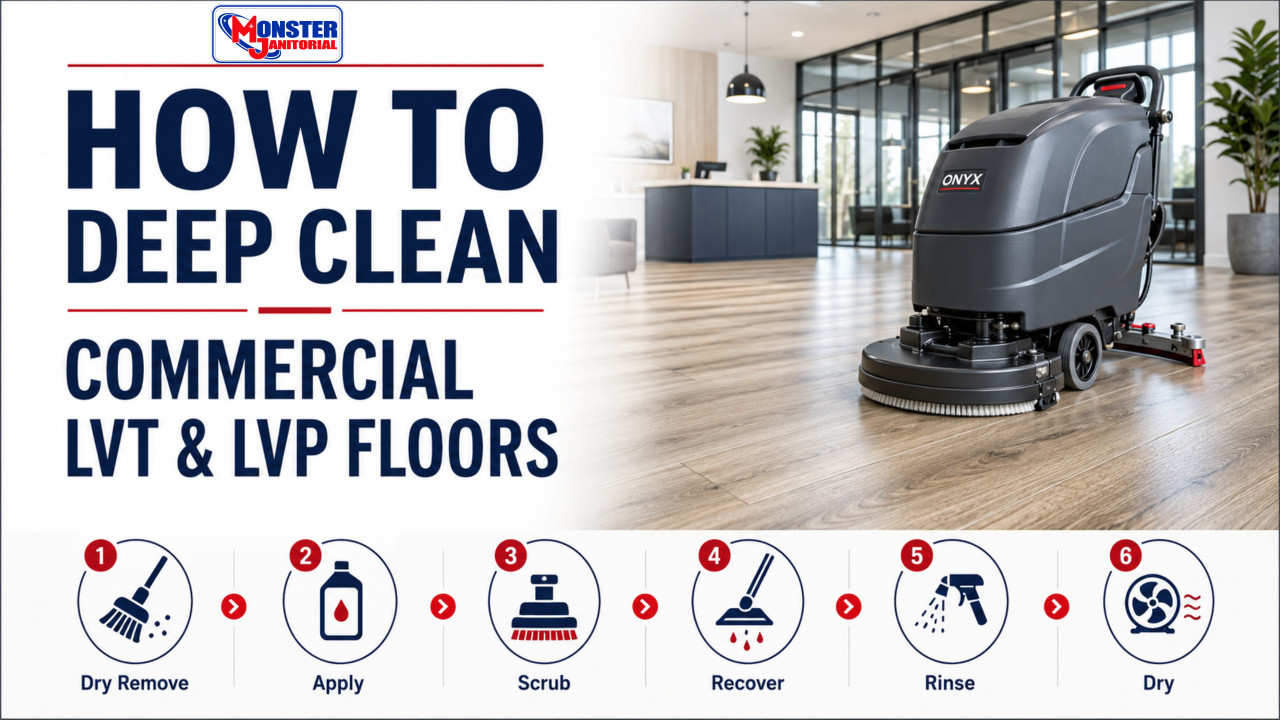
How to Deep Clean Commercial LVT & LVP Floors
Deep cleaning commercial luxury vinyl requires more than simply using a stronger chemical or more aggressive floor pad.
The best process combines dry-soil removal, compatible chemistry, correct dilution, adequate dwell time, controlled agitation, complete dirty-solution recovery, and proper drying while protecting the LVT or LVP wear layer.
Deep clean LVT and LVP by loosening embedded soil without unnecessarily increasing chemical strength, abrasion, pressure, or water.
When Does LVT or LVP Need Deep Cleaning?
Deep cleaning is appropriate when routine maintenance is no longer removing accumulated surface soil.
Make Sure the Problem Is Actually Soil
Deep cleaning can remove accumulated soil and residue. It cannot repair physical damage to the flooring.
Inspect & Identify the Floor
Confirm that the floor is LVT or LVP and inspect the installation before introducing moisture or mechanical agitation.
- Check glue-down vs. floating or click-lock construction.
- Inspect seams and perimeter edges.
- Look for loose tiles or planks.
- Document scratches, gouges and wear.
- Determine whether a field-applied coating may be present.
- Review manufacturer maintenance instructions when available.
Remove Dry Soil Before Wet Cleaning
Sand, grit, dust and loose debris should be removed before scrubbing. Mechanical agitation over loose grit can contribute to scratching.
Choose Compatible Cleaning Chemistry
A deep clean does not automatically require a high-pH degreaser or stripping chemical. Start with a cleaner approved for the flooring or finish and match the chemistry to the actual soil.
Recommended Cleaners for LVT & LVP
Always verify the flooring manufacturer's chemical requirements before use and follow the product label for dilution and application.
Pioneer Eclipse Helios H303 Daily Neutral Cleaner
Low-foaming commercial cleaner designed for LVT and other compatible washable floors. Suitable for auto scrubbers, damp mopping, routine maintenance and periodic deep scrubbing when used according to label directions.
View Helios H303 →Pioneer Eclipse 301 Eclipse Neutral Cleaner
Commercial floor cleaner designed for daily maintenance and periodic deep scrubbing on compatible washable floors using an auto scrubber or damp-mop process.
View Eclipse 301 →Measure the Chemical Correctly
More chemical does not automatically produce a cleaner floor. Over-concentration can leave residue, increase rinsing requirements, create streaking or haze, and complicate future maintenance. Follow the product label instead of estimating the dilution.
Give the Cleaner Time to Work
Dwell time allows the cleaning solution to loosen soil before mechanical agitation. This can reduce the temptation to compensate with a harsher pad or excessive machine pressure.
Choose the Right Agitation
Do Not Jump Straight to an Aggressive Pad
LVT and LVP should not automatically receive the same aggressive stripping-pad process commonly associated with traditional VCT maintenance.
Start with the least aggressive pad or brush that can accomplish the cleaning objective. If more cleaning power is needed, first evaluate chemistry, dilution, dwell time and number of passes before increasing abrasion.
Deep Cleaning LVT/LVP With an Auto Scrubber
A properly configured auto scrubber combines chemical application, agitation and dirty-water recovery in one cleaning process.
Recommended Equipment for Deep Cleaning LVT & LVP
Choose equipment based on facility size, floor texture, soil load and the flooring manufacturer's maintenance requirements.
TASKI ULTIMAXX 360
Compact battery-powered dual-disc scrubber for commercial spaces where maneuverability and effective solution recovery are important.
Best For: Smaller commercial LVT/LVP areas View TASKI ULTIMAXX 360 →Pacific S-24XM Disc Scrubber
24-inch walk-behind scrubber for facilities requiring greater cleaning productivity while retaining good maneuverability.
Best For: Medium commercial LVT/LVP areas View Pacific S-24XM →Karcher BDS 43/Orbital C
17-inch commercial orbital machine for controlled hard-floor agitation and periodic deep cleaning with an appropriate pad.
Best For: Controlled orbital deep cleaning View Karcher BDS 43/Orbital C →Viper AS530R
Compact 20-inch rider scrubber for larger facilities that need higher cleaning productivity.
Best For: Larger open commercial LVT/LVP areas View Viper AS530R →Deep Cleaning Textured LVT & LVP
Wood-grain embossing, stone texture and grout-like patterns can trap soil below the high points of the flooring.
Recover the Dirty Solution
Soil that has been loosened from the floor needs to be removed. Leaving dirty solution behind can redeposit soil and contribute to haze, streaking or sticky residue.
Rinse Only When Needed
Follow the cleaner manufacturer's directions. Some low-residue maintenance cleaners may not require a separate rinse at the correct dilution, while heavier cleaning procedures or products may require clean-water recovery to remove remaining residue.
Allow the Floor to Dry Completely
Do not reopen the area while moisture remains on the surface. Proper recovery normally shortens drying time and reduces the amount of water sitting near seams and edges.
Commercial LVT & LVP Deep-Cleaning Process
Common LVT & LVP Deep-Cleaning Mistakes
LVT & LVP Floor Care Learning Library
Explore focused commercial LVT and LVP guides covering identification, equipment, chemicals, deep cleaning, troubleshooting, coatings, repair, restoration, and replacement.
How to Identify LVT & LVP Floors Before Cleaning
Learn how construction, wear layers, factory finishes, coatings, textures, and floor condition affect cleaning and maintenance.
Read Identification Guide →Auto Scrubbers, Floor Machines & Pads for Commercial LVT & LVP Floors
Compare auto scrubbers, low-speed machines, disc and cylindrical systems, floor pads, brushes, and cleaning methods.
Read Equipment & Pad Guide →How to Deep Clean Commercial LVT & LVP Floors
Learn how to improve chemistry, dwell time, agitation, pads or brushes, fresh solution, and dirty-water recovery.
Current GuideBest Cleaning Chemicals for Commercial LVT & LVP Floors
Compare neutral cleaners, low-foam auto scrubber chemistry, maintainers, coatings, and specialty restorative products.
Read Chemical Guide →Commercial LVT & LVP Floor Problems
Diagnose dullness, haze, streaks, scratches, scuffs, adhesive residue, soil buildup, and other appearance problems.
Read Troubleshooting Guide →Should Commercial LVT & LVP Floors Be Coated or Finished?
Learn when a factory wear layer is enough and when an approved maintainer, coating, or restorative system may be appropriate.
Read Coating & Finish Guide →Commercial LVT & LVP Floor Repair & Replacement Guide
Learn when scratches, gouges, loose flooring, wear, or widespread damage should be repaired, restored, or replaced.
Read Repair & Replacement Guide →Complete Commercial LVT & LVP Floor Cleaning & Maintenance Guide
Use the complete guide as the central reference for commercial LVT/LVP cleaning, maintenance, troubleshooting, restoration, and repair.
Read Complete Guide →Helpful Equipment, Pad & Chemical Guides
Commercial LVT & LVP Deep-Cleaning FAQs
How often should commercial LVT be deep cleaned?
There is no single schedule for every facility. Deep-cleaning frequency depends on traffic, entrance soil, facility use, routine maintenance quality, surface texture and the flooring manufacturer's recommendations.
Can an auto scrubber be used to deep clean LVT?
Many commercial LVT systems can be cleaned with an auto scrubber when machine cleaning is permitted. Use compatible chemistry, appropriate pads or brushes, controlled solution flow and effective recovery.
What pad should be used to deep clean LVT?
Start with the least aggressive pad capable of removing the soil. Never assume an aggressive stripping pad is appropriate simply because the floor needs a deeper clean.
Should LVT be rinsed after deep cleaning?
Follow the cleaner manufacturer's directions. A separate rinse may be needed when the cleaning product or soil load leaves residue, while some properly diluted low-residue cleaners may not require one.
Why does LVT still look dull after deep cleaning?
The cause may be remaining residue, incorrect chemistry, incomplete soil recovery, scratches, worn factory finish or wear-layer damage rather than removable dirt.
Can LVT be stripped like VCT?
Do not automatically use a traditional VCT stripping process on LVT or LVP. Determine whether the floor has a field-applied coating and follow the flooring or coating manufacturer's approved maintenance procedure.
Need Help Deep Cleaning Commercial LVT & LVP?
Monster Janitorial can help you select commercial cleaning chemicals, auto scrubbers, floor machines, pads and brushes for your facility's LVT or LVP maintenance program.